


Leo Morgenstern
-
Posts
626 -
Joined
-
Last visited
Content Type
Profiles
Toronto Blue Jays Videos
2026 Toronto Blue Jays Top Prospects Ranking
Toronto Blue Jays Free Agent & Trade Rumors, Notes, & Tidbits
Guides & Resources
2025 Toronto Blue Jays Draft Pick Tracker
News
2026 Toronto Blue Jays Draft Tracker: Picks & Bonuses
Forums
Blogs
Events
Store
Downloads
Gallery
Everything posted by Leo Morgenstern
-
 In addition to the arms on their official 30-man rosters, each country in the World Baseball Classic can name up to six pitchers to its Designated Pitcher Pool. These pitchers will be ready to serve as potential replacements in later rounds of the tournament. According to MLB.com's Michael Clair, "Teams can replace up to four pitchers following the first round and then up to two pitchers after the quarterfinal. These players can replace one of up to four arms that the team had previously marked as a potential substitute." Clair also published a list of all the known pitchers that have been included in their country's DPP. Team Canada was not included in the article, and it's unclear if that means Canada doesn't have a DPP or if it just hasn't been revealed yet. However, three notable Blue Jays names appeared on the DPP lists: Jeff Hoffman (USA), Tyler Rogers (USA), and José Berríos (Puerto Rico). They could join the 12 other Blue Jays expected to participate in the WBC. Berríos was originally going to be on Puerto Rico's 30-man roster, but he was one of several players denied insurance coverage for the tournament. It isn't clear what his inclusion in the DPP means about his insurance status. View full rumor
 -
.jpg.69f576256c369f177e9f136a6f56dee7.jpg) In addition to the arms on their official 30-man rosters, each country in the World Baseball Classic can name up to six pitchers to its Designated Pitcher Pool. These pitchers will be ready to serve as potential replacements in later rounds of the tournament. According to MLB.com's Michael Clair, "Teams can replace up to four pitchers following the first round and then up to two pitchers after the quarterfinal. These players can replace one of up to four arms that the team had previously marked as a potential substitute." Clair also published a list of all the known pitchers that have been included in their country's DPP. Team Canada was not included in the article, and it's unclear if that means Canada doesn't have a DPP or if it just hasn't been revealed yet. However, three notable Blue Jays names appeared on the DPP lists: Jeff Hoffman (USA), Tyler Rogers (USA), and José Berríos (Puerto Rico). They could join the 12 other Blue Jays expected to participate in the WBC. Berríos was originally going to be on Puerto Rico's 30-man roster, but he was one of several players denied insurance coverage for the tournament. It isn't clear what his inclusion in the DPP means about his insurance status.
In addition to the arms on their official 30-man rosters, each country in the World Baseball Classic can name up to six pitchers to its Designated Pitcher Pool. These pitchers will be ready to serve as potential replacements in later rounds of the tournament. According to MLB.com's Michael Clair, "Teams can replace up to four pitchers following the first round and then up to two pitchers after the quarterfinal. These players can replace one of up to four arms that the team had previously marked as a potential substitute." Clair also published a list of all the known pitchers that have been included in their country's DPP. Team Canada was not included in the article, and it's unclear if that means Canada doesn't have a DPP or if it just hasn't been revealed yet. However, three notable Blue Jays names appeared on the DPP lists: Jeff Hoffman (USA), Tyler Rogers (USA), and José Berríos (Puerto Rico). They could join the 12 other Blue Jays expected to participate in the WBC. Berríos was originally going to be on Puerto Rico's 30-man roster, but he was one of several players denied insurance coverage for the tournament. It isn't clear what his inclusion in the DPP means about his insurance status. -
Nothing signals the start of spring training like a barrage of injury news. Pitchers and catchers report to camp today, and that means Blue Jays reporters started showing up to Dunedin earlier this week. Once they did, it wasn't long before injury updates were thrust upon us. The big news yesterday was that Anthony Santander could miss the next five to six months recovering from shoulder surgery. However, Santander isn't the only Blue Jay undergoing major surgery. Manager John Schneider revealed that right-hander Bowden Francis needs UCL reconstruction and will miss the 2026 season. It's not yet clear if he's going for Tommy John or the less invasive internal brace procedure, but either way, he's out for the year. Schneider also offered a concerning update regarding right-hander Shane Bieber. The 2020 AL Cy Young winner will begin the season on the injured list, as he's dealing with forearm fatigue right now. On the bright side, it doesn't seem as if he'll miss significant time; he hasn't been shut down from baseball activities, he just won't be able to ramp up in time for Opening Day. With that said, forearm issues are always worrisome, and especially so for a pitcher who only just returned from Tommy John surgery. Given Bieber's status, it's hardly surprising that Eric Lauer will be stretched out as a starter this spring. For as long as Bieber is out, Lauer will be the sixth man on Toronto's starting pitching depth chart – a depth chart that's also thinner without Francis as an emergency backup plan. John Schneider also spoke about Yimi García, whose 2025 season concluded before the All-Star break. While an ankle injury sent him to the shelf, it was ulnar nerve symptoms that stopped him from making a return. He had season-ending surgery to address the issue in August. On top of that, he also missed time with a shoulder injury earlier in the year. According to Schneider, García is on track to make the Opening Day roster, though the team is still exercising caution with the 35-year-old righty. Finally, Toronto's skipper spoke about the many injury issues George Springer played through in 2025. While we already knew about some of them, Schneider told Sportsnet's Ben Nicholson-Smith that right wrist discomfort became a problem for the veteran as the year went on. Apparently, the injury interfered with his throwing, therefore making it difficult for him to play the outfield. Now that he's feeling stronger, however, Springer could see time in the outfield again. Of course, with Santander on the shelf, it might make sense for Springer to be a full-time DH in 2026 anyway, but more flexibility is never a bad thing. View full article
- 1 reply
-
- 1
-

-
- bowden francis
- shane bieber
- (and 1 more)
-
.jpg.2da8462ddb72c38b6fa4cd0c513a2484.jpg) Nothing signals the start of spring training like a barrage of injury news. Pitchers and catchers report to camp today, and that means Blue Jays reporters started showing up to Dunedin earlier this week. Once they did, it wasn't long before injury updates were thrust upon us. The big news yesterday was that Anthony Santander could miss the next five to six months recovering from shoulder surgery. However, Santander isn't the only Blue Jay undergoing major surgery. Manager John Schneider revealed that right-hander Bowden Francis needs UCL reconstruction and will miss the 2026 season. It's not yet clear if he's going for Tommy John or the less invasive internal brace procedure, but either way, he's out for the year. Schneider also offered a concerning update regarding right-hander Shane Bieber. The 2020 AL Cy Young winner will begin the season on the injured list, as he's dealing with forearm fatigue right now. On the bright side, it doesn't seem as if he'll miss significant time; he hasn't been shut down from baseball activities, he just won't be able to ramp up in time for Opening Day. With that said, forearm issues are always worrisome, and especially so for a pitcher who only just returned from Tommy John surgery. Given Bieber's status, it's hardly surprising that Eric Lauer will be stretched out as a starter this spring. For as long as Bieber is out, Lauer will be the sixth man on Toronto's starting pitching depth chart – a depth chart that's also thinner without Francis as an emergency backup plan. John Schneider also spoke about Yimi García, whose 2025 season concluded before the All-Star break. While an ankle injury sent him to the shelf, it was ulnar nerve symptoms that stopped him from making a return. He had season-ending surgery to address the issue in August. On top of that, he also missed time with a shoulder injury earlier in the year. According to Schneider, García is on track to make the Opening Day roster, though the team is still exercising caution with the 35-year-old righty. Finally, Toronto's skipper spoke about the many injury issues George Springer played through in 2025. While we already knew about some of them, Schneider told Sportsnet's Ben Nicholson-Smith that right wrist discomfort became a problem for the veteran as the year went on. Apparently, the injury interfered with his throwing, therefore making it difficult for him to play the outfield. Now that he's feeling stronger, however, Springer could see time in the outfield again. Of course, with Santander on the shelf, it might make sense for Springer to be a full-time DH in 2026 anyway, but more flexibility is never a bad thing.
Nothing signals the start of spring training like a barrage of injury news. Pitchers and catchers report to camp today, and that means Blue Jays reporters started showing up to Dunedin earlier this week. Once they did, it wasn't long before injury updates were thrust upon us. The big news yesterday was that Anthony Santander could miss the next five to six months recovering from shoulder surgery. However, Santander isn't the only Blue Jay undergoing major surgery. Manager John Schneider revealed that right-hander Bowden Francis needs UCL reconstruction and will miss the 2026 season. It's not yet clear if he's going for Tommy John or the less invasive internal brace procedure, but either way, he's out for the year. Schneider also offered a concerning update regarding right-hander Shane Bieber. The 2020 AL Cy Young winner will begin the season on the injured list, as he's dealing with forearm fatigue right now. On the bright side, it doesn't seem as if he'll miss significant time; he hasn't been shut down from baseball activities, he just won't be able to ramp up in time for Opening Day. With that said, forearm issues are always worrisome, and especially so for a pitcher who only just returned from Tommy John surgery. Given Bieber's status, it's hardly surprising that Eric Lauer will be stretched out as a starter this spring. For as long as Bieber is out, Lauer will be the sixth man on Toronto's starting pitching depth chart – a depth chart that's also thinner without Francis as an emergency backup plan. John Schneider also spoke about Yimi García, whose 2025 season concluded before the All-Star break. While an ankle injury sent him to the shelf, it was ulnar nerve symptoms that stopped him from making a return. He had season-ending surgery to address the issue in August. On top of that, he also missed time with a shoulder injury earlier in the year. According to Schneider, García is on track to make the Opening Day roster, though the team is still exercising caution with the 35-year-old righty. Finally, Toronto's skipper spoke about the many injury issues George Springer played through in 2025. While we already knew about some of them, Schneider told Sportsnet's Ben Nicholson-Smith that right wrist discomfort became a problem for the veteran as the year went on. Apparently, the injury interfered with his throwing, therefore making it difficult for him to play the outfield. Now that he's feeling stronger, however, Springer could see time in the outfield again. Of course, with Santander on the shelf, it might make sense for Springer to be a full-time DH in 2026 anyway, but more flexibility is never a bad thing. -
Spring training is here! Well, sort of. It's pitchers and catchers day at the Blue Jays' spring training complex in Dunedin, Florida. Injury updates have already started rolling in, and, on a more positive note, pictures and videos of real-life baseball activities are coming soon. All pitchers and catchers are expected to report to camp today, while any other position players participating in the World Baseball Classic will report tomorrow. The rest of the squad is expected to arrive no later than Monday, February 16. Blue Jays photo day is scheduled for Friday, February 20 (new headshots to use in our articles, yay!), and the following day, the Jays will welcome the Phillies for the first game of spring training on Saturday, February 21 at 1:07 pm. That kicks off a stretch of 11 Grapefruit League games in 10 days, leading up to an exhibition match against Team Canada at 1:07 pm on Tuesday, March 3. Another date to keep on your calendar is Saturday, March 21, when a team of Blue Jays prospects will take on a team of Phillies prospects as part of the Spring Breakout weekend. The Phillies will host that contest at 1:05 pm in Clearwater. Finally, spring training will come to a close at the end of March. While 24 teams will play their Opening Day matchups on March 25 or 26, the Blue Jays are one of a handful of clubs waiting until Friday, March 27 to begin their regular season. Their first game will also be their home opener, as they take on the Athletics at 7:07 pm in Toronto. View full rumor
-
.jpg.82f9bd813c4971caf98d3b466956ab67.jpg) Spring training is here! Well, sort of. It's pitchers and catchers day at the Blue Jays' spring training complex in Dunedin, Florida. Injury updates have already started rolling in, and, on a more positive note, pictures and videos of real-life baseball activities are coming soon. All pitchers and catchers are expected to report to camp today, while any other position players participating in the World Baseball Classic will report tomorrow. The rest of the squad is expected to arrive no later than Monday, February 16. Blue Jays photo day is scheduled for Friday, February 20 (new headshots to use in our articles, yay!), and the following day, the Jays will welcome the Phillies for the first game of spring training on Saturday, February 21 at 1:07 pm. That kicks off a stretch of 11 Grapefruit League games in 10 days, leading up to an exhibition match against Team Canada at 1:07 pm on Tuesday, March 3. Another date to keep on your calendar is Saturday, March 21, when a team of Blue Jays prospects will take on a team of Phillies prospects as part of the Spring Breakout weekend. The Phillies will host that contest at 1:05 pm in Clearwater. Finally, spring training will come to a close at the end of March. While 24 teams will play their Opening Day matchups on March 25 or 26, the Blue Jays are one of a handful of clubs waiting until Friday, March 27 to begin their regular season. Their first game will also be their home opener, as they take on the Athletics at 7:07 pm in Toronto.
Spring training is here! Well, sort of. It's pitchers and catchers day at the Blue Jays' spring training complex in Dunedin, Florida. Injury updates have already started rolling in, and, on a more positive note, pictures and videos of real-life baseball activities are coming soon. All pitchers and catchers are expected to report to camp today, while any other position players participating in the World Baseball Classic will report tomorrow. The rest of the squad is expected to arrive no later than Monday, February 16. Blue Jays photo day is scheduled for Friday, February 20 (new headshots to use in our articles, yay!), and the following day, the Jays will welcome the Phillies for the first game of spring training on Saturday, February 21 at 1:07 pm. That kicks off a stretch of 11 Grapefruit League games in 10 days, leading up to an exhibition match against Team Canada at 1:07 pm on Tuesday, March 3. Another date to keep on your calendar is Saturday, March 21, when a team of Blue Jays prospects will take on a team of Phillies prospects as part of the Spring Breakout weekend. The Phillies will host that contest at 1:05 pm in Clearwater. Finally, spring training will come to a close at the end of March. While 24 teams will play their Opening Day matchups on March 25 or 26, the Blue Jays are one of a handful of clubs waiting until Friday, March 27 to begin their regular season. Their first game will also be their home opener, as they take on the Athletics at 7:07 pm in Toronto. -
Speaking to Sportnet's Ben Nicholson-Smith, Toronto Blue Jays GM Ross Atkins said that the team is "not significantly" involved in the outfield market. This comes in light of the news that Anthony Santander could miss the next five to six months recovering from shoulder surgery. While Santander's injury news was a shock, this update from Atkins isn't altogether surprising. The Blue Jays have no shortage of healthy outfielders on their 40-man roster, including Daulton Varsho, Addison Barger, Nathan Lukes, Davis Schneider, and Myles Straw. Varsho will be the everyday center fielder, with Straw as his backup. Manager John Schneider told Nicholson-Smith today that he expects Barger to get the majority of the reps in right field, while Lukes and Davis Schneider will platoon in left. The skipper also suggested that George Springer will be an option for the outfield as needed. There will be a spot up for grabs on Toronto's bench, which could go to another outfielder (likely Joey Loperfido), but an infielder might make more sense. Leo Jiménez is already on the 40-man roster, while Josh Kasevich is another name to keep an eye on. One more player to follow will be outfielder RJ Schreck. He isn't on the 40-man, but Atkins told MLB.com's Keegan Matheson that he's particularly excited to watch Schreck in spring training. View full rumor
-
.jpg.65bae3801c2a34370a40da44130b19c4.jpg) Speaking to Sportnet's Ben Nicholson-Smith, Toronto Blue Jays GM Ross Atkins said that the team is "not significantly" involved in the outfield market. This comes in light of the news that Anthony Santander could miss the next five to six months recovering from shoulder surgery. While Santander's injury news was a shock, this update from Atkins isn't altogether surprising. The Blue Jays have no shortage of healthy outfielders on their 40-man roster, including Daulton Varsho, Addison Barger, Nathan Lukes, Davis Schneider, and Myles Straw. Varsho will be the everyday center fielder, with Straw as his backup. Manager John Schneider told Nicholson-Smith today that he expects Barger to get the majority of the reps in right field, while Lukes and Davis Schneider will platoon in left. The skipper also suggested that George Springer will be an option for the outfield as needed. There will be a spot up for grabs on Toronto's bench, which could go to another outfielder (likely Joey Loperfido), but an infielder might make more sense. Leo Jiménez is already on the 40-man roster, while Josh Kasevich is another name to keep an eye on. One more player to follow will be outfielder RJ Schreck. He isn't on the 40-man, but Atkins told MLB.com's Keegan Matheson that he's particularly excited to watch Schreck in spring training.
Speaking to Sportnet's Ben Nicholson-Smith, Toronto Blue Jays GM Ross Atkins said that the team is "not significantly" involved in the outfield market. This comes in light of the news that Anthony Santander could miss the next five to six months recovering from shoulder surgery. While Santander's injury news was a shock, this update from Atkins isn't altogether surprising. The Blue Jays have no shortage of healthy outfielders on their 40-man roster, including Daulton Varsho, Addison Barger, Nathan Lukes, Davis Schneider, and Myles Straw. Varsho will be the everyday center fielder, with Straw as his backup. Manager John Schneider told Nicholson-Smith today that he expects Barger to get the majority of the reps in right field, while Lukes and Davis Schneider will platoon in left. The skipper also suggested that George Springer will be an option for the outfield as needed. There will be a spot up for grabs on Toronto's bench, which could go to another outfielder (likely Joey Loperfido), but an infielder might make more sense. Leo Jiménez is already on the 40-man roster, while Josh Kasevich is another name to keep an eye on. One more player to follow will be outfielder RJ Schreck. He isn't on the 40-man, but Atkins told MLB.com's Keegan Matheson that he's particularly excited to watch Schreck in spring training. -
The Blue Jays announced two more non-roster invitees to spring training over the weekend: Tanner Andrews and Nate Garkow. Inviting the pair of right-handers brings the team's NRI total up to 31. Andrews, 30, signed a minor league contract with Toronto in November. A 10th-round draft pick in 2018, he has played in the minors for the Marlins, Giants, and Twins. His 2025 season was successful, albeit brief; the righty pitched to a 3.78 ERA and 2.01 FIP in 16.2 innings with Minnesota's Double-A affiliate. From 2023-24, he posted a 6.36 ERA and 5.04 FIP in 109 Triple-A innings in the Giants organization. Garkow, 28, signed with the Blue Jays as an undrafted free agent in 2024. The right-hander has thrown a total of 77.2 innings between Single-A Dunedin, High-A Vancouver, and Double-A New Hampshire, putting up a 2.78 ERA and 2.72 FIP. He has struck out 38.1% of the batters he's faced in his two-year professional career. Garkow earned shoutouts as one of Jays Centre's Minor League Relievers of the Month in both July and August last season. View full rumor
-
.jpg.a3a35ce810625ed03713cd39344b4f60.jpg) The Blue Jays announced two more non-roster invitees to spring training over the weekend: Tanner Andrews and Nate Garkow. Inviting the pair of right-handers brings the team's NRI total up to 31. Andrews, 30, signed a minor league contract with Toronto in November. A 10th-round draft pick in 2018, he has played in the minors for the Marlins, Giants, and Twins. His 2025 season was successful, albeit brief; the righty pitched to a 3.78 ERA and 2.01 FIP in 16.2 innings with Minnesota's Double-A affiliate. From 2023-24, he posted a 6.36 ERA and 5.04 FIP in 109 Triple-A innings in the Giants organization. Garkow, 28, signed with the Blue Jays as an undrafted free agent in 2024. The right-hander has thrown a total of 77.2 innings between Single-A Dunedin, High-A Vancouver, and Double-A New Hampshire, putting up a 2.78 ERA and 2.72 FIP. He has struck out 38.1% of the batters he's faced in his two-year professional career. Garkow earned shoutouts as one of Jays Centre's Minor League Relievers of the Month in both July and August last season.
The Blue Jays announced two more non-roster invitees to spring training over the weekend: Tanner Andrews and Nate Garkow. Inviting the pair of right-handers brings the team's NRI total up to 31. Andrews, 30, signed a minor league contract with Toronto in November. A 10th-round draft pick in 2018, he has played in the minors for the Marlins, Giants, and Twins. His 2025 season was successful, albeit brief; the righty pitched to a 3.78 ERA and 2.01 FIP in 16.2 innings with Minnesota's Double-A affiliate. From 2023-24, he posted a 6.36 ERA and 5.04 FIP in 109 Triple-A innings in the Giants organization. Garkow, 28, signed with the Blue Jays as an undrafted free agent in 2024. The right-hander has thrown a total of 77.2 innings between Single-A Dunedin, High-A Vancouver, and Double-A New Hampshire, putting up a 2.78 ERA and 2.72 FIP. He has struck out 38.1% of the batters he's faced in his two-year professional career. Garkow earned shoutouts as one of Jays Centre's Minor League Relievers of the Month in both July and August last season. -
Last week, Jon Heyman and Joel Sherman of the New York Post reported that the Toronto Blue Jays were interested in signing Framber Valdez, shortly before the All-Star left-hander inked a three-year, $115 million contract with the Detroit Tigers. After Valdez signed with Detroit, Heyman noted that Max Scherzer was "back on [Toronto's] radar." He also wondered if the Jays might pursue Zac Gallen or Chris Bassitt, though only the link to Scherzer was more than speculative. Adding another starting pitcher would further complicate an already overcrowded rotation picture. The Blue Jays might have been willing to do that for Valdez, but none of Gallen, Bassitt, or Scherzer is the same calibre of pitcher. It's no guarantee any of them would be an upgrade over Toronto's internal options. However, Scherzer has expressed a willingness to wait to sign until after Opening Day (per The Athletic's Ken Rosenthal). So, at least it makes sense why the Jays are staying in touch with the three-time Cy Young winner. They might not have a job for him right now, but Scherzer could be a nice backup plan if any of Toronto's other starting pitchers suffer injuries in the next few months. View full rumor
-
.jpg.d72cb2bd84491678b30d1d8a73c8ed08.jpg) Last week, Jon Heyman and Joel Sherman of the New York Post reported that the Toronto Blue Jays were interested in signing Framber Valdez, shortly before the All-Star left-hander inked a three-year, $115 million contract with the Detroit Tigers. After Valdez signed with Detroit, Heyman noted that Max Scherzer was "back on [Toronto's] radar." He also wondered if the Jays might pursue Zac Gallen or Chris Bassitt, though only the link to Scherzer was more than speculative. Adding another starting pitcher would further complicate an already overcrowded rotation picture. The Blue Jays might have been willing to do that for Valdez, but none of Gallen, Bassitt, or Scherzer is the same calibre of pitcher. It's no guarantee any of them would be an upgrade over Toronto's internal options. However, Scherzer has expressed a willingness to wait to sign until after Opening Day (per The Athletic's Ken Rosenthal). So, at least it makes sense why the Jays are staying in touch with the three-time Cy Young winner. They might not have a job for him right now, but Scherzer could be a nice backup plan if any of Toronto's other starting pitchers suffer injuries in the next few months.
Last week, Jon Heyman and Joel Sherman of the New York Post reported that the Toronto Blue Jays were interested in signing Framber Valdez, shortly before the All-Star left-hander inked a three-year, $115 million contract with the Detroit Tigers. After Valdez signed with Detroit, Heyman noted that Max Scherzer was "back on [Toronto's] radar." He also wondered if the Jays might pursue Zac Gallen or Chris Bassitt, though only the link to Scherzer was more than speculative. Adding another starting pitcher would further complicate an already overcrowded rotation picture. The Blue Jays might have been willing to do that for Valdez, but none of Gallen, Bassitt, or Scherzer is the same calibre of pitcher. It's no guarantee any of them would be an upgrade over Toronto's internal options. However, Scherzer has expressed a willingness to wait to sign until after Opening Day (per The Athletic's Ken Rosenthal). So, at least it makes sense why the Jays are staying in touch with the three-time Cy Young winner. They might not have a job for him right now, but Scherzer could be a nice backup plan if any of Toronto's other starting pitchers suffer injuries in the next few months. -
.jpg.4235e5b805521a7f9e7f3bb23c48524f.jpg) As reported by The Athletic's Mitch Bannon, Eric Lauer had his arbitration hearing on Tuesday, February 3. That means his representatives and the Blue Jays went before a three-person panel to make their cases for the respective salary proposals they submitted; Lauer filed at $5.75 million, while the team filed at $4.4 million. According to Bannon, we can expect a decision at some point next week. Lauer's case is an unusual one. The lefty earned $5.075 million from the Brewers in 2023, his second year of arbitration eligibility. He did not pitch in the majors in 2024, splitting his time between the Pirates' and Astros' Triple-A affiliates and the KBO's Kia Tigers, and he joined the Blue Jays on a minor league contract in 2025. As a result, he was still eligible for one more year of arbitration entering 2026. Typically, salaries do not decrease in arbitration. If a team isn't willing to give a player a raise, they simply won't tender him a contract. Lauer is also coming off what was arguably just as strong a season as his last campaign prior to arbitration; according to fWAR, bWAR, and WARP, he was more valuable in 2025 than he was in 2022. With that in mind, it would seem to be a given that Lauer would win his hearing, since he asked for $675,000 more than $5.075 million, while the Blue Jays countered with $675,000 less. Yet, the Blue Jays wouldn't have filed at $4.4 million if they didn't think that number had a chance to win. There isn't much of a precedent for players re-entering the arbitration system after returning from a stop overseas. Moreover, precedent isn't everything when it comes to arbitration. If old precedents weren't broken, new ones would never be set. Just look at Tarik Skubal, who asked for $32 million, far more money than a player has ever won in an arbitration hearing. The panel sided with the back-to-back Cy Young winner, setting a new precedent in the process. The Blue Jays are betting that's what happens in this hearing as well. In Skubal's case, the panel made the player-friendly decision. Presuming the arbitration system stays in place in the next CBA, their judgment will help boost player salaries for years to come. However, history tells us that, more often than not, arbiters side in favor of teams. That doesn't bode so well for Lauer. It's one thing for the best pitcher in baseball to win over an arbitration panel. An inconsistent swingman is facing a tougher battle. It's also worth noting that Toronto's $4.4 million offer is the exact number MLB Trade Rumors projected Lauer would earn in arbitration. The model MLBTR uses, developed by Matt Swartz, considers a player's "playing time, position, role, and performance statistics." It also accounts for inflation. Swartz's model has been the gold standard for predicting arbitration salaries for more than a decade, and it tells us that the panel is more likely to side with the Blue Jays. All of this to say, there's no good way to guess the outcome here. Thankfully, we're talking about an utterly negligible amount of money for a team like the Blue Jays that has not and will not affect how they operate in the slightest. Arbitration cases are interesting to think about, especially when there isn't much else to think about, but at the end of the day, I just hope Lauer gets his money and both sides can move on and start preparing for the season ahead.
As reported by The Athletic's Mitch Bannon, Eric Lauer had his arbitration hearing on Tuesday, February 3. That means his representatives and the Blue Jays went before a three-person panel to make their cases for the respective salary proposals they submitted; Lauer filed at $5.75 million, while the team filed at $4.4 million. According to Bannon, we can expect a decision at some point next week. Lauer's case is an unusual one. The lefty earned $5.075 million from the Brewers in 2023, his second year of arbitration eligibility. He did not pitch in the majors in 2024, splitting his time between the Pirates' and Astros' Triple-A affiliates and the KBO's Kia Tigers, and he joined the Blue Jays on a minor league contract in 2025. As a result, he was still eligible for one more year of arbitration entering 2026. Typically, salaries do not decrease in arbitration. If a team isn't willing to give a player a raise, they simply won't tender him a contract. Lauer is also coming off what was arguably just as strong a season as his last campaign prior to arbitration; according to fWAR, bWAR, and WARP, he was more valuable in 2025 than he was in 2022. With that in mind, it would seem to be a given that Lauer would win his hearing, since he asked for $675,000 more than $5.075 million, while the Blue Jays countered with $675,000 less. Yet, the Blue Jays wouldn't have filed at $4.4 million if they didn't think that number had a chance to win. There isn't much of a precedent for players re-entering the arbitration system after returning from a stop overseas. Moreover, precedent isn't everything when it comes to arbitration. If old precedents weren't broken, new ones would never be set. Just look at Tarik Skubal, who asked for $32 million, far more money than a player has ever won in an arbitration hearing. The panel sided with the back-to-back Cy Young winner, setting a new precedent in the process. The Blue Jays are betting that's what happens in this hearing as well. In Skubal's case, the panel made the player-friendly decision. Presuming the arbitration system stays in place in the next CBA, their judgment will help boost player salaries for years to come. However, history tells us that, more often than not, arbiters side in favor of teams. That doesn't bode so well for Lauer. It's one thing for the best pitcher in baseball to win over an arbitration panel. An inconsistent swingman is facing a tougher battle. It's also worth noting that Toronto's $4.4 million offer is the exact number MLB Trade Rumors projected Lauer would earn in arbitration. The model MLBTR uses, developed by Matt Swartz, considers a player's "playing time, position, role, and performance statistics." It also accounts for inflation. Swartz's model has been the gold standard for predicting arbitration salaries for more than a decade, and it tells us that the panel is more likely to side with the Blue Jays. All of this to say, there's no good way to guess the outcome here. Thankfully, we're talking about an utterly negligible amount of money for a team like the Blue Jays that has not and will not affect how they operate in the slightest. Arbitration cases are interesting to think about, especially when there isn't much else to think about, but at the end of the day, I just hope Lauer gets his money and both sides can move on and start preparing for the season ahead. -
As reported by The Athletic's Mitch Bannon, Eric Lauer had his arbitration hearing on Tuesday, February 3. That means his representatives and the Blue Jays went before a three-person panel to make their cases for the respective salary proposals they submitted; Lauer filed at $5.75 million, while the team filed at $4.4 million. According to Bannon, we can expect a decision at some point next week. Lauer's case is an unusual one. The lefty earned $5.075 million from the Brewers in 2023, his second year of arbitration eligibility. He did not pitch in the majors in 2024, splitting his time between the Pirates' and Astros' Triple-A affiliates and the KBO's Kia Tigers, and he joined the Blue Jays on a minor league contract in 2025. As a result, he was still eligible for one more year of arbitration entering 2026. Typically, salaries do not decrease in arbitration. If a team isn't willing to give a player a raise, they simply won't tender him a contract. Lauer is also coming off what was arguably just as strong a season as his last campaign prior to arbitration; according to fWAR, bWAR, and WARP, he was more valuable in 2025 than he was in 2022. With that in mind, it would seem to be a given that Lauer would win his hearing, since he asked for $675,000 more than $5.075 million, while the Blue Jays countered with $675,000 less. Yet, the Blue Jays wouldn't have filed at $4.4 million if they didn't think that number had a chance to win. There isn't much of a precedent for players re-entering the arbitration system after returning from a stop overseas. Moreover, precedent isn't everything when it comes to arbitration. If old precedents weren't broken, new ones would never be set. Just look at Tarik Skubal, who asked for $32 million, far more money than a player has ever won in an arbitration hearing. The panel sided with the back-to-back Cy Young winner, setting a new precedent in the process. The Blue Jays are betting that's what happens in this hearing as well. In Skubal's case, the panel made the player-friendly decision. Presuming the arbitration system stays in place in the next CBA, their judgment will help boost player salaries for years to come. However, history tells us that, more often than not, arbiters side in favor of teams. That doesn't bode so well for Lauer. It's one thing for the best pitcher in baseball to win over an arbitration panel. An inconsistent swingman is facing a tougher battle. It's also worth noting that Toronto's $4.4 million offer is the exact number MLB Trade Rumors projected Lauer would earn in arbitration. The model MLBTR uses, developed by Matt Swartz, considers a player's "playing time, position, role, and performance statistics." It also accounts for inflation. Swartz's model has been the gold standard for predicting arbitration salaries for more than a decade, and it tells us that the panel is more likely to side with the Blue Jays. All of this to say, there's no good way to guess the outcome here. Thankfully, we're talking about an utterly negligible amount of money for a team like the Blue Jays that has not and will not affect how they operate in the slightest. Arbitration cases are interesting to think about, especially when there isn't much else to think about, but at the end of the day, I just hope Lauer gets his money and both sides can move on and start preparing for the season ahead. View full article
-
.jpg.f55377f71254e7230dae19052eb978c4.jpg) According to ESPN's Alden González, the Blue Jays have agreed to a minor league contract with left-handed pitcher Josh Fleming. González notes that the deal includes an invitation to big league training camp. He will join the ranks of the 27 other non-roster invitees that Jesse Burrill wrote about over the weekend. Fleming, 29, owns a 4.77 ERA and 4.53 xERA in 254.2 MLB innings for the Rays (2020-23) and Pirates (2024). While he doesn't miss many bats (14.6% strikeout rate, 20% whiff rate), he has excelled at inducing swings outside the zone (33% chase rate) and batted balls on the ground (58.4% GB rate). Pitch models like Stuff+ and PitchingBot have generally respected his arsenal; despite his mediocre career ERA, his 3.62 botERA and 110 Pitching+ are notably better than league average. His sinker, in particular, is a darling of both models. From 2020-24, his sinker ranked among the 25 best in the game (min. 200 IP, 5% sinker usage) according to the overall models Pitching+ and botOvr. If you aren't familiar with pitch models, here's all you really need to know: Fleming's sinker hasn't seen much success, but it shares characteristics with some of the most effective sinkers in the game. Fleming did not appear in the majors at all in 2025, instead tossing 84.1 innings over 47 games for the Mariners' Triple-A affiliate. He struggled to a 4.91 ERA, striking out just 11.5% of his opponents. There is certainly upside in his arm, but he'll turn 30 in May and has yet to realize his potential at the higher levels. He's a worthwhile pitcher for the Jays to take a chance on, but don't get me wrong, I'm not expecting another Eric Lauer here. The most likely outcome is that Fleming briefly makes the roster as an injury replacement and gives Toronto a handful of low-leverage innings with an ERA in the high 4.00s. Over a nine-year professional career, Fleming has gained experience as a starter, an opener, a long-reliever, and a more traditional bullpen arm. So, while he is unlikely to make the 26-man roster out of spring training, he can provide some much-needed southpaw swingman depth in the minors, filling the sort of role I imagined Kolby Allard could take on before Allard re-signed with the Guardians earlier this week. It's not necessarily an exciting role, but there's a reason I wrote about Allard before, and there's a reason I'm writing about Fleming now. This team needed left-handed depth. Badly. The Blue Jays currently have five left-handers on their 40-man roster, though only three have pitched in the majors: Eric Lauer, Brendon Little, and Mason Fluharty. (Ricky Tiedemann and Adam Macko have yet to make their MLB debuts.) Aside from Fleming, the only other lefty in the organization with any big league experience is fellow NRI Michael Plassmeyer, who threw 11 innings over three games for the Phillies from 2022-23. Toronto won't be planning to call on Fleming anytime soon, but if he forces the issue with a strong performance, or if injuries force the issue upon him, the Jays could end up very grateful they made this mid-winter minor league signing.
According to ESPN's Alden González, the Blue Jays have agreed to a minor league contract with left-handed pitcher Josh Fleming. González notes that the deal includes an invitation to big league training camp. He will join the ranks of the 27 other non-roster invitees that Jesse Burrill wrote about over the weekend. Fleming, 29, owns a 4.77 ERA and 4.53 xERA in 254.2 MLB innings for the Rays (2020-23) and Pirates (2024). While he doesn't miss many bats (14.6% strikeout rate, 20% whiff rate), he has excelled at inducing swings outside the zone (33% chase rate) and batted balls on the ground (58.4% GB rate). Pitch models like Stuff+ and PitchingBot have generally respected his arsenal; despite his mediocre career ERA, his 3.62 botERA and 110 Pitching+ are notably better than league average. His sinker, in particular, is a darling of both models. From 2020-24, his sinker ranked among the 25 best in the game (min. 200 IP, 5% sinker usage) according to the overall models Pitching+ and botOvr. If you aren't familiar with pitch models, here's all you really need to know: Fleming's sinker hasn't seen much success, but it shares characteristics with some of the most effective sinkers in the game. Fleming did not appear in the majors at all in 2025, instead tossing 84.1 innings over 47 games for the Mariners' Triple-A affiliate. He struggled to a 4.91 ERA, striking out just 11.5% of his opponents. There is certainly upside in his arm, but he'll turn 30 in May and has yet to realize his potential at the higher levels. He's a worthwhile pitcher for the Jays to take a chance on, but don't get me wrong, I'm not expecting another Eric Lauer here. The most likely outcome is that Fleming briefly makes the roster as an injury replacement and gives Toronto a handful of low-leverage innings with an ERA in the high 4.00s. Over a nine-year professional career, Fleming has gained experience as a starter, an opener, a long-reliever, and a more traditional bullpen arm. So, while he is unlikely to make the 26-man roster out of spring training, he can provide some much-needed southpaw swingman depth in the minors, filling the sort of role I imagined Kolby Allard could take on before Allard re-signed with the Guardians earlier this week. It's not necessarily an exciting role, but there's a reason I wrote about Allard before, and there's a reason I'm writing about Fleming now. This team needed left-handed depth. Badly. The Blue Jays currently have five left-handers on their 40-man roster, though only three have pitched in the majors: Eric Lauer, Brendon Little, and Mason Fluharty. (Ricky Tiedemann and Adam Macko have yet to make their MLB debuts.) Aside from Fleming, the only other lefty in the organization with any big league experience is fellow NRI Michael Plassmeyer, who threw 11 innings over three games for the Phillies from 2022-23. Toronto won't be planning to call on Fleming anytime soon, but if he forces the issue with a strong performance, or if injuries force the issue upon him, the Jays could end up very grateful they made this mid-winter minor league signing. -
According to ESPN's Alden González, the Blue Jays have agreed to a minor league contract with left-handed pitcher Josh Fleming. González notes that the deal includes an invitation to big league training camp. He will join the ranks of the 27 other non-roster invitees that Jesse Burrill wrote about over the weekend. Fleming, 29, owns a 4.77 ERA and 4.53 xERA in 254.2 MLB innings for the Rays (2020-23) and Pirates (2024). While he doesn't miss many bats (14.6% strikeout rate, 20% whiff rate), he has excelled at inducing swings outside the zone (33% chase rate) and batted balls on the ground (58.4% GB rate). Pitch models like Stuff+ and PitchingBot have generally respected his arsenal; despite his mediocre career ERA, his 3.62 botERA and 110 Pitching+ are notably better than league average. His sinker, in particular, is a darling of both models. From 2020-24, his sinker ranked among the 25 best in the game (min. 200 IP, 5% sinker usage) according to the overall models Pitching+ and botOvr. If you aren't familiar with pitch models, here's all you really need to know: Fleming's sinker hasn't seen much success, but it shares characteristics with some of the most effective sinkers in the game. Fleming did not appear in the majors at all in 2025, instead tossing 84.1 innings over 47 games for the Mariners' Triple-A affiliate. He struggled to a 4.91 ERA, striking out just 11.5% of his opponents. There is certainly upside in his arm, but he'll turn 30 in May and has yet to realize his potential at the higher levels. He's a worthwhile pitcher for the Jays to take a chance on, but don't get me wrong, I'm not expecting another Eric Lauer here. The most likely outcome is that Fleming briefly makes the roster as an injury replacement and gives Toronto a handful of low-leverage innings with an ERA in the high 4.00s. Over a nine-year professional career, Fleming has gained experience as a starter, an opener, a long-reliever, and a more traditional bullpen arm. So, while he is unlikely to make the 26-man roster out of spring training, he can provide some much-needed southpaw swingman depth in the minors, filling the sort of role I imagined Kolby Allard could take on before Allard re-signed with the Guardians earlier this week. It's not necessarily an exciting role, but there's a reason I wrote about Allard before, and there's a reason I'm writing about Fleming now. This team needed left-handed depth. Badly. The Blue Jays currently have five left-handers on their 40-man roster, though only three have pitched in the majors: Eric Lauer, Brendon Little, and Mason Fluharty. (Ricky Tiedemann and Adam Macko have yet to make their MLB debuts.) Aside from Fleming, the only other lefty in the organization with any big league experience is fellow NRI Michael Plassmeyer, who threw 11 innings over three games for the Phillies from 2022-23. Toronto won't be planning to call on Fleming anytime soon, but if he forces the issue with a strong performance, or if injuries force the issue upon him, the Jays could end up very grateful they made this mid-winter minor league signing. View full article
-
Haha, an important clarification (Our image service didn't even have a picture of the Ted Rogers statue for me to put Carter in front of... tells you how 'important' that statue was...) I like anything that gives a stadium character, and The Audience is definitely that. But I also found something about those figures terrifying when I was little
-
I don't disagree. But for what it's worth, all reports have indicated the Blue Jays really have been exploring every avenue to improve this winter. Valdez might be the only player left available who could help separate Toronto from the pack in a competitive AL East. And we know they can afford him. I don't think they're the frontrunners, but I definitely think their interest could be real.
-
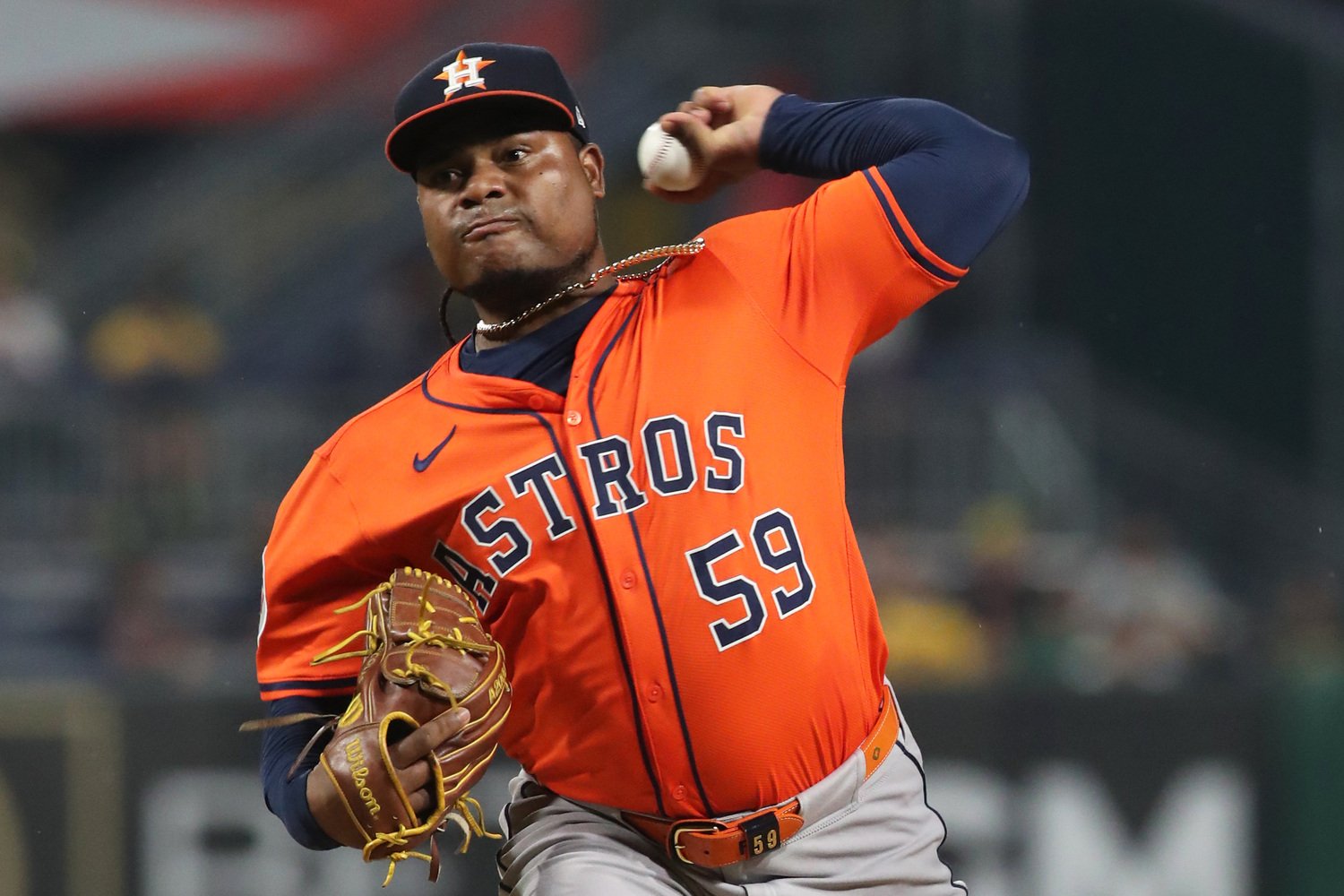 According to Jon Heyman and Joel Sherman of the New York Post, the Toronto Blue Jays are one of "several teams" interested in free agent left-hander Framber Valdez. Valdez, 32, has been one of the most consistent frontline starters in the league over the past six years, with a 3.23 ERA and an MLB-leading 73 wins since 2020. His 973 innings rank fifth among pitchers, while his 20.3 FanGraphs WAR ranks sixth. Without a doubt, Valdez is the top free agent left unsigned. There is no question that Valdez would make the Blue Jays better. Indeed, Ben Nicholson-Smith of Sportsnet reported earlier this year that the Jays met with the southpaw at the GM Meetings in November, but that was before they signed Dylan Cease to a seven-year, $210 million contract. They later signed Cody Ponce, creating a logjam in the rotation we've all been talking about ever since. Presumably, Toronto's renewed interest in Valdez indicates that his asking price has dropped substantially. With a week to go before pitchers and catchers report to spring training, it's hard to believe he'll still be able to command the five-year, $150 million deal DiamondCentric expected him to sign earlier this winter. The Blue Jays might not really have room for Valdez, and he clearly wasn't their top priority, but if his price is low enough, Ross Atkins and John Schneider can figure out how to make it work. Valdez may be on the wrong side of 30, and the character concerns are well-founded, but he's also a multi-time All-Star with significant postseason experience. If this front office was willing to give Kyle Tucker a 10-year contract, there is surely a number at which they'd pull the trigger on Valdez.
 -
According to Jon Heyman and Joel Sherman of the New York Post, the Toronto Blue Jays are one of "several teams" interested in free agent left-hander Framber Valdez. Valdez, 32, has been one of the most consistent frontline starters in the league over the past six years, with a 3.23 ERA and an MLB-leading 73 wins since 2020. His 973 innings rank fifth among pitchers, while his 20.3 FanGraphs WAR ranks sixth. Without a doubt, Valdez is the top free agent left unsigned. There is no question that Valdez would make the Blue Jays better. Indeed, Ben Nicholson-Smith of Sportsnet reported earlier this year that the Jays met with the southpaw at the GM Meetings in November, but that was before they signed Dylan Cease to a seven-year, $210 million contract. They later signed Cody Ponce, creating a logjam in the rotation we've all been talking about ever since. Presumably, Toronto's renewed interest in Valdez indicates that his asking price has dropped substantially. With a week to go before pitchers and catchers report to spring training, it's hard to believe he'll still be able to command the five-year, $150 million deal DiamondCentric expected him to sign earlier this winter. The Blue Jays might not really have room for Valdez, and he clearly wasn't their top priority, but if his price is low enough, Ross Atkins and John Schneider can figure out how to make it work. Valdez may be on the wrong side of 30, and the character concerns are well-founded, but he's also a multi-time All-Star with significant postseason experience. If this front office was willing to give Kyle Tucker a 10-year contract, there is surely a number at which they'd pull the trigger on Valdez. View full rumor
-
When I tell people I write about baseball for a living, they tend to ask how I stay busy during the winter. "What do you have to write about when there aren't any games?" My response has become something I say so often it almost feels scripted. "The offseason can be just as busy for me," I explain. "There are trades and free agent signings, of course. But there is also endless speculation preceding every move and endless analysis that follows. I write about the season that was, the season that's soon to come, and what we learned from the former that will matter in the latter." All of that is true, except perhaps for how eloquent I made myself sound. When the offseason begins, there's no shortage of topics to choose from. It's also nice to be able to write without worrying about stats going out of date or a catastrophic injury changing everything. In early fall, I sometimes even catch myself saying that I prefer writing about baseball during the offseason. Then February rolls around. Today marks one month since the Blue Jays added a player to their 40-man roster. It's been 31 days of writing about minor league signings, arbitration cases, and spring training invitations. The glass-half-empty voice in my head wants to scream. I'm bored! Thankfully, I also have a glass-half-full side to my personality. That part of me is grateful for projections. I may not have real baseball to write about, but at least I have hypothetical data from tens of thousands of simulated seasons. Playoff odds went live at FanGraphs this week. These odds are calculated by simulating the upcoming season 20,000 times using the FG Depth Charts player projections. The player projections provide an estimate of how many runs each team will score and allow. The simulations show the many different ways those runs could translate into wins and losses. As I write this, the Blue Jays' playoff odds are 61.5%. In other words, the Jays made the playoffs in roughly 12,300 of FanGraphs's simulated seasons. Their 85 projected wins (technically 84.9) are the average of their win total in each simulation. In half of the simulated seasons, they finished somewhere between 81 and 89 wins. FanGraphs gives them a one-in-four shot of finishing with 89 or more wins, but also one-in-four odds to finish at or below .500. Their chances of winning the AL East are also about one-in-four (23.4%). If 85 wins and 23.4% division odds feel low to you, I promise you aren't alone. Last year, the Blue Jays entered the season with 83 projected wins and 15.6% division odds. Considering the difference between Toronto's 2024 and 2025 seasons, and taking into account all the front office has done this winter, it really seems like the Blue Jays should have the best odds to win the AL East and a projection closer to 90 wins. That would have been my guess before any projections came out, and last week's ZiPS projected standings support that prognostication. Yet, as I pointed out when I wrote about the ZiPS standings, the most meaningful takeaway from those projections wasn't that the Blue Jays were the best team in their division, but that the AL East is going to be a tight race. The FanGraphs playoff odds indicate the same thing. The AL East is the only division in which all five teams have a projected strength of schedule above .500. None of the teams in this division will make things easy for any of the others. FanGraphs gives the Yankees the highest odds to win the division, but those odds are worse than one-in-three. That means it's more than twice as likely that someone other than the favourite wins the AL East. And while New York's division odds are about seven percentage points higher than Toronto's and Boston's, the Yankees' projected win total is only 86.2. The projected spread between the Yankees in first and the Orioles in fourth is only 2.4 wins. Heck, even the Rays aren't that far behind. Tampa Bay has the worst projections in the AL East, but the Rays still have about a one-in-five chance to play in October (21.0%). The FanGraphs odds suggest it's basically just as likely that the Rays make the playoffs as it is that the Blue Jays repeat as division champs. With that said, I can't deny that the FanGraphs odds are less optimistic about the Blue Jays than ZiPS is. Only one team, the Astros, sees a bigger drop-off between their ZiPS projected win total and their FanGraphs playoff odds projected win total. That said, the FanGraphs odds are less enamoured with the AL East in general, projecting worse records for every team except the Rays. Altogether, the five AL East teams have 12 fewer wins according to the FanGraphs playoff odds than ZiPS. Now, five days have passed since Dan Szymborski put out the ZiPS standings, and the projections will have already changed a tad. But it's not as if the teams in the AL East have been particularly busy over the last few days. So, where did those 12 wins go? For the most part, they went to the National League. The ZiPS standings have the 15 AL teams collectively winning six more games than the 15 NL teams. On the other hand, the FanGraphs playoff odds have the clubs in the Senior Circuit winning 16 more games than the clubs in the Junior Circuit. FanGraphs is also higher on last-place teams. According to both systems, the best team in each division has an average of 89 projected wins. However, the worst team in each division has an average median projection three wins higher according to FanGraphs. The basement-dwellers have an average of 68 projected wins according to ZiPS and 71 projected wins according to the FanGraphs playoff odds. This is particularly relevant for the Blue Jays, because no division has a stronger weakest link than the AL East. The ZiPS projected standings all but write off the Rays, putting their postseason odds at 11.7% and their division odds at 1.1%. The FanGraphs playoff odds, however, think the Rays are almost twice as likely to make the playoffs and almost four times as likely to win the division. They're still long shots, but the FanGraphs playoff odds suggest they're much more "dark horse" than "punching bag." Finally, it's worth noting that despite the Blue Jays' differing win total projections and division odds, their World Series odds are almost identical according to ZiPS (4.8%) and FanGraphs (4.7%). Per FanGraphs, the Blue Jays have the seventh-best odds to win it all, although the Yankees and Red Sox are only just above them, and the Phillies and Tigers are only just below. View full article
-
What the FanGraphs Playoff Odds Tell Us About the Blue Jays
Leo Morgenstern posted an article in Blue Jays
.jpg.de0431acce874a5d27d8f7b5676d5299.jpg) When I tell people I write about baseball for a living, they tend to ask how I stay busy during the winter. "What do you have to write about when there aren't any games?" My response has become something I say so often it almost feels scripted. "The offseason can be just as busy for me," I explain. "There are trades and free agent signings, of course. But there is also endless speculation preceding every move and endless analysis that follows. I write about the season that was, the season that's soon to come, and what we learned from the former that will matter in the latter." All of that is true, except perhaps for how eloquent I made myself sound. When the offseason begins, there's no shortage of topics to choose from. It's also nice to be able to write without worrying about stats going out of date or a catastrophic injury changing everything. In early fall, I sometimes even catch myself saying that I prefer writing about baseball during the offseason. Then February rolls around. Today marks one month since the Blue Jays added a player to their 40-man roster. It's been 31 days of writing about minor league signings, arbitration cases, and spring training invitations. The glass-half-empty voice in my head wants to scream. I'm bored! Thankfully, I also have a glass-half-full side to my personality. That part of me is grateful for projections. I may not have real baseball to write about, but at least I have hypothetical data from tens of thousands of simulated seasons. Playoff odds went live at FanGraphs this week. These odds are calculated by simulating the upcoming season 20,000 times using the FG Depth Charts player projections. The player projections provide an estimate of how many runs each team will score and allow. The simulations show the many different ways those runs could translate into wins and losses. As I write this, the Blue Jays' playoff odds are 61.5%. In other words, the Jays made the playoffs in roughly 12,300 of FanGraphs's simulated seasons. Their 85 projected wins (technically 84.9) are the average of their win total in each simulation. In half of the simulated seasons, they finished somewhere between 81 and 89 wins. FanGraphs gives them a one-in-four shot of finishing with 89 or more wins, but also one-in-four odds to finish at or below .500. Their chances of winning the AL East are also about one-in-four (23.4%). If 85 wins and 23.4% division odds feel low to you, I promise you aren't alone. Last year, the Blue Jays entered the season with 83 projected wins and 15.6% division odds. Considering the difference between Toronto's 2024 and 2025 seasons, and taking into account all the front office has done this winter, it really seems like the Blue Jays should have the best odds to win the AL East and a projection closer to 90 wins. That would have been my guess before any projections came out, and last week's ZiPS projected standings support that prognostication. Yet, as I pointed out when I wrote about the ZiPS standings, the most meaningful takeaway from those projections wasn't that the Blue Jays were the best team in their division, but that the AL East is going to be a tight race. The FanGraphs playoff odds indicate the same thing. The AL East is the only division in which all five teams have a projected strength of schedule above .500. None of the teams in this division will make things easy for any of the others. FanGraphs gives the Yankees the highest odds to win the division, but those odds are worse than one-in-three. That means it's more than twice as likely that someone other than the favourite wins the AL East. And while New York's division odds are about seven percentage points higher than Toronto's and Boston's, the Yankees' projected win total is only 86.2. The projected spread between the Yankees in first and the Orioles in fourth is only 2.4 wins. Heck, even the Rays aren't that far behind. Tampa Bay has the worst projections in the AL East, but the Rays still have about a one-in-five chance to play in October (21.0%). The FanGraphs odds suggest it's basically just as likely that the Rays make the playoffs as it is that the Blue Jays repeat as division champs. With that said, I can't deny that the FanGraphs odds are less optimistic about the Blue Jays than ZiPS is. Only one team, the Astros, sees a bigger drop-off between their ZiPS projected win total and their FanGraphs playoff odds projected win total. That said, the FanGraphs odds are less enamoured with the AL East in general, projecting worse records for every team except the Rays. Altogether, the five AL East teams have 12 fewer wins according to the FanGraphs playoff odds than ZiPS. Now, five days have passed since Dan Szymborski put out the ZiPS standings, and the projections will have already changed a tad. But it's not as if the teams in the AL East have been particularly busy over the last few days. So, where did those 12 wins go? For the most part, they went to the National League. The ZiPS standings have the 15 AL teams collectively winning six more games than the 15 NL teams. On the other hand, the FanGraphs playoff odds have the clubs in the Senior Circuit winning 16 more games than the clubs in the Junior Circuit. FanGraphs is also higher on last-place teams. According to both systems, the best team in each division has an average of 89 projected wins. However, the worst team in each division has an average median projection three wins higher according to FanGraphs. The basement-dwellers have an average of 68 projected wins according to ZiPS and 71 projected wins according to the FanGraphs playoff odds. This is particularly relevant for the Blue Jays, because no division has a stronger weakest link than the AL East. The ZiPS projected standings all but write off the Rays, putting their postseason odds at 11.7% and their division odds at 1.1%. The FanGraphs playoff odds, however, think the Rays are almost twice as likely to make the playoffs and almost four times as likely to win the division. They're still long shots, but the FanGraphs playoff odds suggest they're much more "dark horse" than "punching bag." Finally, it's worth noting that despite the Blue Jays' differing win total projections and division odds, their World Series odds are almost identical according to ZiPS (4.8%) and FanGraphs (4.7%). Per FanGraphs, the Blue Jays have the seventh-best odds to win it all, although the Yankees and Red Sox are only just above them, and the Phillies and Tigers are only just below.
When I tell people I write about baseball for a living, they tend to ask how I stay busy during the winter. "What do you have to write about when there aren't any games?" My response has become something I say so often it almost feels scripted. "The offseason can be just as busy for me," I explain. "There are trades and free agent signings, of course. But there is also endless speculation preceding every move and endless analysis that follows. I write about the season that was, the season that's soon to come, and what we learned from the former that will matter in the latter." All of that is true, except perhaps for how eloquent I made myself sound. When the offseason begins, there's no shortage of topics to choose from. It's also nice to be able to write without worrying about stats going out of date or a catastrophic injury changing everything. In early fall, I sometimes even catch myself saying that I prefer writing about baseball during the offseason. Then February rolls around. Today marks one month since the Blue Jays added a player to their 40-man roster. It's been 31 days of writing about minor league signings, arbitration cases, and spring training invitations. The glass-half-empty voice in my head wants to scream. I'm bored! Thankfully, I also have a glass-half-full side to my personality. That part of me is grateful for projections. I may not have real baseball to write about, but at least I have hypothetical data from tens of thousands of simulated seasons. Playoff odds went live at FanGraphs this week. These odds are calculated by simulating the upcoming season 20,000 times using the FG Depth Charts player projections. The player projections provide an estimate of how many runs each team will score and allow. The simulations show the many different ways those runs could translate into wins and losses. As I write this, the Blue Jays' playoff odds are 61.5%. In other words, the Jays made the playoffs in roughly 12,300 of FanGraphs's simulated seasons. Their 85 projected wins (technically 84.9) are the average of their win total in each simulation. In half of the simulated seasons, they finished somewhere between 81 and 89 wins. FanGraphs gives them a one-in-four shot of finishing with 89 or more wins, but also one-in-four odds to finish at or below .500. Their chances of winning the AL East are also about one-in-four (23.4%). If 85 wins and 23.4% division odds feel low to you, I promise you aren't alone. Last year, the Blue Jays entered the season with 83 projected wins and 15.6% division odds. Considering the difference between Toronto's 2024 and 2025 seasons, and taking into account all the front office has done this winter, it really seems like the Blue Jays should have the best odds to win the AL East and a projection closer to 90 wins. That would have been my guess before any projections came out, and last week's ZiPS projected standings support that prognostication. Yet, as I pointed out when I wrote about the ZiPS standings, the most meaningful takeaway from those projections wasn't that the Blue Jays were the best team in their division, but that the AL East is going to be a tight race. The FanGraphs playoff odds indicate the same thing. The AL East is the only division in which all five teams have a projected strength of schedule above .500. None of the teams in this division will make things easy for any of the others. FanGraphs gives the Yankees the highest odds to win the division, but those odds are worse than one-in-three. That means it's more than twice as likely that someone other than the favourite wins the AL East. And while New York's division odds are about seven percentage points higher than Toronto's and Boston's, the Yankees' projected win total is only 86.2. The projected spread between the Yankees in first and the Orioles in fourth is only 2.4 wins. Heck, even the Rays aren't that far behind. Tampa Bay has the worst projections in the AL East, but the Rays still have about a one-in-five chance to play in October (21.0%). The FanGraphs odds suggest it's basically just as likely that the Rays make the playoffs as it is that the Blue Jays repeat as division champs. With that said, I can't deny that the FanGraphs odds are less optimistic about the Blue Jays than ZiPS is. Only one team, the Astros, sees a bigger drop-off between their ZiPS projected win total and their FanGraphs playoff odds projected win total. That said, the FanGraphs odds are less enamoured with the AL East in general, projecting worse records for every team except the Rays. Altogether, the five AL East teams have 12 fewer wins according to the FanGraphs playoff odds than ZiPS. Now, five days have passed since Dan Szymborski put out the ZiPS standings, and the projections will have already changed a tad. But it's not as if the teams in the AL East have been particularly busy over the last few days. So, where did those 12 wins go? For the most part, they went to the National League. The ZiPS standings have the 15 AL teams collectively winning six more games than the 15 NL teams. On the other hand, the FanGraphs playoff odds have the clubs in the Senior Circuit winning 16 more games than the clubs in the Junior Circuit. FanGraphs is also higher on last-place teams. According to both systems, the best team in each division has an average of 89 projected wins. However, the worst team in each division has an average median projection three wins higher according to FanGraphs. The basement-dwellers have an average of 68 projected wins according to ZiPS and 71 projected wins according to the FanGraphs playoff odds. This is particularly relevant for the Blue Jays, because no division has a stronger weakest link than the AL East. The ZiPS projected standings all but write off the Rays, putting their postseason odds at 11.7% and their division odds at 1.1%. The FanGraphs playoff odds, however, think the Rays are almost twice as likely to make the playoffs and almost four times as likely to win the division. They're still long shots, but the FanGraphs playoff odds suggest they're much more "dark horse" than "punching bag." Finally, it's worth noting that despite the Blue Jays' differing win total projections and division odds, their World Series odds are almost identical according to ZiPS (4.8%) and FanGraphs (4.7%). Per FanGraphs, the Blue Jays have the seventh-best odds to win it all, although the Yankees and Red Sox are only just above them, and the Phillies and Tigers are only just below. -
Even without signing Kyle Tucker or Bo Bichette, the Blue Jays have had a successful offseason. While they said goodbye to players like Bichette, Chris Bassitt, Max Scherzer, and Seranthony Domínguez, they improved by adding Dylan Cease, Kazuma Okamoto, Cody Ponce, and Tyler Rogers. They look like one of the best teams in baseball, and they’re primed to defend their AL East title. Of course, to do all that, they had to spend. They had to spend a lot. In terms of guaranteed money, the Jays have given out $337 million this winter, in addition to Okamoto’s $10.875 million posting fee. On top of that, this coming season will mark the first year of Vladimir Guerrero Jr. and Alejandro Kirk’s extensions, and several more players are due raises, either due to arbitration or back-loaded contracts. As such, RosterResource estimates Toronto’s player payroll will rise from $258 million to $282 million, just a year after increasing from $217 million to $258 million. It shouldn’t come as any surprise that a $282 million payroll would be the highest in franchise history. What’s more, the Blue Jays’ payroll for luxury tax purposes is an estimated $311 million. For 2025, they ended up paying a $13.6 million tax bill on a CBT payroll of just over $286 million. As of right now, their tax bill for 2026 will be another $22 million higher: Tax Rate Tax Total CBT Payroll $310,590,764 Amount between $244M - $264M $20,000,000 30% $6,000,000 Amount between $264M - $284M $20,000,000 42% $8,400,000 Amount between $284M - $304M $20,000,000 75% $15,000,000 Amount over $304M $6,590,764 90% $5,931,688 Total $35,331,688 All things considered, the Jays will be spending almost $50 million more on their roster in 2026 compared to 2025, and about $100 million more than in 2024. That’s a lot of moolah. Of course, it’s not like they can’t afford it. The Blue Jays have one of the richest owners in the league, and they play in one of the biggest media markets in North America. Oh, and they just so happened to rake in more than $100 million in extra revenue during their run to the World Series last fall. They also still only have the fifth-highest payroll in MLB, trailing the Dodgers, Mets, Yankees, and Phillies. This kind of spending may be unprecedented for Toronto, but that doesn’t mean it’s unsustainable. With that said, there is a limit to how much the Blue Jays can spend, even if we don’t know what that limit is. So, presuming the front office is done with major moves for now, I want to turn my attention to how much money is coming off the books next winter. That should give us at least a rough idea of how much Ross Atkins and company will be able to spend for 2027 (and beyond). I know a lot could change between now and then. The Blue Jays could still add more payroll. They could also shed payroll. The next free agent class already looks thin, and it will only grow weaker if top projected free agents like Tarik Skubal, Jazz Chisholm Jr., and David Bednar sign extensions, or if players with contract options, like Bichette and Michael King, choose not to opt out. Moreover, the possibility of a lockout looms large. As far as the Blue Jays go, even a slightly less successful 2026 season could put an end to their status as a desirable destination for top free agents or, even worse, persuade ownership to tighten the purse strings. These are all key reasons why Atkins was smart to go big this year. Still, it’s always worth thinking ahead. (Also, let’s face it, the offseason is boring right now.) So, let’s talk about how much the Jays will have to work with next offseason. Expiring Contracts Six Blue Jays are headed for free agency after 2026. They’re listed below, along with their pay for the upcoming season. Eric Lauer’s salary has yet to be determined, so I listed the halfway point between the number he filed at ($5.75M) and the number the team filed at ($4.4M) for his arbitration hearing. I also included Myles Straw; he is technically under contract through 2028, but I’d be surprised if the Blue Jays pick up his $8 million club option for 2027 instead of paying a $1.75 million buyout and setting him free. George Springer: $24.167 million Kevin Gausman: $23 million Shane Bieber: $16 million Daulton Varsho: $10.75 million Yimi García: $7.5 million *Myles Straw: $7.4 million ($1.75 million buyout) *Eric Lauer: $5.075 million Total: $92.142 million That’s a lot of cash coming off the books. In terms of annual salary, it’s significantly more than Toronto spent on free agents this winter (Cease, Okamoto, Rogers, and Ponce will earn about $50 million combined in 2026). However, expiring contracts are only part of the equation. Guaranteed Raises Almost every Blue Jay with a guaranteed contract beyond 2026 will see a salary bump in 2027. The only exceptions are Guerrero, Anthony Santander, and Jeff Hoffman. The eight players receiving raises are listed below, along with the amount by which their salary is increasing: Kazuma Okamoto: $9 million Dylan Cease: $8 million Andrés Giménez: $8 million Cody Ponce: $6 million José Berríos: $6 million Tyler Rogers: $5 million Alejandro Kirk: $3.625 million Yariel Rodríguez: $1 million Total: $46.625 million That right there is half the money "freed up" by expiring contracts. And the raises aren’t done coming. Players Eligible for Arbitration Seven players on Toronto's roster will be eligible for arbitration next offseason: Ernie Clement (Arb 2) Tyler Heineman (Arb 2) Louis Varland (Arb 1) Brendon Little (Arb 1) Davis Schneider (Arb 1) Nathan Lukes (Arb 1) Bowden Francis (Arb 1) These players’ salaries are hard to estimate when we don’t know how any of them will perform in 2026. Still, this is another $10 million in raises at the minimum, presuming the Jays tender contracts to all of the above except Bowden Francis. So, now we’re looking at only $35 million or so to fill significant holes in the rotation (Gausman, Bieber), bullpen (García, Lauer), and lineup (Springer, Varsho, Straw). That’s not a lot to work with. Don’t forget, however, that Toronto is also set to pay another $35 million or so in luxury tax penalties for 2026. That’s also money coming off the books, even if it isn't included in the estimated payroll. Thankfully, payroll for luxury tax purposes is calculated using AAV, not yearly salaries, so Toronto’s CBT payroll figure won’t be affected by any of the players under guaranteed contract who are earning raises. It will, however, drop significantly thanks to all those expiring deals. Right now, RosterResource projects Toronto’s CBT payroll for 2027 at about $202 million. That estimation doesn’t include any salaries for arbitration-eligible players or pre-arb players, so let’s tack on another $20 million for arbitration salaries and $12 million for pre-arb salaries. Those are rough estimates, but rough estimates are all we have right now. That brings the CBT payroll up to $234 million. We also don’t know what the luxury tax thresholds or penalties will be in the next collective bargaining agreement. Heck, we can’t be sure the luxury tax as we know it will exist at all come 2027. (We can't be sure Major League Baseball will exist come 2027!) For my purposes right now, I’m going to pretend the current system remains in place. That’s a big presumption, but everyone is operating under big presumptions right now – major league executives included. So, let’s say the first threshold for luxury tax penalties increases by $4 million in 2027 and all the penalties stay the same. If the Jays add $35 million in new salary during the 2026-27 offseason, their estimated tax bill would only come to about $10 million. That’s $25 million less than their estimated tax bill for 2026. Now, that doesn’t mean they'll have another $25 million to spend, because every dollar spent would also increase their tax bill. But they could spend about $16 million more (on top of that initial $35 million) without increasing their total expenditure compared to 2026. That’s $51 million. All of a sudden, those numerous holes seem a lot more fillable. Furthermore, my whole exercise, to this point, has presumed the Blue Jays won’t spend a dime more in 2027 than they will in 2026. Yet, we all know they could spend more. A lot more. The Jays reportedly offered Kyle Tucker a 10-year, $350 million deal. We don’t know the exact details of that offer, but presuming the same annual salary all 10 years, Tucker would have added $35 million to the payroll and $31.5 million to the tax bill. That’s another $66.5 million. The Blue Jays made a huge splash this offseason. They’re spending at a level we’ve never seen them spend at before. However, their front office isn’t one that ever likes to sacrifice the future for immediate gain, and that’s not what they’ve done here. The Blue Jays should be one of the best teams in baseball in 2026, and the following winter, they should have the financial flexibility to rule the offseason once again. View full article
-
.jpg.6951d1a075eea933b630fa2acb1d2da2.jpg) Even without signing Kyle Tucker or Bo Bichette, the Blue Jays have had a successful offseason. While they said goodbye to players like Bichette, Chris Bassitt, Max Scherzer, and Seranthony Domínguez, they improved by adding Dylan Cease, Kazuma Okamoto, Cody Ponce, and Tyler Rogers. They look like one of the best teams in baseball, and they’re primed to defend their AL East title. Of course, to do all that, they had to spend. They had to spend a lot. In terms of guaranteed money, the Jays have given out $337 million this winter, in addition to Okamoto’s $10.875 million posting fee. On top of that, this coming season will mark the first year of Vladimir Guerrero Jr. and Alejandro Kirk’s extensions, and several more players are due raises, either due to arbitration or back-loaded contracts. As such, RosterResource estimates Toronto’s player payroll will rise from $258 million to $282 million, just a year after increasing from $217 million to $258 million. It shouldn’t come as any surprise that a $282 million payroll would be the highest in franchise history. What’s more, the Blue Jays’ payroll for luxury tax purposes is an estimated $311 million. For 2025, they ended up paying a $13.6 million tax bill on a CBT payroll of just over $286 million. As of right now, their tax bill for 2026 will be another $22 million higher: Tax Rate Tax Total CBT Payroll $310,590,764 Amount between $244M - $264M $20,000,000 30% $6,000,000 Amount between $264M - $284M $20,000,000 42% $8,400,000 Amount between $284M - $304M $20,000,000 75% $15,000,000 Amount over $304M $6,590,764 90% $5,931,688 Total $35,331,688 All things considered, the Jays will be spending almost $50 million more on their roster in 2026 compared to 2025, and about $100 million more than in 2024. That’s a lot of moolah. Of course, it’s not like they can’t afford it. The Blue Jays have one of the richest owners in the league, and they play in one of the biggest media markets in North America. Oh, and they just so happened to rake in more than $100 million in extra revenue during their run to the World Series last fall. They also still only have the fifth-highest payroll in MLB, trailing the Dodgers, Mets, Yankees, and Phillies. This kind of spending may be unprecedented for Toronto, but that doesn’t mean it’s unsustainable. With that said, there is a limit to how much the Blue Jays can spend, even if we don’t know what that limit is. So, presuming the front office is done with major moves for now, I want to turn my attention to how much money is coming off the books next winter. That should give us at least a rough idea of how much Ross Atkins and company will be able to spend for 2027 (and beyond). I know a lot could change between now and then. The Blue Jays could still add more payroll. They could also shed payroll. The next free agent class already looks thin, and it will only grow weaker if top projected free agents like Tarik Skubal, Jazz Chisholm Jr., and David Bednar sign extensions, or if players with contract options, like Bichette and Michael King, choose not to opt out. Moreover, the possibility of a lockout looms large. As far as the Blue Jays go, even a slightly less successful 2026 season could put an end to their status as a desirable destination for top free agents or, even worse, persuade ownership to tighten the purse strings. These are all key reasons why Atkins was smart to go big this year. Still, it’s always worth thinking ahead. (Also, let’s face it, the offseason is boring right now.) So, let’s talk about how much the Jays will have to work with next offseason. Expiring Contracts Six Blue Jays are headed for free agency after 2026. They’re listed below, along with their pay for the upcoming season. Eric Lauer’s salary has yet to be determined, so I listed the halfway point between the number he filed at ($5.75M) and the number the team filed at ($4.4M) for his arbitration hearing. I also included Myles Straw; he is technically under contract through 2028, but I’d be surprised if the Blue Jays pick up his $8 million club option for 2027 instead of paying a $1.75 million buyout and setting him free. George Springer: $24.167 million Kevin Gausman: $23 million Shane Bieber: $16 million Daulton Varsho: $10.75 million Yimi García: $7.5 million *Myles Straw: $7.4 million ($1.75 million buyout) *Eric Lauer: $5.075 million Total: $92.142 million That’s a lot of cash coming off the books. In terms of annual salary, it’s significantly more than Toronto spent on free agents this winter (Cease, Okamoto, Rogers, and Ponce will earn about $50 million combined in 2026). However, expiring contracts are only part of the equation. Guaranteed Raises Almost every Blue Jay with a guaranteed contract beyond 2026 will see a salary bump in 2027. The only exceptions are Guerrero, Anthony Santander, and Jeff Hoffman. The eight players receiving raises are listed below, along with the amount by which their salary is increasing: Kazuma Okamoto: $9 million Dylan Cease: $8 million Andrés Giménez: $8 million Cody Ponce: $6 million José Berríos: $6 million Tyler Rogers: $5 million Alejandro Kirk: $3.625 million Yariel Rodríguez: $1 million Total: $46.625 million That right there is half the money "freed up" by expiring contracts. And the raises aren’t done coming. Players Eligible for Arbitration Seven players on Toronto's roster will be eligible for arbitration next offseason: Ernie Clement (Arb 2) Tyler Heineman (Arb 2) Louis Varland (Arb 1) Brendon Little (Arb 1) Davis Schneider (Arb 1) Nathan Lukes (Arb 1) Bowden Francis (Arb 1) These players’ salaries are hard to estimate when we don’t know how any of them will perform in 2026. Still, this is another $10 million in raises at the minimum, presuming the Jays tender contracts to all of the above except Bowden Francis. So, now we’re looking at only $35 million or so to fill significant holes in the rotation (Gausman, Bieber), bullpen (García, Lauer), and lineup (Springer, Varsho, Straw). That’s not a lot to work with. Don’t forget, however, that Toronto is also set to pay another $35 million or so in luxury tax penalties for 2026. That’s also money coming off the books, even if it isn't included in the estimated payroll. Thankfully, payroll for luxury tax purposes is calculated using AAV, not yearly salaries, so Toronto’s CBT payroll figure won’t be affected by any of the players under guaranteed contract who are earning raises. It will, however, drop significantly thanks to all those expiring deals. Right now, RosterResource projects Toronto’s CBT payroll for 2027 at about $202 million. That estimation doesn’t include any salaries for arbitration-eligible players or pre-arb players, so let’s tack on another $20 million for arbitration salaries and $12 million for pre-arb salaries. Those are rough estimates, but rough estimates are all we have right now. That brings the CBT payroll up to $234 million. We also don’t know what the luxury tax thresholds or penalties will be in the next collective bargaining agreement. Heck, we can’t be sure the luxury tax as we know it will exist at all come 2027. (We can't be sure Major League Baseball will exist come 2027!) For my purposes right now, I’m going to pretend the current system remains in place. That’s a big presumption, but everyone is operating under big presumptions right now – major league executives included. So, let’s say the first threshold for luxury tax penalties increases by $4 million in 2027 and all the penalties stay the same. If the Jays add $35 million in new salary during the 2026-27 offseason, their estimated tax bill would only come to about $10 million. That’s $25 million less than their estimated tax bill for 2026. Now, that doesn’t mean they'll have another $25 million to spend, because every dollar spent would also increase their tax bill. But they could spend about $16 million more (on top of that initial $35 million) without increasing their total expenditure compared to 2026. That’s $51 million. All of a sudden, those numerous holes seem a lot more fillable. Furthermore, my whole exercise, to this point, has presumed the Blue Jays won’t spend a dime more in 2027 than they will in 2026. Yet, we all know they could spend more. A lot more. The Jays reportedly offered Kyle Tucker a 10-year, $350 million deal. We don’t know the exact details of that offer, but presuming the same annual salary all 10 years, Tucker would have added $35 million to the payroll and $31.5 million to the tax bill. That’s another $66.5 million. The Blue Jays made a huge splash this offseason. They’re spending at a level we’ve never seen them spend at before. However, their front office isn’t one that ever likes to sacrifice the future for immediate gain, and that’s not what they’ve done here. The Blue Jays should be one of the best teams in baseball in 2026, and the following winter, they should have the financial flexibility to rule the offseason once again.
Even without signing Kyle Tucker or Bo Bichette, the Blue Jays have had a successful offseason. While they said goodbye to players like Bichette, Chris Bassitt, Max Scherzer, and Seranthony Domínguez, they improved by adding Dylan Cease, Kazuma Okamoto, Cody Ponce, and Tyler Rogers. They look like one of the best teams in baseball, and they’re primed to defend their AL East title. Of course, to do all that, they had to spend. They had to spend a lot. In terms of guaranteed money, the Jays have given out $337 million this winter, in addition to Okamoto’s $10.875 million posting fee. On top of that, this coming season will mark the first year of Vladimir Guerrero Jr. and Alejandro Kirk’s extensions, and several more players are due raises, either due to arbitration or back-loaded contracts. As such, RosterResource estimates Toronto’s player payroll will rise from $258 million to $282 million, just a year after increasing from $217 million to $258 million. It shouldn’t come as any surprise that a $282 million payroll would be the highest in franchise history. What’s more, the Blue Jays’ payroll for luxury tax purposes is an estimated $311 million. For 2025, they ended up paying a $13.6 million tax bill on a CBT payroll of just over $286 million. As of right now, their tax bill for 2026 will be another $22 million higher: Tax Rate Tax Total CBT Payroll $310,590,764 Amount between $244M - $264M $20,000,000 30% $6,000,000 Amount between $264M - $284M $20,000,000 42% $8,400,000 Amount between $284M - $304M $20,000,000 75% $15,000,000 Amount over $304M $6,590,764 90% $5,931,688 Total $35,331,688 All things considered, the Jays will be spending almost $50 million more on their roster in 2026 compared to 2025, and about $100 million more than in 2024. That’s a lot of moolah. Of course, it’s not like they can’t afford it. The Blue Jays have one of the richest owners in the league, and they play in one of the biggest media markets in North America. Oh, and they just so happened to rake in more than $100 million in extra revenue during their run to the World Series last fall. They also still only have the fifth-highest payroll in MLB, trailing the Dodgers, Mets, Yankees, and Phillies. This kind of spending may be unprecedented for Toronto, but that doesn’t mean it’s unsustainable. With that said, there is a limit to how much the Blue Jays can spend, even if we don’t know what that limit is. So, presuming the front office is done with major moves for now, I want to turn my attention to how much money is coming off the books next winter. That should give us at least a rough idea of how much Ross Atkins and company will be able to spend for 2027 (and beyond). I know a lot could change between now and then. The Blue Jays could still add more payroll. They could also shed payroll. The next free agent class already looks thin, and it will only grow weaker if top projected free agents like Tarik Skubal, Jazz Chisholm Jr., and David Bednar sign extensions, or if players with contract options, like Bichette and Michael King, choose not to opt out. Moreover, the possibility of a lockout looms large. As far as the Blue Jays go, even a slightly less successful 2026 season could put an end to their status as a desirable destination for top free agents or, even worse, persuade ownership to tighten the purse strings. These are all key reasons why Atkins was smart to go big this year. Still, it’s always worth thinking ahead. (Also, let’s face it, the offseason is boring right now.) So, let’s talk about how much the Jays will have to work with next offseason. Expiring Contracts Six Blue Jays are headed for free agency after 2026. They’re listed below, along with their pay for the upcoming season. Eric Lauer’s salary has yet to be determined, so I listed the halfway point between the number he filed at ($5.75M) and the number the team filed at ($4.4M) for his arbitration hearing. I also included Myles Straw; he is technically under contract through 2028, but I’d be surprised if the Blue Jays pick up his $8 million club option for 2027 instead of paying a $1.75 million buyout and setting him free. George Springer: $24.167 million Kevin Gausman: $23 million Shane Bieber: $16 million Daulton Varsho: $10.75 million Yimi García: $7.5 million *Myles Straw: $7.4 million ($1.75 million buyout) *Eric Lauer: $5.075 million Total: $92.142 million That’s a lot of cash coming off the books. In terms of annual salary, it’s significantly more than Toronto spent on free agents this winter (Cease, Okamoto, Rogers, and Ponce will earn about $50 million combined in 2026). However, expiring contracts are only part of the equation. Guaranteed Raises Almost every Blue Jay with a guaranteed contract beyond 2026 will see a salary bump in 2027. The only exceptions are Guerrero, Anthony Santander, and Jeff Hoffman. The eight players receiving raises are listed below, along with the amount by which their salary is increasing: Kazuma Okamoto: $9 million Dylan Cease: $8 million Andrés Giménez: $8 million Cody Ponce: $6 million José Berríos: $6 million Tyler Rogers: $5 million Alejandro Kirk: $3.625 million Yariel Rodríguez: $1 million Total: $46.625 million That right there is half the money "freed up" by expiring contracts. And the raises aren’t done coming. Players Eligible for Arbitration Seven players on Toronto's roster will be eligible for arbitration next offseason: Ernie Clement (Arb 2) Tyler Heineman (Arb 2) Louis Varland (Arb 1) Brendon Little (Arb 1) Davis Schneider (Arb 1) Nathan Lukes (Arb 1) Bowden Francis (Arb 1) These players’ salaries are hard to estimate when we don’t know how any of them will perform in 2026. Still, this is another $10 million in raises at the minimum, presuming the Jays tender contracts to all of the above except Bowden Francis. So, now we’re looking at only $35 million or so to fill significant holes in the rotation (Gausman, Bieber), bullpen (García, Lauer), and lineup (Springer, Varsho, Straw). That’s not a lot to work with. Don’t forget, however, that Toronto is also set to pay another $35 million or so in luxury tax penalties for 2026. That’s also money coming off the books, even if it isn't included in the estimated payroll. Thankfully, payroll for luxury tax purposes is calculated using AAV, not yearly salaries, so Toronto’s CBT payroll figure won’t be affected by any of the players under guaranteed contract who are earning raises. It will, however, drop significantly thanks to all those expiring deals. Right now, RosterResource projects Toronto’s CBT payroll for 2027 at about $202 million. That estimation doesn’t include any salaries for arbitration-eligible players or pre-arb players, so let’s tack on another $20 million for arbitration salaries and $12 million for pre-arb salaries. Those are rough estimates, but rough estimates are all we have right now. That brings the CBT payroll up to $234 million. We also don’t know what the luxury tax thresholds or penalties will be in the next collective bargaining agreement. Heck, we can’t be sure the luxury tax as we know it will exist at all come 2027. (We can't be sure Major League Baseball will exist come 2027!) For my purposes right now, I’m going to pretend the current system remains in place. That’s a big presumption, but everyone is operating under big presumptions right now – major league executives included. So, let’s say the first threshold for luxury tax penalties increases by $4 million in 2027 and all the penalties stay the same. If the Jays add $35 million in new salary during the 2026-27 offseason, their estimated tax bill would only come to about $10 million. That’s $25 million less than their estimated tax bill for 2026. Now, that doesn’t mean they'll have another $25 million to spend, because every dollar spent would also increase their tax bill. But they could spend about $16 million more (on top of that initial $35 million) without increasing their total expenditure compared to 2026. That’s $51 million. All of a sudden, those numerous holes seem a lot more fillable. Furthermore, my whole exercise, to this point, has presumed the Blue Jays won’t spend a dime more in 2027 than they will in 2026. Yet, we all know they could spend more. A lot more. The Jays reportedly offered Kyle Tucker a 10-year, $350 million deal. We don’t know the exact details of that offer, but presuming the same annual salary all 10 years, Tucker would have added $35 million to the payroll and $31.5 million to the tax bill. That’s another $66.5 million. The Blue Jays made a huge splash this offseason. They’re spending at a level we’ve never seen them spend at before. However, their front office isn’t one that ever likes to sacrifice the future for immediate gain, and that’s not what they’ve done here. The Blue Jays should be one of the best teams in baseball in 2026, and the following winter, they should have the financial flexibility to rule the offseason once again. -
Several players who were planning to suit up for this year’s World Baseball Classic have been forced to withdraw from the tournament, just days before final rosters are due. The (frustrating and disappointing) reason? Insurance. To participate in the WBC, MLB players must be approved for an insurance policy – unless their team is willing to absorb all financial risk in case of injury. If granted, these policies cover up to two years of salary for position players and up to four years for pitchers (per The Athletic’s Ken Rosenthal and Evan Drellich). The list of names that have dropped out of the WBC includes, among others, Francisco Lindor, Carlos Correa, and Toronto Blue Jays right-hander José Berríos. Berríos is a true veteran of the tournament, having pitched in each of the last three Classics. While he hasn't had much individual success (13.98 ERA in five WBC appearances), he was a member of the runner-up Puerto Rico teams in both 2013 and 2017. His insurance case is currently under review, according to Puerto Rico’s operations manager Joey Sola, but right now, it’s looking like he’ll have to sit out the WBC for the first time in his career. It seems unlikely the Blue Jays would be willing to let him play without insurance. Berríos has long been one of MLB’s most durable arms, but he landed on the injured list last season for the first time in his career. The Blue Jays placed him on the 15-day IL with right elbow inflammation on September 25, and he was unable to pitch in the playoffs. He later told MLB Network that he suffered through elbow and biceps issues “all year long,” clarifying that it was biceps tendon inflammation that ultimately forced him to the shelf. Thankfully, the righty described the issue as “nothing major.” Indeed, GM Ross Atkins told reporters in November that Berríos would have a “completely normal offseason.” The Blue Jays expect him to be at 100% in spring training as he competes for a job in their starting rotation. Until recently, it seemed like a given that a healthy Berríos would also pitch in the World Baseball Classic. A strong performance might have even helped him earn a rotation spot. “I want to pitch in the WBC,” he said in his December appearance on MLB Network. “That's my goal right now.” Puerto Rico has been hit harder by insurance rejections than any other team, leading José Quiles, president of the Puerto Rico Baseball Federation, to contemplate pulling his team from the tournament. He told journalist Jay Fonseca that no final decision has been made, but he does not want to participate if his team does not have a fair chance to win. This news is especially disappointing considering that Puerto Rico’s Hiram Bithorn Stadium in San Juan is set to host Pool A for the first round of competition. Venezuelan infielder Miguel Rojas, another would-be participant who was denied insurance, voiced his displeasure that insurance rejections have impacted Latin American teams, like Venezuela and Puerto Rico, more than any others. “There's a lot of things I would like to talk about with someone in control, with someone from MLB,” the veteran told ESPN’s Alden Gonzalez. Hopefully, MLB, the MLBPA, and the WBC will find a solution that allows more players to participate and prevents Puerto Rico from exiting the tournament. However, the clock is ticking. Official rosters are due February 3, and they will be formally announced on February 5. Pool play is scheduled to kick off a month later. Blue Jays who are still expected to play in the WBC include Vladimir Guerrero Jr. (Dominican Republic), Alejandro Kirk (Mexico), Kazuma Okamoto (Japan), Ernie Clement (USA), Yariel Rodríguez (Cuba), Adam Macko (Canada), and Leo Jiménez (Panama). George Springer was named to Puerto Rico's preliminary roster but later backed out due to minor injury concerns of his own. View full article
.jpg.69f576256c369f177e9f136a6f56dee7.jpg)
.jpg.2da8462ddb72c38b6fa4cd0c513a2484.jpg)
.jpg.82f9bd813c4971caf98d3b466956ab67.jpg)
.jpg.65bae3801c2a34370a40da44130b19c4.jpg)
.jpg.a3a35ce810625ed03713cd39344b4f60.jpg)
.jpg.d72cb2bd84491678b30d1d8a73c8ed08.jpg)
.jpg.4235e5b805521a7f9e7f3bb23c48524f.jpg)
.jpg.f55377f71254e7230dae19052eb978c4.jpg)

.jpg.de0431acce874a5d27d8f7b5676d5299.jpg)
.jpg.6951d1a075eea933b630fa2acb1d2da2.jpg)