Bob Ritchie
-
Posts
121 -
Joined
-
Last visited
-
Days Won
1
Content Type
Profiles
Toronto Blue Jays Videos
2026 Toronto Blue Jays Top Prospects Ranking
Toronto Blue Jays Free Agent & Trade Rumors, Notes, & Tidbits
Guides & Resources
2025 Toronto Blue Jays Draft Pick Tracker
News
2026 Toronto Blue Jays Draft Tracker: Picks & Bonuses
Forums
Blogs
Events
Store
Downloads
Gallery
Everything posted by Bob Ritchie
-
My second favourite team are the Cardinals. Maybe I slipped an article draft to the Cardinals' Management before publication. :)
- 12 replies
-
- 1
-

-
- dillon tate
- david robertson
- (and 4 more)
-
On the assumption that Swanson will miss a considerable amount of time, I think Toronto should immediately replace him with someone experienced in his later-inning role. Neither Macko nor Bloss fits that criterion. Also, Macko is out after knee surgery and is expected to miss at least the season's first month. Tate, who is signed, can fill the Swanson slot. I have no issue with Macko or Bloss vying for a regular bullpen role in non-late-inning/higher-leverage situations.
-
On Thursday, Erik Swanson will visit a specialist to have his ailing arm examined. Which replacement candidates could the Jays consider if the medical prognosis is a lengthy stint on the IL? Recently, I wrote about Erik Swanson 's importance to the Blue Jays bullpen. Although he struggled in 2024, his performance in the latter part of the season was encouraging. However, on March 10, manager John Schneider announced that Swanson would visit Dr. Keith Meister today. The good doctor is well-known in baseball circles. Last year, he performed season-ending surgeries on Alek Manoah, Ricky Tiedemman, and Brandon Barriera, among others. If Swanson were to miss a substantial portion, if not all, of the 2025 campaign, what options would be available to Toronto? There are some internal candidates, such as Ryan Burr, Tommy Nance, Ryan Yarbrough, and the recently-signed Dillon Tate. However, given Swanson's late-inning, high-leverage bullpen role, only Tate has the experience to replace Swanson in that capacity. None of Burr, Nance and Yarbrough has more than 88 career outings that came after the sixth inning. Swanson and Tate have 196 and 145, respectively. FanGraphs' free-agent tracker shows 15 unsigned free-agent relievers, including several well-known names. I used ZiPS Depth Chart projections for my list and selected the five pitchers with the best 2025 FIP estimates available to play now. Brooks Raley and Keynan Middleton ranked third and fifth in my FIP rankings, but the expectation is that neither will be available for the beginning of the season due to recovery from surgery. Tate ranks fourth on the FIP list after the Raley-Middleton exclusion. Table 1 below shows some key projections. Table 2 is a summary of key 2024 metrics. Let's examine each candidate. Joe Kelly Joe Kelly struggled in 2024. Shoulder issues plagued him, and according to RotoWire, his shoulder is not 100%. The 3.85 FIP estimate is respectable, but his 2024 xwOBA was higher than the average MLB reliever. Despite the 2024 blip, Kelly is an accomplished reliever. Nonetheless, I ruled him out because of his age and injury status. Craig Kimbrel For Craig Kimbrel, 2024 was the tale of two halves. In the first half, he posted a .280 xwOBA (77th percentile) and a 26.3 K%-BB%, better than the MLB average. In the second half, Kimbrel's xwOBA ballooned to .384 (first percentile), and his walk rate ballooned to 15.6%, nearly twice the league average. He was a Baltimore Oriole during the 2024 campaign, but the Orioles released him on September 24. Like Kelly, Kimbrel performed much better in previous seasons. Kimbrel is worth considering as a Swanson replacement, but he would be a distant third choice given his 2024 second-half collapse and age. Phil Maton Recently, Phil Maton has been inconsistent season-to-season. In 2024 and 2022, he recorded .320 xwOBA marks. In 2023 and 2021, Maton generated much better xwOBA scores of .274 and .294, respectively. ZiPS sees him as below average in 2025. I placed Maton fourth on my list mainly due to his inconsistency. David Robertson The group's elder statesman, David Robertson, had a good 2024 campaign, with excellent whiff, home run, groundball, and strikeout rates. Despite his age, Robertson has been healthy, with his only lengthy IL stint occurring in 2020, when he missed the season because of Tommy John surgery. ZiPS expects him to run the best FIP and strikeouts-minus-walk rate among the five relievers. Robertson's low home run rate is attractive because in 2024, the Blue Jays posted the highest rate among all bullpens. There are two negatives to Robertson's candidacy. First, he may be expensive. FanGraphs' estimated deal is one year, $10 million. However, since Opening Day is approaching, Robertson's market price could be lower. The second negative is age. At 40, his performance could fall off a cliff, particularly with no spring training game action. All things considered, Robertson would be my top choice. (A hat tip to Marie Illerbrun for suggesting candidate Robertson to me.) Dillon Tate The Blue Jays announced Tate's signing yesterday, and he is an interesting candidate. In his five-season career, his .300 xwOBA is better than than the league's .315 mark over the same period. His FIP is 3.98 is also more than a quarter of a run better than average. Notably, Tate missed the 2023 campaign due to arm issues. He returned in 2024 with the Orioles and posted a 3.57 FIP in 29 1/3 innings before July 1. Tate stumbled in July, and Baltimore demoted him. Baltimore designated Tate for assignment in August, and the Blue Jays claimed him off waivers on September 1. Tate generated a 3.47 FIP in 3 1/3 innings for the Blue Jays. but, the ballclub granted him free agency on November 22, 2024. Tate is a three-pitch pitcher: sinker, sweeper, and changeup, throwing the sinker just over half the time, the sweeper a third of the time, and mixing a changeup 13% of the time. In 2024, Tate's sinker fell to 92.6 mph, after averaging 94 in 2022. On the other hand, his sinker's average velocity was 91.6 in the first month of the season (121 pitches), 93.4 in May through July (175 pitches) and 92.5 in September (23 pitches). The change in velocity from 2022 to 2024 is not unusual for a pitcher who missed an entire season with arm issues. Therefore, Tate's 2025 sinker velocity could be more like the 2022 version and less like 2024. Throughout his career, Tate has posted below-average strikeout rates. He gets outs by inducing soft contact and by inviting batters to beat his sinker into the ground, but he was better at that in 2022, when he ran a 59% groundball rate, than in 2024, when he was at a (still well above-average) 51%. Furthermore, his edge rate (the percentage of pitches crossing the plate within one baseball's width of the strike zone's edges) dropped from 44% in 2022 to 37% in 2024. Suppose Tate regains some sinker velocity and locates a higher percentage of pitches on the edge of the strike zone. That could help him regain his 2022 form. I would rate Tate second on my list, but not far from to Robertson's perch. Tate should be a little cheaper, and at 31, his age is his favour. The Last Word Swanson is a critical member of the Blue Jays bullpen. However, given the question surrounding his availability to pitch, the Blue Jays may need a replacement for Swanson. Tate, is a reasonable choice. Robertson profiles as a better candidate, but the difference between the two is not significant. View full article
- 12 replies
-
- 2
-

-
- dillon tate
- david robertson
- (and 4 more)
-
Dillon Tate and Bullpen Arms for the Blue Jays To Consider
Bob Ritchie posted an article in Blue Jays
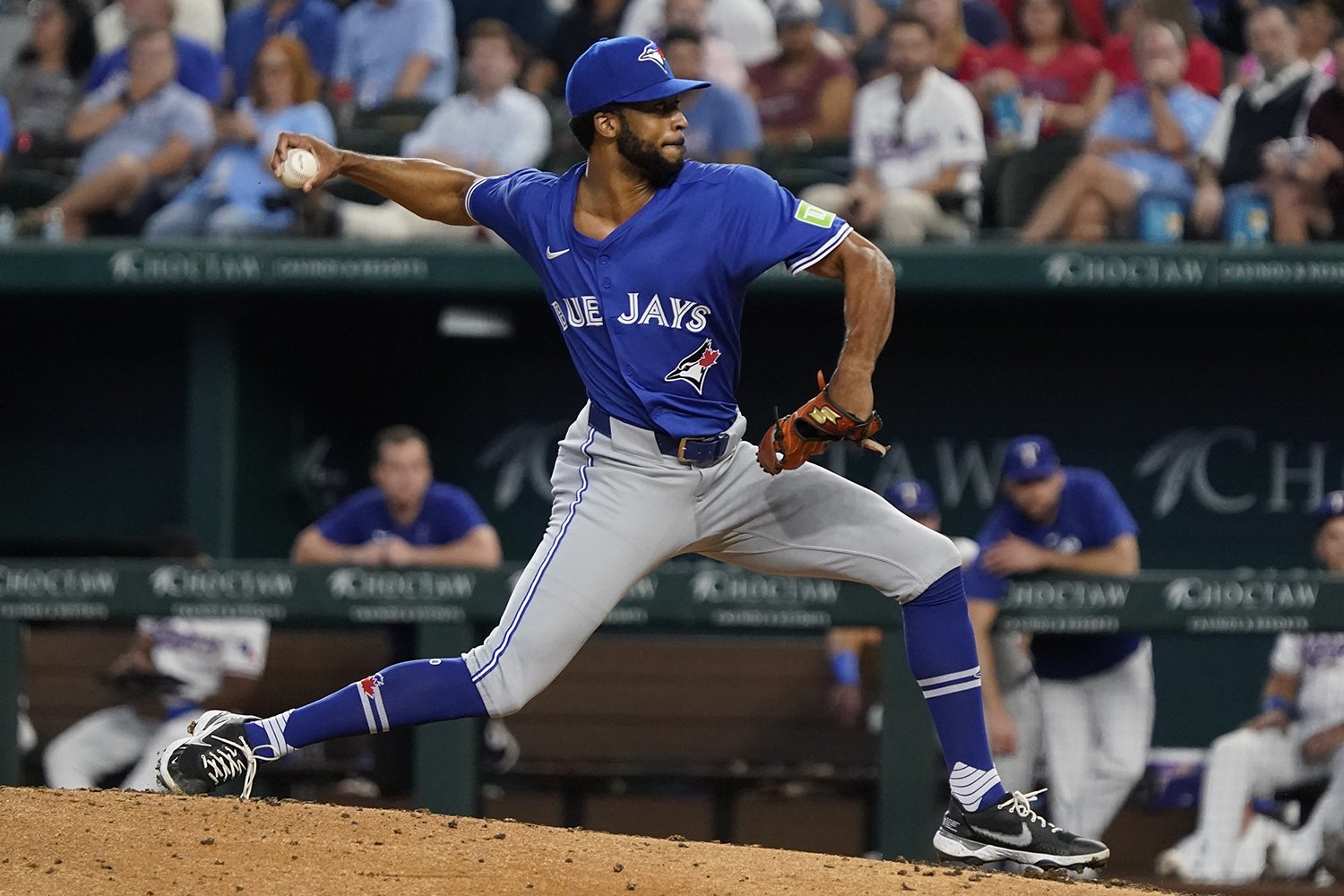 Recently, I wrote about Erik Swanson 's importance to the Blue Jays bullpen. Although he struggled in 2024, his performance in the latter part of the season was encouraging. However, on March 10, manager John Schneider announced that Swanson would visit Dr. Keith Meister today. The good doctor is well-known in baseball circles. Last year, he performed season-ending surgeries on Alek Manoah, Ricky Tiedemman, and Brandon Barriera, among others. If Swanson were to miss a substantial portion, if not all, of the 2025 campaign, what options would be available to Toronto? There are some internal candidates, such as Ryan Burr, Tommy Nance, Ryan Yarbrough, and the recently-signed Dillon Tate. However, given Swanson's late-inning, high-leverage bullpen role, only Tate has the experience to replace Swanson in that capacity. None of Burr, Nance and Yarbrough has more than 88 career outings that came after the sixth inning. Swanson and Tate have 196 and 145, respectively. FanGraphs' free-agent tracker shows 15 unsigned free-agent relievers, including several well-known names. I used ZiPS Depth Chart projections for my list and selected the five pitchers with the best 2025 FIP estimates available to play now. Brooks Raley and Keynan Middleton ranked third and fifth in my FIP rankings, but the expectation is that neither will be available for the beginning of the season due to recovery from surgery. Tate ranks fourth on the FIP list after the Raley-Middleton exclusion. Table 1 below shows some key projections. Table 2 is a summary of key 2024 metrics. Let's examine each candidate. Joe Kelly Joe Kelly struggled in 2024. Shoulder issues plagued him, and according to RotoWire, his shoulder is not 100%. The 3.85 FIP estimate is respectable, but his 2024 xwOBA was higher than the average MLB reliever. Despite the 2024 blip, Kelly is an accomplished reliever. Nonetheless, I ruled him out because of his age and injury status. Craig Kimbrel For Craig Kimbrel, 2024 was the tale of two halves. In the first half, he posted a .280 xwOBA (77th percentile) and a 26.3 K%-BB%, better than the MLB average. In the second half, Kimbrel's xwOBA ballooned to .384 (first percentile), and his walk rate ballooned to 15.6%, nearly twice the league average. He was a Baltimore Oriole during the 2024 campaign, but the Orioles released him on September 24. Like Kelly, Kimbrel performed much better in previous seasons. Kimbrel is worth considering as a Swanson replacement, but he would be a distant third choice given his 2024 second-half collapse and age. Phil Maton Recently, Phil Maton has been inconsistent season-to-season. In 2024 and 2022, he recorded .320 xwOBA marks. In 2023 and 2021, Maton generated much better xwOBA scores of .274 and .294, respectively. ZiPS sees him as below average in 2025. I placed Maton fourth on my list mainly due to his inconsistency. David Robertson The group's elder statesman, David Robertson, had a good 2024 campaign, with excellent whiff, home run, groundball, and strikeout rates. Despite his age, Robertson has been healthy, with his only lengthy IL stint occurring in 2020, when he missed the season because of Tommy John surgery. ZiPS expects him to run the best FIP and strikeouts-minus-walk rate among the five relievers. Robertson's low home run rate is attractive because in 2024, the Blue Jays posted the highest rate among all bullpens. There are two negatives to Robertson's candidacy. First, he may be expensive. FanGraphs' estimated deal is one year, $10 million. However, since Opening Day is approaching, Robertson's market price could be lower. The second negative is age. At 40, his performance could fall off a cliff, particularly with no spring training game action. All things considered, Robertson would be my top choice. (A hat tip to Marie Illerbrun for suggesting candidate Robertson to me.) Dillon Tate The Blue Jays announced Tate's signing yesterday, and he is an interesting candidate. In his five-season career, his .300 xwOBA is better than than the league's .315 mark over the same period. His FIP is 3.98 is also more than a quarter of a run better than average. Notably, Tate missed the 2023 campaign due to arm issues. He returned in 2024 with the Orioles and posted a 3.57 FIP in 29 1/3 innings before July 1. Tate stumbled in July, and Baltimore demoted him. Baltimore designated Tate for assignment in August, and the Blue Jays claimed him off waivers on September 1. Tate generated a 3.47 FIP in 3 1/3 innings for the Blue Jays. but, the ballclub granted him free agency on November 22, 2024. Tate is a three-pitch pitcher: sinker, sweeper, and changeup, throwing the sinker just over half the time, the sweeper a third of the time, and mixing a changeup 13% of the time. In 2024, Tate's sinker fell to 92.6 mph, after averaging 94 in 2022. On the other hand, his sinker's average velocity was 91.6 in the first month of the season (121 pitches), 93.4 in May through July (175 pitches) and 92.5 in September (23 pitches). The change in velocity from 2022 to 2024 is not unusual for a pitcher who missed an entire season with arm issues. Therefore, Tate's 2025 sinker velocity could be more like the 2022 version and less like 2024. Throughout his career, Tate has posted below-average strikeout rates. He gets outs by inducing soft contact and by inviting batters to beat his sinker into the ground, but he was better at that in 2022, when he ran a 59% groundball rate, than in 2024, when he was at a (still well above-average) 51%. Furthermore, his edge rate (the percentage of pitches crossing the plate within one baseball's width of the strike zone's edges) dropped from 44% in 2022 to 37% in 2024. Suppose Tate regains some sinker velocity and locates a higher percentage of pitches on the edge of the strike zone. That could help him regain his 2022 form. I would rate Tate second on my list, but not far from to Robertson's perch. Tate should be a little cheaper, and at 31, his age is his favour. The Last Word Swanson is a critical member of the Blue Jays bullpen. However, given the question surrounding his availability to pitch, the Blue Jays may need a replacement for Swanson. Tate, is a reasonable choice. Robertson profiles as a better candidate, but the difference between the two is not significant.
 -
Make Or Break Players On The 2025 Blue Jays: Erik Swanson
Bob Ritchie posted an article in Blue Jays
 On November 16, 2022, the Blue Jays traded Teoscar Hernández for Erik Swanson and prospect Adam Macko. In his debut season with the Blue Jays, Swanson made 69 appearances and ran a 2.97 ERA and 3.04 xERA (which analyzes a pitcher's exit velocities and launch angles to predict their expected ERA). His 32% whiff rate put him in the 79th percentile of all pitchers. In short, Swanson was an essential member of Toronto's 2023 bullpen. Unfortunately, 2024 went very differently. Swanson ran a 5.03 ERA, and his 5.18 xERA was even worse. His whiff rate fell all the way to the 28th percentile, and he put up -0.7 fWAR. What Went Wrong in 2024? Two spring training developments affected Swanson's preparation for the 2024 campaign, and very likely his performance. The first and most significant event concerned his four-year-old son, Toby. On February 25, Toby was hit by an SUV and airlifted to a hospital. He recuperated in a pediatric intensive care unit and was released from the hospital on March 7. Naturally, Swanson took some time away from camp to be with his family during the ordeal. The second development was an injury. Soon after Swanson returned to camp, he suffered forearm stiffness. The injury and the absence limited Swanson to just two spring training appearances, in which he faced seven batters and threw 32 pitches. He started the season on the IL, making three rehab outings before his first appearance with the Blue Jays on April 17. Things didn't go well. Swanson ran a disastrous 9.77 ERA over his first 17 appearances, and the advanced stats didn't see much to like either. He ran a 7.34 FIP and a 55.8% hard-hit rate. The Blue Jays optioned Swanson to Buffalo on May 28. Things didn't get better. In 17 appearances with the Bisons, Swansons ERA and FIP were both up over 10.00. Nonetheless, he returned to an MLB mound on July 20. He ran a scary 4.95 FIP the rest of the way, but thanks to some serious luck, such as a 100% strand rate and a .185 BABIP, his ERA over that stretch was down to 2.55. Swanson's profile also changed significantly in 2024. His splitter lost some of its sink and some of its arm-side run, but more importantly, he stopped hitting the zone with it, frequently locating the pitch off the plate to his arm side. It stopped performing well, and he utilized it significantly less. The most dramatic change was to his slider. In 2023, the pitch averaged nearly 10 inches of induced rise, but in 2024, the pitch had nearly no rise at all. It essentially functioned like a gyro slider. The projection system ZiPS sees Swanson running a 3.91 ERA and 4.14 FIP in 2025, making him essentially a league-average reliever. However, there is a cautionary note. Swanson has had a setback at the current Spring Training. He experienced right elbow discomfort and will likely start the season on the IL. What Can Go Right In 2025? To answer the question above, we need to examine Swanson's 2024 more closely. The first positive sign was Swanson's improved xwOBA after his July 20 return from Buffalo. The chart below has the details. Before July 20, Swanson faced 70 batters. From the 71 plate appearances point on the chart, his rolling xwOBA moved steadily towards and ultimately below the MLB average xwOBA through to the end of the 2024 campaign. This trend is a positive sign for 2025. Swanson's performance improved after his second Buffalo stint. Although his numbers were not as good as the ones he put up in 2022 and 2023, they were much better than the pre-July 20 period. What changed? The answer lies in the pitch data. Pitch Data Table 1 shows the critical metrics for Swanson's three-pitch arsenal: four-seam fastball, splitter, and slider. Notably, the average velocity and spin rates of the 2024 pitches were similar to the velocities and spin rates of the same pitch types in 2022 and 2023. Compared to the pre-July 20 timeframe, Swanson's fastball produced better xSLG and Whiff% results, and the xISO related to his slider was better after July 19. Swanson's split-finger fastball was a more effective pitch after July 19. The xSLG, xISO and Whiff% numbers were similar to his 2022 and 2023 results. Let's take a closer look at the splitter. Why is my primary focus on the splitter? According to Baseball Savant's Run-Value metric, it has been Swanson's best pitch in recent years. His splitter's RV/100 (Run Value per 100 pitches) was +2.9 and +2.3 in 2023 and 2022, respectively. In 2024, the split-finger fastball's RV/100 was -2.9. On the good news front, Swanson's splitter generated a +2.5 RV/100 after July 19. For Swanson to succeed in 2025, he needs an effective splitter. The Attack Zones The Attack Zone chart below details Baseball Savant's zones in and around the plate. Except for the Shadow Zone, the other zones do not require an explanation. However, the Shadow Zone is worth examining. The Shadow Zone is the width of two baseballs. I split the Shadow Zone into an inner zone and an outer zone; the inner zone resides within the strike zone, and the outer zone does not. I created the inner and outer zones to dive deeper into why Swanson's splitter was more effective after July 19. There are two reasons of note. First, Swanson's split-finger fastball generated lower xSLG numbers in the Heart Zone and both sectors of the Shadow Zone. Second, after July 19, Swanson located a higher percentage of pitches into the outer rather than the inner section of the Shadow zone. Hence, batters connected on more pitches in an area (the outer zone) where it is more challenging to make good contact. Tables 2 and 3 show the particulars. Other possible factors contributing to Swanson's better performance in the post-July 19 period include pitch sequencing and more reps. In summary, Swanson's improved performance after his return, mainly due to a more effective splitter and, to a lesser extent, the four-seam fastball, bodes well for 2025. How Will This Impact the Blue Jays? Among MLB reliever corps, Toronto's 2024 bullpen ranked near the bottom in many metrics. The Blue Jays' crew was 28th in WPA and 30th in FIP and fWAR. For Toronto to contend for a playoff spot in 2025, they will need better bullpen results. Toronto's signing of Jeff Hoffman and the re-signing of Yimi García should bolster the reliever squad. However, Toronto would benefit significantly from a return to form by Swanson. Why? Because Swanson was an essential member of Toronto's 2023 bullpen. He was primarily a set-up man (74% of his outings started in the seventh and eighth inning), and he appeared in the ninth inning in 13 of his 69 (19%) appearances. If Swanson can return to his 2023 form, he would provide Manager John Schneider with another high-quality, late-game option in the bullpen. The 2025 Blue Jays undoubtedly count on Swanson's improved performance. The Last Word Swanson likely wants to put the 2024 season in the rearview mirror. However, his numbers improved after returning to Toronto for the balance of the 2024 season. In particular, his split-finger fastball, his most important pitch in recent years, was very effective after he departed Buffalo in July. On the assumption that Swanson's current injury woes will not materially affect his performance, Swanson should be a key member of Toronto's bullpen, as he was in 2023.
 -
From family emergencies to injury to underperformance, everything went wrong for Erik Swanson in 2024. Can he turn it around? On November 16, 2022, the Blue Jays traded Teoscar Hernández for Erik Swanson and prospect Adam Macko. In his debut season with the Blue Jays, Swanson made 69 appearances and ran a 2.97 ERA and 3.04 xERA (which analyzes a pitcher's exit velocities and launch angles to predict their expected ERA). His 32% whiff rate put him in the 79th percentile of all pitchers. In short, Swanson was an essential member of Toronto's 2023 bullpen. Unfortunately, 2024 went very differently. Swanson ran a 5.03 ERA, and his 5.18 xERA was even worse. His whiff rate fell all the way to the 28th percentile, and he put up -0.7 fWAR. What Went Wrong in 2024? Two spring training developments affected Swanson's preparation for the 2024 campaign, and very likely his performance. The first and most significant event concerned his four-year-old son, Toby. On February 25, Toby was hit by an SUV and airlifted to a hospital. He recuperated in a pediatric intensive care unit and was released from the hospital on March 7. Naturally, Swanson took some time away from camp to be with his family during the ordeal. The second development was an injury. Soon after Swanson returned to camp, he suffered forearm stiffness. The injury and the absence limited Swanson to just two spring training appearances, in which he faced seven batters and threw 32 pitches. He started the season on the IL, making three rehab outings before his first appearance with the Blue Jays on April 17. Things didn't go well. Swanson ran a disastrous 9.77 ERA over his first 17 appearances, and the advanced stats didn't see much to like either. He ran a 7.34 FIP and a 55.8% hard-hit rate. The Blue Jays optioned Swanson to Buffalo on May 28. Things didn't get better. In 17 appearances with the Bisons, Swansons ERA and FIP were both up over 10.00. Nonetheless, he returned to an MLB mound on July 20. He ran a scary 4.95 FIP the rest of the way, but thanks to some serious luck, such as a 100% strand rate and a .185 BABIP, his ERA over that stretch was down to 2.55. Swanson's profile also changed significantly in 2024. His splitter lost some of its sink and some of its arm-side run, but more importantly, he stopped hitting the zone with it, frequently locating the pitch off the plate to his arm side. It stopped performing well, and he utilized it significantly less. The most dramatic change was to his slider. In 2023, the pitch averaged nearly 10 inches of induced rise, but in 2024, the pitch had nearly no rise at all. It essentially functioned like a gyro slider. The projection system ZiPS sees Swanson running a 3.91 ERA and 4.14 FIP in 2025, making him essentially a league-average reliever. However, there is a cautionary note. Swanson has had a setback at the current Spring Training. He experienced right elbow discomfort and will likely start the season on the IL. What Can Go Right In 2025? To answer the question above, we need to examine Swanson's 2024 more closely. The first positive sign was Swanson's improved xwOBA after his July 20 return from Buffalo. The chart below has the details. Before July 20, Swanson faced 70 batters. From the 71 plate appearances point on the chart, his rolling xwOBA moved steadily towards and ultimately below the MLB average xwOBA through to the end of the 2024 campaign. This trend is a positive sign for 2025. Swanson's performance improved after his second Buffalo stint. Although his numbers were not as good as the ones he put up in 2022 and 2023, they were much better than the pre-July 20 period. What changed? The answer lies in the pitch data. Pitch Data Table 1 shows the critical metrics for Swanson's three-pitch arsenal: four-seam fastball, splitter, and slider. Notably, the average velocity and spin rates of the 2024 pitches were similar to the velocities and spin rates of the same pitch types in 2022 and 2023. Compared to the pre-July 20 timeframe, Swanson's fastball produced better xSLG and Whiff% results, and the xISO related to his slider was better after July 19. Swanson's split-finger fastball was a more effective pitch after July 19. The xSLG, xISO and Whiff% numbers were similar to his 2022 and 2023 results. Let's take a closer look at the splitter. Why is my primary focus on the splitter? According to Baseball Savant's Run-Value metric, it has been Swanson's best pitch in recent years. His splitter's RV/100 (Run Value per 100 pitches) was +2.9 and +2.3 in 2023 and 2022, respectively. In 2024, the split-finger fastball's RV/100 was -2.9. On the good news front, Swanson's splitter generated a +2.5 RV/100 after July 19. For Swanson to succeed in 2025, he needs an effective splitter. The Attack Zones The Attack Zone chart below details Baseball Savant's zones in and around the plate. Except for the Shadow Zone, the other zones do not require an explanation. However, the Shadow Zone is worth examining. The Shadow Zone is the width of two baseballs. I split the Shadow Zone into an inner zone and an outer zone; the inner zone resides within the strike zone, and the outer zone does not. I created the inner and outer zones to dive deeper into why Swanson's splitter was more effective after July 19. There are two reasons of note. First, Swanson's split-finger fastball generated lower xSLG numbers in the Heart Zone and both sectors of the Shadow Zone. Second, after July 19, Swanson located a higher percentage of pitches into the outer rather than the inner section of the Shadow zone. Hence, batters connected on more pitches in an area (the outer zone) where it is more challenging to make good contact. Tables 2 and 3 show the particulars. Other possible factors contributing to Swanson's better performance in the post-July 19 period include pitch sequencing and more reps. In summary, Swanson's improved performance after his return, mainly due to a more effective splitter and, to a lesser extent, the four-seam fastball, bodes well for 2025. How Will This Impact the Blue Jays? Among MLB reliever corps, Toronto's 2024 bullpen ranked near the bottom in many metrics. The Blue Jays' crew was 28th in WPA and 30th in FIP and fWAR. For Toronto to contend for a playoff spot in 2025, they will need better bullpen results. Toronto's signing of Jeff Hoffman and the re-signing of Yimi García should bolster the reliever squad. However, Toronto would benefit significantly from a return to form by Swanson. Why? Because Swanson was an essential member of Toronto's 2023 bullpen. He was primarily a set-up man (74% of his outings started in the seventh and eighth inning), and he appeared in the ninth inning in 13 of his 69 (19%) appearances. If Swanson can return to his 2023 form, he would provide Manager John Schneider with another high-quality, late-game option in the bullpen. The 2025 Blue Jays undoubtedly count on Swanson's improved performance. The Last Word Swanson likely wants to put the 2024 season in the rearview mirror. However, his numbers improved after returning to Toronto for the balance of the 2024 season. In particular, his split-finger fastball, his most important pitch in recent years, was very effective after he departed Buffalo in July. On the assumption that Swanson's current injury woes will not materially affect his performance, Swanson should be a key member of Toronto's bullpen, as he was in 2023. View full article
-
Baseball Savant has a breakdown of where Vlad struggles. In 2024, he was noticeably below average when he had to move in to field a ball (-6 OAA). Also, in my opinion, quickness is more important than 90 ft Running Speeds when evaluating a first baseman's fielding ability. Accordingly, Baseball Savant data shows that Vlad is not quick in shorter distances. https://baseballsavant.mlb.com/leaderboard/outs_above_average?type=Fielder&startYear=2021&endYear=2024&split=yes&team=TOR&range=year&min=q&pos=3&roles=&viz=hide&sort=2&sortDir=desc https://baseballsavant.mlb.com/running_splits?type=percent&bats=&year=2024&position=3&team=&min=5
-
Yes, the ZiPS DC model shows Rodriguez, Bloss, Manoah and Macko as starters 6 through 9. Unfortunately, Shi Davidi reported today that "Canadian lefty prospect Adam Macko has a meniscus tear in his left knee, said Blue Jays manager John Schneider. Macko felt something during a weekend side and has an appointment Wednesday. He's looking at a probable surgery, added Schneider." Certainly, Burr and Lauer are options.
-
In 2024, Toronto’s rotation was in the middle of the pack. ZiPS offers hope for better starting pitching in 2025. Let's return to the halcyon days of 2023, when the Blue Jays starting rotation performed very well. The group posted a 3.85 ERA and a 12.6 fWAR in 895 innings, which ranked second, fourth, and fourth among American League teams, respectively. However, the 2024 staff did not perform as well, as evidenced by their 3.95 ERA (which ranked ninth), 10.6 fWAR (also ninth), and 862 innings pitched (sixth). Although their 3.95 ERA was similar to 2023's 3.85 mark, it is misleading because the offensive environment changed. In 2023, the Toronto rotation ran a 91 ERA-, meaning it was 9% better than league average; in 2024, it was 99, just 1% better. So how will Blue Jay starters perform in 2025? I will use ZiPS DC projections to answer that question, focusing on two critical aspects of starting rotations: quality and depth. Model Talk Many attribute the quote above to George E. P. Box, a British mathematician. It underscores the idea that while no model can perfectly predict the future, some can provide valuable insights. This idea is particularly relevant to our discussion. The ZiPS DC model is a widely respected and comprehensive forecasting model that considers various performance metrics and historical data to project future player performance. Quality Baseball fans are accustomed to arguing about whether a pitcher should be categorized as a number one starter, number two starter, or even lower. The answer depends on the definition of each role. I address the issue by applying a metric-based framework. For a given metric, I define a number one starter as one whose metric (ERA, for example) is in the top 20% of starters. A number two is a starter who posted an ERA that fell into the next 20% of starters, and so on. I used ERA as my metric of choice for the analysis to follow. Table 1 shows the percentile breakpoints/thresholds for 2023 starters, and Table 2 concerns 2024. In 2023, five of Toronto's starters were either a one or a two, which explains, in part, why the Blue Jays' 2023 starter group had the second-lowest ERA among AL teams. Last season, according to this model, a starter with an ERA of 3.36 or lower was a number one. Between 3.36 and 3.77 made a pitcher a number two. A number five had an ERA higher than 4.99. Table 2 reflects the slots for Toronto's 2024 pitchers. Only Bowden Francis qualified as a number one. The Blue Jays had one number two (José Berríos), two number threes (Kevin Gausman and Chris Bassitt), and two number fours (Yusei Kikuchi and Yariel Rodríguez). Toronto's 2024 starter crew had less concentration in one and two slots than the prior season and, accordingly, posted an inferior overall ERA. 2025 Projection The ZiPS DC forecast predicts that Blue Jay starters will outperform the 2024 group. Table 3 provides the details. The projected ERA distribution is narrow. Toronto's fifth-best ERA (3.94) is just 0.11 points away from Tampa's second-lowest ERA (3.83) and 0.12 points lower than Kansas City's tenth-best ERA (4.06). The key takeaway is that the ZiPS DC model projects the Blue Jays' starting rotation to perform better. Let's delve into the specifics. Table 4 shows the projected ERAs of Toronto's starters and how those pitchers slot into the starter framework. The ZiPS DC forecast estimates better ERA seasons than 2024 for Gausman, Max Scherzer (3.61 versus 3.95), and Rodríguez. According to the projection, Alex Manoah (3.70 in 2024), Berríos and Francis should see higher ERAs than they produced last season. In summary, the ZiPS DC model projects the Blue Jays' starting rotation (on a relative basis) to outperform last season's crew and potentially rank among the top five American League rotations in 2025. This projection should fuel excitement among Blue Jays fans about the potential strength of Toronto's starters and the team's overall performance in the upcoming season. Depth Last season, MLB teams used an average of 13 different starters. Thus, the average team required another eight starters in addition to the five on the Opening Day roster. Accordingly, some MLB observers will determine how good the depth of a team's 2025 starting rotation will be by the quality of starters six through 13. However, the need for eight additional starters (13 less the top five) is somewhat misleading for three reasons: the distribution of starts, the average performance level from starters outside of the top five, and opener usage. The Distribution of Starts While the average MLB team will likely use approximately 13 starters in 2025, the distribution of starts is not even. Consider Table 5. In 2024, on average, five pitchers made 76% of all starts, and nine appeared in 94%. Therefore, four pitchers covered the other 6% (approximately 10 games). Suppose the quality of a pitcher decreases as one reaches further down into the organization. Therefore, a team will mitigate the reduced performance level of starters six through 13 because those pitchers will not start as many games as the top five, which is the superior starter group. I will address performance levels in the next section. Concerning the 2024 Blue Jays, five hurlers made 85% of the starts, and nine racked up 99% of the outings. In total, the Blue Jays used ten starters last season. Do you remember Paolo Espino and his 9.00 ERA? Performance Levels The second reason the average number of starters figures can be misleading is that performance levels are different between starter groups. Table 6 shows ERA figures for various groups. In 2024, the MLB average starter ERA was 4.15. However, the average ERA for the top five was 4.02, 4.68 for the next four, and 4.71 for the other starters. Concerning playoff teams, the numbers are 3.72, 4.68, and 5.27, respectively. Accordingly, a team would be satisfied if starters six through nine and 10 to 13 produced ERAs lower than 4.68 and 4.71, respectively. Therefore, the ERA expected from starters six to 13 should be higher than the average MLB starter ERA. Hence, it is okay if starters outside the top five are inferior. The ERA of the top five Blue Jays starters was slightly higher than the MLB average for a top five (4.07 versus 4.02). Still, the other four starters generated a 3.00 ERA, MLB's second-lowest in the six to nine groupings. Those pitchers were Francis (2.92), Manoah (3.70), Ryan Burr (3.38) and Trevor Richards (0.00). Opener Usage Teams can minimize the number of starters called up from the minors by using openers and swingmen such as Rodríguez. Therefore, having 13 pitchers start games does not necessarily mean that a ball club must look deeply into its minor league teams. A ballclub may have spot starters in the bullpen. Given the reasons noted above, a team's task of starting 13 different pitchers is not as daunting as it may seem. Onto the final projection! 2025 Starter Groups' Projection The reader can find Toronto's ZiPS DC projection here. In Table 7, I arranged Blue Jays' starters into the Top Five, Next Four, and Top Nine. The 2025 forecast should encourage Blue Jays fans. According to the ZiPS DC model, Toronto's Top Five slots in as the equivalent of a number two starter, the Next Four as a number three, and the Top Nine as a number two. (Toronto is projected only to need nine starters this season). Given the ZiPS DC projections, the 2025 Blue Jays should have a deep, high-quality starting rotation. The Last Word Toronto's 2024 starting rotation did not perform as well as the 2023 crew. However, ZiPS forecasts that the Blue Jays' 2025 starter group may rank in the top five of American League teams. Furthermore, Toronto's pitching depth should be a competitive advantage. Overall, the Blue Jays' starting rotation holds promise for the upcoming season. View full article
- 3 replies
-
- 4
-
-
- kevin gausman
- jose berrios
- (and 6 more)
-
Projections Show Why the Blue Jays Rotation Holds Promise
Bob Ritchie posted an article in Blue Jays
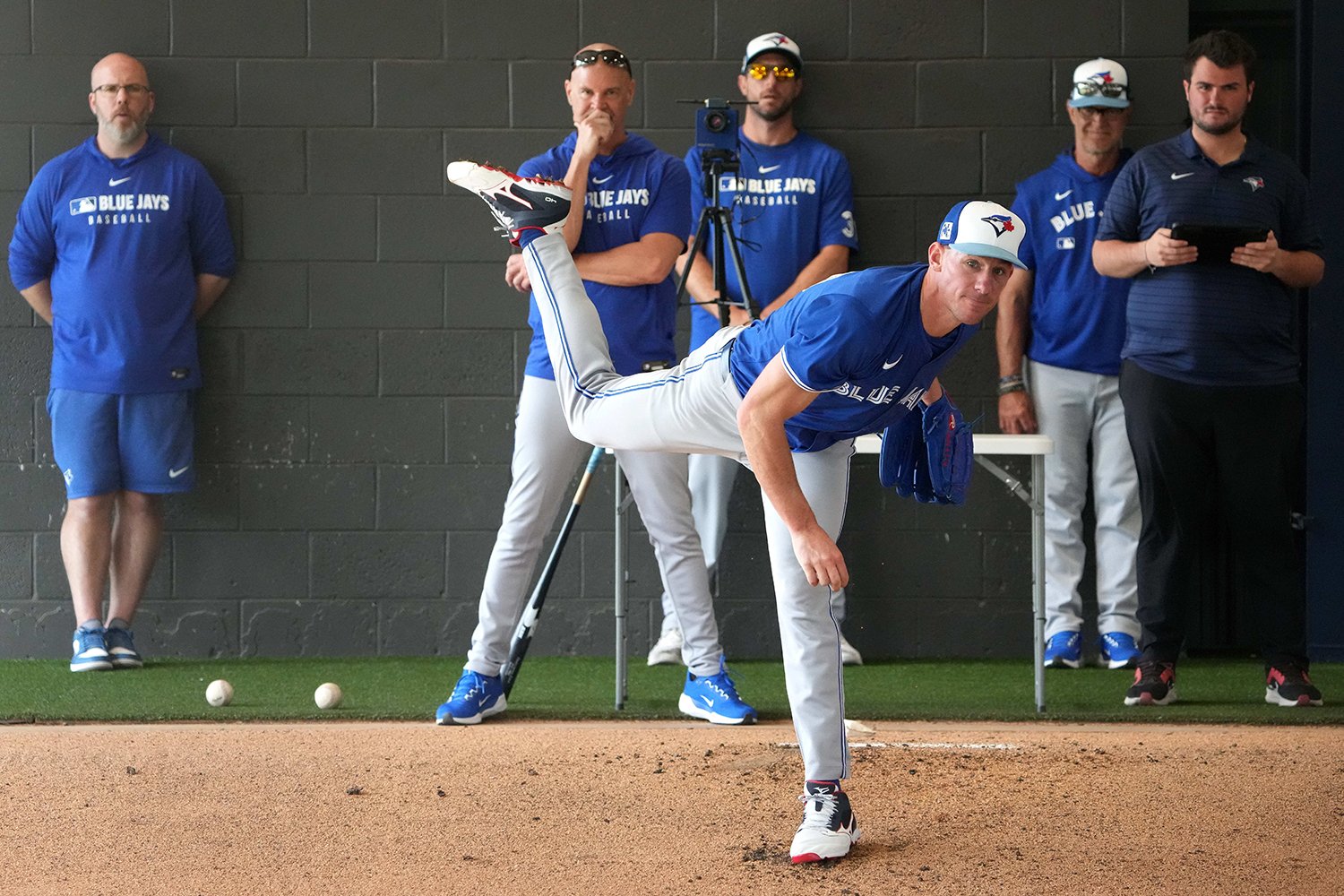 Let's return to the halcyon days of 2023, when the Blue Jays starting rotation performed very well. The group posted a 3.85 ERA and a 12.6 fWAR in 895 innings, which ranked second, fourth, and fourth among American League teams, respectively. However, the 2024 staff did not perform as well, as evidenced by their 3.95 ERA (which ranked ninth), 10.6 fWAR (also ninth), and 862 innings pitched (sixth). Although their 3.95 ERA was similar to 2023's 3.85 mark, it is misleading because the offensive environment changed. In 2023, the Toronto rotation ran a 91 ERA-, meaning it was 9% better than league average; in 2024, it was 99, just 1% better. So how will Blue Jay starters perform in 2025? I will use ZiPS DC projections to answer that question, focusing on two critical aspects of starting rotations: quality and depth. Model Talk Many attribute the quote above to George E. P. Box, a British mathematician. It underscores the idea that while no model can perfectly predict the future, some can provide valuable insights. This idea is particularly relevant to our discussion. The ZiPS DC model is a widely respected and comprehensive forecasting model that considers various performance metrics and historical data to project future player performance. Quality Baseball fans are accustomed to arguing about whether a pitcher should be categorized as a number one starter, number two starter, or even lower. The answer depends on the definition of each role. I address the issue by applying a metric-based framework. For a given metric, I define a number one starter as one whose metric (ERA, for example) is in the top 20% of starters. A number two is a starter who posted an ERA that fell into the next 20% of starters, and so on. I used ERA as my metric of choice for the analysis to follow. Table 1 shows the percentile breakpoints/thresholds for 2023 starters, and Table 2 concerns 2024. In 2023, five of Toronto's starters were either a one or a two, which explains, in part, why the Blue Jays' 2023 starter group had the second-lowest ERA among AL teams. Last season, according to this model, a starter with an ERA of 3.36 or lower was a number one. Between 3.36 and 3.77 made a pitcher a number two. A number five had an ERA higher than 4.99. Table 2 reflects the slots for Toronto's 2024 pitchers. Only Bowden Francis qualified as a number one. The Blue Jays had one number two (José Berríos), two number threes (Kevin Gausman and Chris Bassitt), and two number fours (Yusei Kikuchi and Yariel Rodríguez). Toronto's 2024 starter crew had less concentration in one and two slots than the prior season and, accordingly, posted an inferior overall ERA. 2025 Projection The ZiPS DC forecast predicts that Blue Jay starters will outperform the 2024 group. Table 3 provides the details. The projected ERA distribution is narrow. Toronto's fifth-best ERA (3.94) is just 0.11 points away from Tampa's second-lowest ERA (3.83) and 0.12 points lower than Kansas City's tenth-best ERA (4.06). The key takeaway is that the ZiPS DC model projects the Blue Jays' starting rotation to perform better. Let's delve into the specifics. Table 4 shows the projected ERAs of Toronto's starters and how those pitchers slot into the starter framework. The ZiPS DC forecast estimates better ERA seasons than 2024 for Gausman, Max Scherzer (3.61 versus 3.95), and Rodríguez. According to the projection, Alex Manoah (3.70 in 2024), Berríos and Francis should see higher ERAs than they produced last season. In summary, the ZiPS DC model projects the Blue Jays' starting rotation (on a relative basis) to outperform last season's crew and potentially rank among the top five American League rotations in 2025. This projection should fuel excitement among Blue Jays fans about the potential strength of Toronto's starters and the team's overall performance in the upcoming season. Depth Last season, MLB teams used an average of 13 different starters. Thus, the average team required another eight starters in addition to the five on the Opening Day roster. Accordingly, some MLB observers will determine how good the depth of a team's 2025 starting rotation will be by the quality of starters six through 13. However, the need for eight additional starters (13 less the top five) is somewhat misleading for three reasons: the distribution of starts, the average performance level from starters outside of the top five, and opener usage. The Distribution of Starts While the average MLB team will likely use approximately 13 starters in 2025, the distribution of starts is not even. Consider Table 5. In 2024, on average, five pitchers made 76% of all starts, and nine appeared in 94%. Therefore, four pitchers covered the other 6% (approximately 10 games). Suppose the quality of a pitcher decreases as one reaches further down into the organization. Therefore, a team will mitigate the reduced performance level of starters six through 13 because those pitchers will not start as many games as the top five, which is the superior starter group. I will address performance levels in the next section. Concerning the 2024 Blue Jays, five hurlers made 85% of the starts, and nine racked up 99% of the outings. In total, the Blue Jays used ten starters last season. Do you remember Paolo Espino and his 9.00 ERA? Performance Levels The second reason the average number of starters figures can be misleading is that performance levels are different between starter groups. Table 6 shows ERA figures for various groups. In 2024, the MLB average starter ERA was 4.15. However, the average ERA for the top five was 4.02, 4.68 for the next four, and 4.71 for the other starters. Concerning playoff teams, the numbers are 3.72, 4.68, and 5.27, respectively. Accordingly, a team would be satisfied if starters six through nine and 10 to 13 produced ERAs lower than 4.68 and 4.71, respectively. Therefore, the ERA expected from starters six to 13 should be higher than the average MLB starter ERA. Hence, it is okay if starters outside the top five are inferior. The ERA of the top five Blue Jays starters was slightly higher than the MLB average for a top five (4.07 versus 4.02). Still, the other four starters generated a 3.00 ERA, MLB's second-lowest in the six to nine groupings. Those pitchers were Francis (2.92), Manoah (3.70), Ryan Burr (3.38) and Trevor Richards (0.00). Opener Usage Teams can minimize the number of starters called up from the minors by using openers and swingmen such as Rodríguez. Therefore, having 13 pitchers start games does not necessarily mean that a ball club must look deeply into its minor league teams. A ballclub may have spot starters in the bullpen. Given the reasons noted above, a team's task of starting 13 different pitchers is not as daunting as it may seem. Onto the final projection! 2025 Starter Groups' Projection The reader can find Toronto's ZiPS DC projection here. In Table 7, I arranged Blue Jays' starters into the Top Five, Next Four, and Top Nine. The 2025 forecast should encourage Blue Jays fans. According to the ZiPS DC model, Toronto's Top Five slots in as the equivalent of a number two starter, the Next Four as a number three, and the Top Nine as a number two. (Toronto is projected only to need nine starters this season). Given the ZiPS DC projections, the 2025 Blue Jays should have a deep, high-quality starting rotation. The Last Word Toronto's 2024 starting rotation did not perform as well as the 2023 crew. However, ZiPS forecasts that the Blue Jays' 2025 starter group may rank in the top five of American League teams. Furthermore, Toronto's pitching depth should be a competitive advantage. Overall, the Blue Jays' starting rotation holds promise for the upcoming season.
 -
Marcus, nice to see you. The charts and tables have found a new home! Jim Scott also joined the Jays Centre team. I expect he will post an article in a week or so.
-
Thanks, Terry! It is nice to be scribbling again.
-
Thanks for reading. That is a lot of money! :) Finding playing time for both Alonso and Bregman would be a real challenge. In addition to the plate appearances from the players I noted (Clement, Barger, and Springer), you would have to reduce the plate appearances of others (for example, Wagner, Schneider, more from Springer, etc.) by approximately 700.
-
Rumours are circulating that the Toronto Blue Jays want to sign either Pete Alonso or Alex Bregman. Which player would be the better fit? Toronto has been active since the end of the 2024 MLB season, adding Andrés Giménez, Nick Sandlin, Yimi García, Jeff Hoffman, Max Scherzer, and Anthony Santander, among others. The question is whether the Blue Jays have done enough to bolster a lackluster offence. In 2024, Toronto’s offence ranked 11th in the American League in runs (671), eighth in slugging percentage (.389) and 13th in home runs (156). Toronto could use another bat. With Santander, Depth Charts projects the team to finish seventh in runs scored in the AL. The issue is whether Pete Alonso and Alex Bregman can enhance Toronto’s ability to score runs. More to the point, do these players excel in aspects of hitting associated with run scoring? Short answer: yes. Depth Charts projects 36 home runs for Alonso, with a 125 wRC+, .473 slugging percentage, and .230 isolated slugging percentage. The projections for Bregman include 24 home runs with a 119 wRC+, .436 SLG, and .180 ISO. All these metrics are above average. Table 1 shows the correlation between runs and other metrics. For example, a strong, positive correlation (.84) between runs and SLG exists. In other words, a change in SLG change can explain 84% of the change in runs scored. The data illustrates that some of Toronto’s projected metrics (SLG, wOBA, etc.) would increase if the Blue Jays added Alonso or Bregman. Therefore, adding either player would improve Toronto's offence, given the correlations between the noted metrics and run-scoring. Although the change in the team metrics is not substantial, Alonso or Bregman would improve Toronto’s ranking vis-a-vis other American League teams. Also, in my experience, the distribution of a projected metric (for example, SLG) has been narrower than the actual spread of a given season. Therefor, in adding a bat such as Alonso or Bregman, the Blue Jays should see a noticeable improvement in runs scored. So, what are the Jays waiting for? Sign either one. Not so fast. Other considerations include defence, base running, contract cost, and Competitive Balance Tax (“CBT”) implications. Let’s examine those areas. It may surprise some, but Vladimir Guerrero Jr. does not field his first-base post well. Neither does Alonso. From 2022 to 2024, Guerrero's -26 OAA ranks last among first basemen, and Alonso (-17 OAA) has not been much better, ranking 34th of 38. Whether Alonso or Guerrero plays first, Toronto will be sub-par defensively. Therefore, an Alonso (with Vladdy moving to third) or Bregman signing will not significantly affect Toronto’s first-base defence. So, what is the third-base story? Bregman is a solid third baseman, as evidenced by his 16 OAA from 2022 to 2024, which ranked seventh-best among third basemen. Incumbent Ernie Clement, whose plate appearances I eliminated to fit Alonso or Bregman into the lineup (see Note 3 in Table 1), started playing third in 2021 and since then has registered 9 OAA in 400 attempts. During the same period, Bregman’s OAA per 400 attempts is 5. With the small sample size caveat for Clement, Bregman is not a better third-base defender. However, Clement’s projected 98 wRC+ trails Bregman. If Alonso signs with Toronto, he will likely be the everyday first baseman, not a DH. In his career, only 7% of his plate appearances have come as a DH, which is lower than Guerrero (21%) and Santander (18%). Therefore, the third base question revolves around Guerrero. Vladdy has played at the hot corner in two seasons, 2019 and 2024. In 2024, in 40 attempts, he put up 1 OAA. In 2019, he registered -20 OAA in 320 attempts, dead last among third basemen. In total, Guerrero Jr. has posted a -19 OAA in 360 attempts. As a first baseman, Guerrero Jr.’s OAA per 360 is -9; he has performed worse at third than first. Can Guerrero Jr. play a cromulent third base? There are two positive points to note. First, of his -19 OAA at third, 11 occurred when he came in on the ball. Moving laterally and backwards, his track record as a third baseman looks the same as his numbers as a first baseman. Given that Guerrero is in better physical shape than he was in 2019, perhaps he will come in on balls better in 2025. A second positive point is Guerrero’s arm strength. To learn more about Arm Strength, see Baseball Savant. In 2024, the average third baseman posted an Arm Strength of 85.7 mph. At first base, Guerrero Jr. registered an Arm Strength of 88.5 mph, the best among all first basemen. That would have been the third-highest among 2024 third basemen. Guerrero has an outstanding arm that is well-suited for third base. In summary, Guerrero’s poor hot-corner record outweighs his potential as a third baseman. If he moves to third, there will likely be a defensive downgrade compared to the expected Bregman or Clement performance level. Both Alonso and Bregman posted -7 baserunning runs from 2022 in 2024, so baserunning skills (or lack there of) are not a differentiator.(or lack t Let’s talk contracts. Assume that recent media reports concerning the contract demands of Alonso and Bregman are accurate. Alonso may receive a three-year deal worth $75 million. Bregman is seeking a six-year deal in the area of $186 million. I used Depth Charts’ projected 2025 fWAR for both free agents: 2.7 for Alonso and 4.1 for Bregman. Based on that, a reasonable three-year deal for Alonso is $57.9 million, while a reasonable siy-year deal for Bregman would be $160.7 million. If I boost Alonso’s projected 2025 fWAR from 2.7 to 3.2, the total value of a three-year deal is $75 million. In Bregman’s case, a 2025 mark of 4.6 fWAR results in a total contract value of $193.1 million, close to his reported demand. All things being equal, the rumoured contracts are reasonable. However, there is more to consider than contract dollars. There is age-performance risk. Given that 2025 will be Alonso’s age-30 season and Bregman’s age-31 campaign, age-related decline over the term of the deal is risky. Toronto can mitigate this risk with a shorter term. Therefore, a shorter contract (Alonso) is more attractive to a team than a longer deal (Bregman). There are two issues concerning CBT implications. Santander, Alonso, and Bregman rejected their qualifying offers. The Santander signing resulted in Toronto surrendering its second-highest pick in the 2025 MLB draft and reducing its bonus pool by $500,000 in the next international signing period. The penalty for signing a second free agent who rejected a qualifying offer is forfeiture of a team’s next-highest pick. Therefore, the draft-pick cost is the same for either player. Second, Toronto's CBT bill will increase. According to Cot’s Baseball Contracts, Toronto’s current CBT payroll is $267.2 million. If that payroll number is the same at season end, the CBT bill will be just under $6 million. Suppose the AAV for Alonso or Bregman is $30 million. That will push Toronto’s CBT payroll to $297.23, translating into a CBT bill of $20,64 million. Also, the Blue Jays will pass the third CBT threshold of $281 million and have their first pick in the 2026 MLB Draft moved back 10 spots. If that first pick is otherwise in the top 6 picks, Toronto’s second pick will drop 10 spots. Make no mistake: It would be expensive to acquire either Alonso or Bregman. If management is willing to absorb that cost, which is the best choice? Bregman is undoubtedly the better player from a performance perspective. Also, his third-base makes Bregman a better fit on the roster. However, Alonso would provide more power, which correlates strongly with run scoring. After all, the objective is to add to the offence. Lastly, from a risk perspective, Alonso is preferred given the difference in contract length (3 years versus six) for two players in their 30s. Considering all factors, I favour Alonso over Bregman. Now, we wait to see what unfolds! View full article
- 27 replies
-
- 8
-
-
- pete alonso
- alex bregman
- (and 3 more)
-
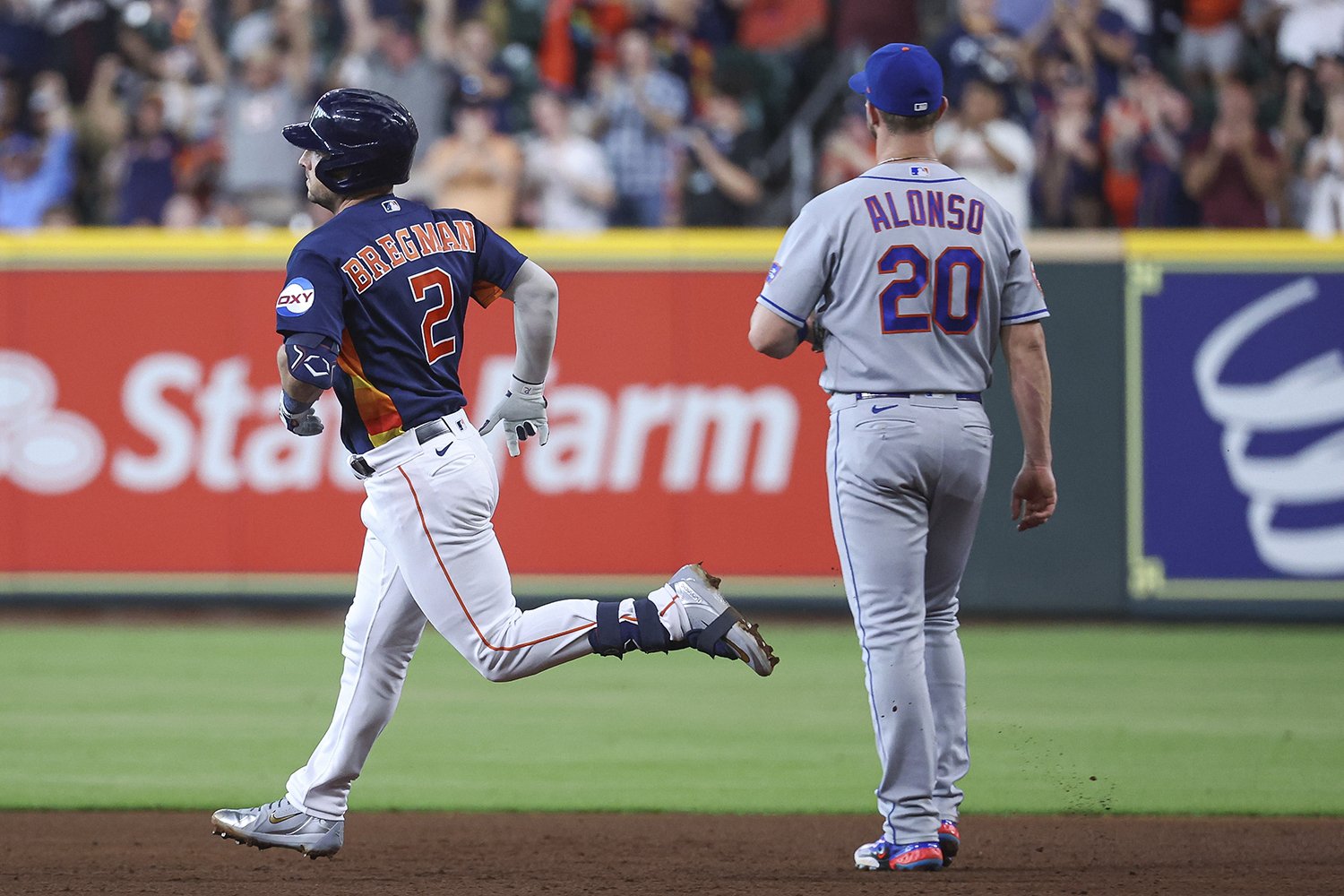 Toronto has been active since the end of the 2024 MLB season, adding Andrés Giménez, Nick Sandlin, Yimi García, Jeff Hoffman, Max Scherzer, and Anthony Santander, among others. The question is whether the Blue Jays have done enough to bolster a lackluster offence. In 2024, Toronto’s offence ranked 11th in the American League in runs (671), eighth in slugging percentage (.389) and 13th in home runs (156). Toronto could use another bat. With Santander, Depth Charts projects the team to finish seventh in runs scored in the AL. The issue is whether Pete Alonso and Alex Bregman can enhance Toronto’s ability to score runs. More to the point, do these players excel in aspects of hitting associated with run scoring? Short answer: yes. Depth Charts projects 36 home runs for Alonso, with a 125 wRC+, .473 slugging percentage, and .230 isolated slugging percentage. The projections for Bregman include 24 home runs with a 119 wRC+, .436 SLG, and .180 ISO. All these metrics are above average. Table 1 shows the correlation between runs and other metrics. For example, a strong, positive correlation (.84) between runs and SLG exists. In other words, a change in SLG change can explain 84% of the change in runs scored. The data illustrates that some of Toronto’s projected metrics (SLG, wOBA, etc.) would increase if the Blue Jays added Alonso or Bregman. Therefore, adding either player would improve Toronto's offence, given the correlations between the noted metrics and run-scoring. Although the change in the team metrics is not substantial, Alonso or Bregman would improve Toronto’s ranking vis-a-vis other American League teams. Also, in my experience, the distribution of a projected metric (for example, SLG) has been narrower than the actual spread of a given season. Therefor, in adding a bat such as Alonso or Bregman, the Blue Jays should see a noticeable improvement in runs scored. So, what are the Jays waiting for? Sign either one. Not so fast. Other considerations include defence, base running, contract cost, and Competitive Balance Tax (“CBT”) implications. Let’s examine those areas. It may surprise some, but Vladimir Guerrero Jr. does not field his first-base post well. Neither does Alonso. From 2022 to 2024, Guerrero's -26 OAA ranks last among first basemen, and Alonso (-17 OAA) has not been much better, ranking 34th of 38. Whether Alonso or Guerrero plays first, Toronto will be sub-par defensively. Therefore, an Alonso (with Vladdy moving to third) or Bregman signing will not significantly affect Toronto’s first-base defence. So, what is the third-base story? Bregman is a solid third baseman, as evidenced by his 16 OAA from 2022 to 2024, which ranked seventh-best among third basemen. Incumbent Ernie Clement, whose plate appearances I eliminated to fit Alonso or Bregman into the lineup (see Note 3 in Table 1), started playing third in 2021 and since then has registered 9 OAA in 400 attempts. During the same period, Bregman’s OAA per 400 attempts is 5. With the small sample size caveat for Clement, Bregman is not a better third-base defender. However, Clement’s projected 98 wRC+ trails Bregman. If Alonso signs with Toronto, he will likely be the everyday first baseman, not a DH. In his career, only 7% of his plate appearances have come as a DH, which is lower than Guerrero (21%) and Santander (18%). Therefore, the third base question revolves around Guerrero. Vladdy has played at the hot corner in two seasons, 2019 and 2024. In 2024, in 40 attempts, he put up 1 OAA. In 2019, he registered -20 OAA in 320 attempts, dead last among third basemen. In total, Guerrero Jr. has posted a -19 OAA in 360 attempts. As a first baseman, Guerrero Jr.’s OAA per 360 is -9; he has performed worse at third than first. Can Guerrero Jr. play a cromulent third base? There are two positive points to note. First, of his -19 OAA at third, 11 occurred when he came in on the ball. Moving laterally and backwards, his track record as a third baseman looks the same as his numbers as a first baseman. Given that Guerrero is in better physical shape than he was in 2019, perhaps he will come in on balls better in 2025. A second positive point is Guerrero’s arm strength. To learn more about Arm Strength, see Baseball Savant. In 2024, the average third baseman posted an Arm Strength of 85.7 mph. At first base, Guerrero Jr. registered an Arm Strength of 88.5 mph, the best among all first basemen. That would have been the third-highest among 2024 third basemen. Guerrero has an outstanding arm that is well-suited for third base. In summary, Guerrero’s poor hot-corner record outweighs his potential as a third baseman. If he moves to third, there will likely be a defensive downgrade compared to the expected Bregman or Clement performance level. Both Alonso and Bregman posted -7 baserunning runs from 2022 in 2024, so baserunning skills (or lack there of) are not a differentiator.(or lack t Let’s talk contracts. Assume that recent media reports concerning the contract demands of Alonso and Bregman are accurate. Alonso may receive a three-year deal worth $75 million. Bregman is seeking a six-year deal in the area of $186 million. I used Depth Charts’ projected 2025 fWAR for both free agents: 2.7 for Alonso and 4.1 for Bregman. Based on that, a reasonable three-year deal for Alonso is $57.9 million, while a reasonable siy-year deal for Bregman would be $160.7 million. If I boost Alonso’s projected 2025 fWAR from 2.7 to 3.2, the total value of a three-year deal is $75 million. In Bregman’s case, a 2025 mark of 4.6 fWAR results in a total contract value of $193.1 million, close to his reported demand. All things being equal, the rumoured contracts are reasonable. However, there is more to consider than contract dollars. There is age-performance risk. Given that 2025 will be Alonso’s age-30 season and Bregman’s age-31 campaign, age-related decline over the term of the deal is risky. Toronto can mitigate this risk with a shorter term. Therefore, a shorter contract (Alonso) is more attractive to a team than a longer deal (Bregman). There are two issues concerning CBT implications. Santander, Alonso, and Bregman rejected their qualifying offers. The Santander signing resulted in Toronto surrendering its second-highest pick in the 2025 MLB draft and reducing its bonus pool by $500,000 in the next international signing period. The penalty for signing a second free agent who rejected a qualifying offer is forfeiture of a team’s next-highest pick. Therefore, the draft-pick cost is the same for either player. Second, Toronto's CBT bill will increase. According to Cot’s Baseball Contracts, Toronto’s current CBT payroll is $267.2 million. If that payroll number is the same at season end, the CBT bill will be just under $6 million. Suppose the AAV for Alonso or Bregman is $30 million. That will push Toronto’s CBT payroll to $297.23, translating into a CBT bill of $20,64 million. Also, the Blue Jays will pass the third CBT threshold of $281 million and have their first pick in the 2026 MLB Draft moved back 10 spots. If that first pick is otherwise in the top 6 picks, Toronto’s second pick will drop 10 spots. Make no mistake: It would be expensive to acquire either Alonso or Bregman. If management is willing to absorb that cost, which is the best choice? Bregman is undoubtedly the better player from a performance perspective. Also, his third-base makes Bregman a better fit on the roster. However, Alonso would provide more power, which correlates strongly with run scoring. After all, the objective is to add to the offence. Lastly, from a risk perspective, Alonso is preferred given the difference in contract length (3 years versus six) for two players in their 30s. Considering all factors, I favour Alonso over Bregman. Now, we wait to see what unfolds!
- 27 comments
-
- 1
-
-
- pete alonso
- alex bregman
- (and 3 more)
-
Thanks! Concerning writing for Jays Centre, I tried multiple times to submit the online form. However, I received the same message: "Error Code EX1364." Is there another way I can inquire about writing for the site?
-
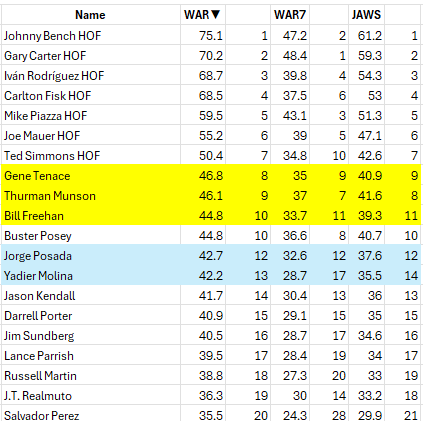
Below is a table of the Top-20 catchers by bWAR for the period after 1946 (the Jackie Robinson era and after). I believe Martin is a candidate for the Very Good Hall of Fame. Furthermore, Gene Tenace, Thurman Munson and Bill Freehan deserve Hall of Fame membership, particularly considering how they were top-tier in many single seasons (according to WAR7, a player's best seven bWAR seasons).