


Blue Jays Video
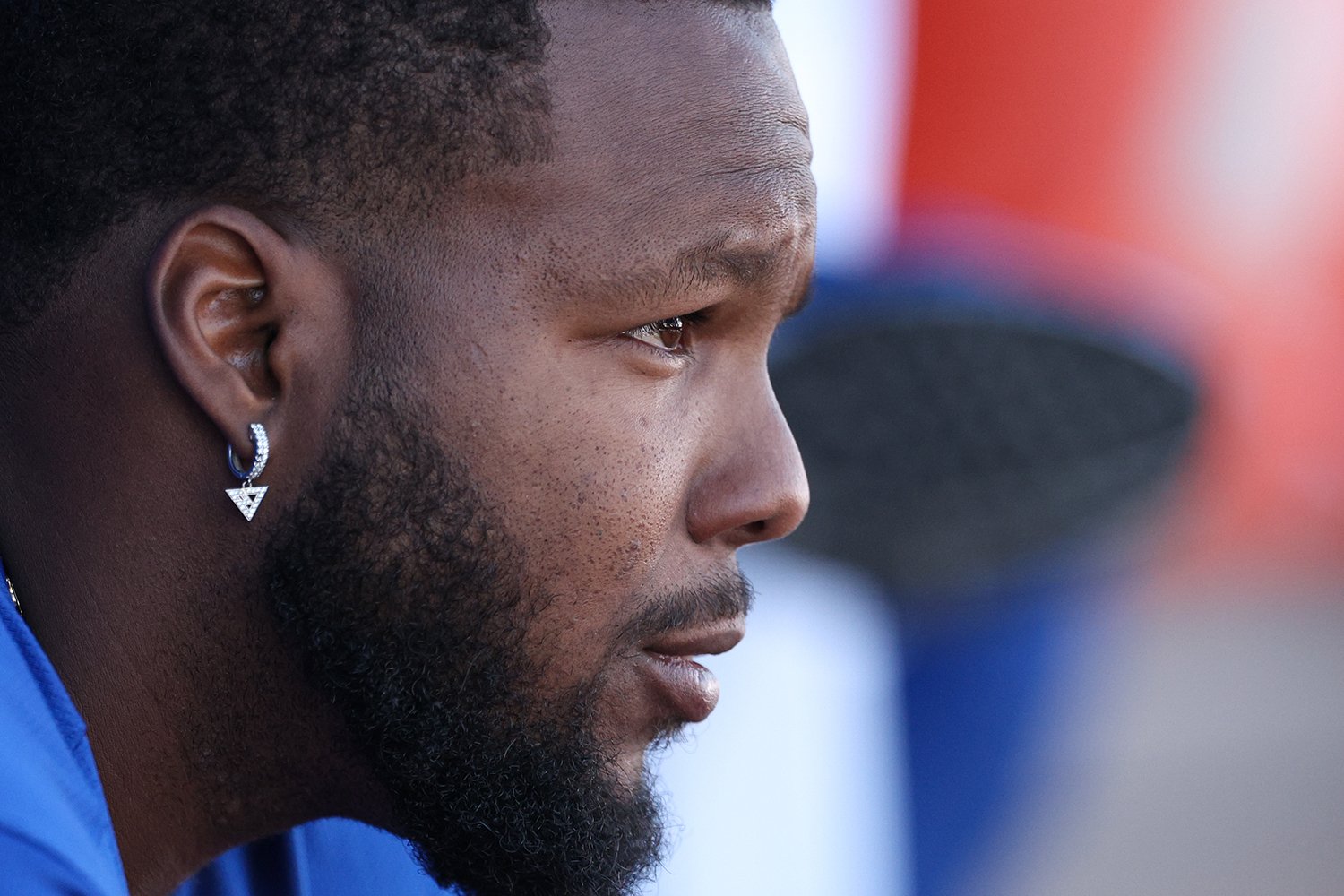
On Thursday, Vladimir Guerrero Jr. spoke to ESPN reporters about what he asked for in his negotiations with the Blue Jays. It was a lot.
When the Blue Jays missed Vladimir Guerrero Jr.’s spring training deadline for negotiating a contract extension with the young superstar, the future of the franchise was condemned to uncertainty for the next season. However, the decision made one thing extremely certain: the rest of us were doomed to spend the entire season discussing that uncertainty. Well, here we are again. On Thursday, Guerrero spoke with ESPN’s Enrique Rojas and Ernesto Jerez about his negotiations with the team. He also revealed further details about what he was asking for, attempting to make it clear that he wasn’t asking for something commensurate with Juan Soto’s record-breaking contract with the Mets. Let’s start with Guerrero’s comments themselves, and then we’ll break them down.
If you speak Spanish, you can watch the interview here, and if you don’t, you can read ESPN’s English-language article here. The quotes below were pulled from the second article, but in some parts, I translated Guerrero’s words myself. I did that not because ESPN did anything wrong – they absolutely didn’t – but just because they combined some answers for readability, whereas I thought the back and forth between Guerrero and the interviewers gave more nuance to the discussion, and I think there was a little bit more information to be gleaned.
It started with a question about how important it was that Guerrero has a father who’s been through the negotiation process. He dismissed that notion, saying that he didn’t discuss the matter with his father, but that he would when negotiations got more serious. Guerrero was then asked about the comments he made back on February 18, when he said, “They had their numbers; I had my numbers,” and that Toronto’s offer was, “not even close to what we are looking for.”
"There was an exchange [of salary figures],” he said. “The meetings lasted until the last day of the deadline, but they [the Blue Jays and Guerrero's agents] couldn't reach an agreement on the numbers. But as I've always said, just because we couldn't reach an agreement, I'm not going to change the way I work. I have to keep working."
Guerrero was then asked if he could give more details about the numbers. He replied, “So a little bit less than Soto. Much, much, much, much, much less than Soto. We’re talking about an amount of money that’s much less than Soto. More than 100. So more than 100 less than Soto.”
He then said something that I don’t quite know how to translate properly: “Que saquen cálculos lo que saben sacar cálculos.” It translates to, “Let them [the Blue Jays] make the calculations they know how to make,” and what I think he meant was, essentially, that he’s asking for a deal for way less money than Soto, so they can run all the numbers they want. If you detect a tiny bit of bitterness there, I think you might be right. However, I want to be very clear once again that a native Spanish speaker might have a better grasp of the nuance here.
He was then asked, “Six-hundred [million], then?”
“No,” he said. “Because, I don’t think it reaches 600, the amount I was looking for. The amount we gave [as a counteroffer] didn’t reach 600.”
He was then asked if the number he was looking for was for fewer years.
“No,” he said, “it was the same years, but it didn’t reach 600. But now…like I told you, I know the business. I lowered it [the salary request] a little, but I also lowered the years. Now, we’re going to have,” he paused. “If they want to sign me,” he paused again. “For me, I’m looking for 14 [years]. I would like 14, 15, even 20 if they give them to me.”
“Years?” he was asked.
“Years,” he said. “But doing it the right way.”
That’s a lot to unpack from a video clip that’s two minutes and 30 seconds long.
Let’s start here. First and foremost, Guerrero is aware of the rumors that he was asking the Blue Jays for a contract in the neighborhood of Juan Soto’s 15-year, $755-million deal with the Mets. He wanted to make it very clear – “mucho, mucho, mucho, mucho, mucho menos” clear – that he asked for much less than what Soto got. That’s the message he wanted out there, and there’s good reason for it. Soto is a year younger, and by fWAR, he’s literally been more than twice as valuable as Guerrero to this point in their careers: 36.3 to 17.0. Although Guerrero is a true superstar who takes his value seriously, even he knows that there’s only one Juan Soto.
That said, Guerrero’s phrasing, saying that the amount he asked for didn’t reach $600 million, makes it clear that he wasn’t that far away from it. The whole point of this interview was to make his contract demands sound reasonable, so if he’d been in a position to say, “It wasn’t even close to $600 million,” he absolutely would’ve said that. Clearly, he was asking for significantly more than $500 million, let alone the $340 that the Blue Jays were rumored to have offered.
Working from that starting point and knowing that he said he did ask for the same number of years as Soto – 15 years, though it’s worth noting that a deal would have bought out 2025, his final year of arbitration, so in effect, it would only add 14 years to his stint in Toronto – let’s make a guess and say that he wanted a $550 million contract. To be clear, this is just an estimate for us to work from, nothing more, but based on his comments, it can't be far off. In terms of total value, that would be the third-largest contract in baseball history. Process that for a moment.
Processed? That breaks down to an average annual value of $36.67 million. That’s still a huge amount of money. By AAV, it would make Guerrero the ninth-highest-paid player in baseball, but only technically. Once you weed out expired contracts and contracts with deferrals that inflate their value, he’d actually be in sixth, behind Soto, Shohei Ohtani, Zack Wheeler, Aaron Judge, and Jacob deGrom. If that sounds to you like a list of the absolute best hitters and pitchers in baseball (plus Ohtani who is both), then you’re not wrong. Moreover, Wheeler’s and deGrom’s deals had such a high AAV because they were shorter deals. Guerrero was asking to be paid like a top-five player in all of baseball.
Guerrero is a true star and one of the game’s great hitters, but it’s really hard to construct an argument in which he’s a top-five player in baseball. Even if you throw out his underwhelming rookie season and the short 2020 season, over the past four years, his 16.4 fWAR makes him the 25th-most valuable position player. He is the game’s worst defender at the worst defensive position, and he’s also one of the worst baserunners. But even if we look just at wRC+, so as to look only at value created at the plate, and even if we once again ignore the first two years of his career, Guerrero’s 145 wRC+ makes him the ninth-best hitter in baseball. There’s just no way to slice things so that he’s a top-five player in the game. Moreover, one-dimensional first basemen are simply not valued very highly right now. Anthony Rizzo can’t find a place to play. Pete Alonso struggled all offseason to find a deal and accepted much less than he was asking for. It’s just a tough market.
Let’s step back for a second and think about these negotiations differently. Speaking very generally, contract extensions can be a way for both parties to win, by balancing risk and security. If Guerrero were to get injured or to play badly in 2025, it would depress his value, and he wouldn’t be able to make as much money in free agency. By signing an extension early, he’d get some security against that possibility, and for that security he would give up some money. Likewise, by strapping itself to one player for such a long time, the team is taking on significant risk. If that one player tanks, so does the team. For that risk, they expect a discount. That mutual benefit is why extensions happen. You can argue that the Blue Jays should have signed Guerrero to an extension years ago, and while I think that would have been a tough swing, I certainly hear the argument. But when it comes to right now, as I hope I made clear in the previous two paragraphs, Guerrero seemed to be asking not just for his full market value, but more than it. That’s just not usually how extensions work.
To be clear, Guerrero has every right to choose free agency and to seek what he believes he's worth. If he does, it will be the first time in his life that he's ever had any control over his employment situation, a factor that I think we often fail to consider in these discussions. Moreover, he has several things working in his favor. He’ll only be 26 this season, so he’s still got several years of his prime left. He’s beloved in Toronto, and the front office knows all too well how upset the city would be to see him sign somewhere else. He also knows that the Blue Jays don’t have a ton of depth either in the majors or the minors, so losing him would be a huge blow. Lastly, the Blue Jays certainly fear that by failing to meet Guerrero’s demands now, they will lose the chance to negotiate with him later. All of those factors make Guerrero more valuable to the Blue Jays than to another team, and they give him more leverage. However, they weren't enough to push the team that far this early. He came out on Thursday hoping to show that he was asking for a reasonable figure, but under the circumstances, I do not think that he achieved that goal. What he revealed is that he wasn’t really asking for an extension deal at all. He was essentially asking the Blue Jays to bid against themselves, taking the number all the way up to and then past his value on the open market. That’s a hard calculation to make.







Recommended Comments
Create an account or sign in to comment
You need to be a member in order to leave a comment
Create an account
Sign up for a new account in our community. It's easy!
Register a new accountSign in
Already have an account? Sign in here.
Sign In Now