


Blue Jays Video
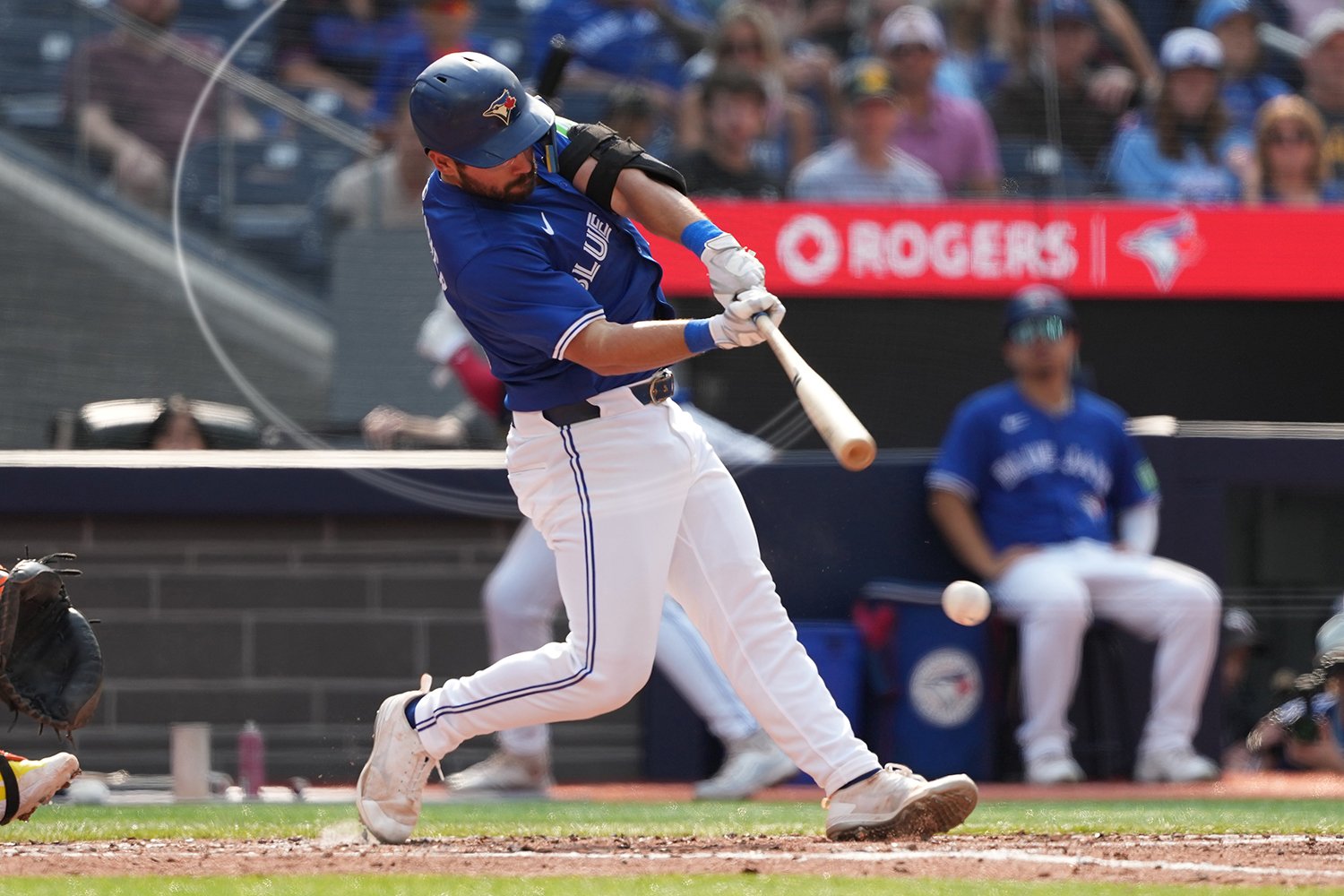
Orelvis Martinez could be a significant contributor to the Jays in 2025 if he can only manage his strikeouts. The Jays were patient with Joey Loperfido in 2024 "despite an abysmal strikeout rate." And one of Alan Roden's top "things to like" is his great plate discipline, as evidenced by his 89th percentile strikeout rate. This fascination with strikeouts is understandable. Strikeouts are very visible, and clearly do nothing to help the team. But are strikeouts really that much worse than any other kind of out?
Conventional wisdom has it that strikeouts are evil. The batter did not advance the runner or give the fielders a chance to make an error. Or the ball could disappear into a drainage hole, or lose its cover, or the fielder could be attacked by a gang of seagulls. All these opportunities are lost when a player strikes out. Of course, the catcher could drop the third strike and the batter could reach first. But that is rare – far more rare than a fielding error on a groundball. True, that groundball or liner to an infielder could also result in a double play, but double plays are also relatively rare. Teams turn double plays, on average, in only 10-12% of potential double-play situations. So what is the answer? Does a strikeout hurt a team more than a different type of out, on average? And how would you answer that question?
Way back in 1963, an ahead-of-his-time baseball statistician named George Lindsey created a tool called a “run expectancy matrix.” That matrix (also called a RE24 matrix) shows the average expected number of runs for each combination of outs and men on base. Here is an RE24 matrix for 2022 (with thanks to Pitcher List)

So for example, when a team has a man on first with nobody out, they will on average score 0.865 runs. If the next player strikes out, the run expectancy of the situation (now man on first, one out) decreases to 0.508. If, instead of striking out, the batter grounds out but advances the runner to second, the run expectancy drops less, to 0.667. And if the batter grounds into a double play, it falls all the way to .097. So advancing the runner decreases the run expectancy by 0.159 but a double play is nearly three times as costly.
To use this RE24 tool to calculate the relative impact of strikeouts to other outs in all situations, it would be necessary to calculate the impact of every possible situation, and to then to weight those situations by their probability. So while a fly ball is far better than a strikeout with the bases loaded and no outs, that situation is relatively rare, so it would get lesser weight.
Sounds like a lot of math?
In their book The Book: Playing The Percentages In Baseball, Tom Tango, Mitchel Lichtman and Andrew Dolphin (“the Gurus”) did the math. For each possible combination of outs and men on base, they calculated the effect on expected runs of a strikeout and of a non-strikeout out based on thousands of actual plays. Their finding are summarized in this table:

Most of their findings are highly intuitive. When there is nobody on base, it does not matter; an out is an out, so the incremental cost of a strikeout is zero. And when there are two outs, it also does not matter; an out ends the inning, regardless. They found that a strikeout was better than a garden variety out with runners on first, or first and second, due to the higher risk of a double play. But a groundball or fly ball out is significantly better than a strikeout with a man on third.
It would be easy to take the average of the plusses and minuses in this table. But that would be misleading. It is far more common for a player to come to bat with the bases empty – or with a man on first – than it is to come up with the bases loaded. And hitters in different spots in the batting order frequently face different on-base situations with different frequencies. So the Gurus took it one step further, and calculated the average difference between a strikeout and a non-K out for each position in the batting order, based on the probability distribution of on-base situations that a person batting in that position would face. Their finding are summarized in this table"

The bottom line? The effect on expected runs of a strikeout is basically the same as a non-strikeout out.
The Book was published in 2006. The results are generally still valid, but there have been developments since then that make strikeouts potentially even more attractive (or at least less unattractive?). The first such development is pitcher usage. In 2008, starting pitchers averaged 93.5 pitches per start. By 2024, that figure had decreased to 86.2 pitches. A strikeout takes, on average, 50% more pitches than an out from a ball in play. Running up a starter’s pitch count in 2024 is, if anything, even more important now than it has been in the past.
The second change is in the number of home runs. In 2006, American League batters hit 2,546 homers. In 2024, that total had increased to 2,714. As the number of home runs increases, the value of advancing the runner decreases and the negative impact of eliminating a runner (through a double play) increases. This makes groundouts even less attractive than they were in the past.
So how does this specifically apply to the Blue Jays?
The RE24 tables were prepared based on averages: average hitting, average pitching, and average baserunning. But the Jays are far from an average baserunning team. In 2024, Baseball Savant graded them as the second-worst baserunning team in baseball, and below-average in team sprint speed. So, as an example, if the Jays have Alejandro Kirk (-3 baserunning runs in 2024) or Vladimir Guerrero Jr. (-6 baserunning runs in 2024 - dead last among all qualified players) at first base with less than two outs, would the manager prefer a strikeout or a grounder to short?
The Bottom Line
It is dangerous to place too much weight on a single player metric. For any individual player, strikeouts might be the reason that their overall offensive profile doesn't work. However, strikeouts need to be evaluated relative to on-base percentage and other measures. It's possible to be productive while striking out frequently, and as swings and missess also tend to go in hand with all-out swings, a high strikeout rate is often the unavoidable side effect of the ability to produce runs through slugging. A pretty fair player - who was once the all-time career strikeout leader - once said that you should not let the fear of striking out hold you back. Perhaps the Jays should not let the fear of a high strikeout rate hold them back when they make roster decisions.









Recommended Comments
Create an account or sign in to comment
You need to be a member in order to leave a comment
Create an account
Sign up for a new account in our community. It's easy!
Register a new accountSign in
Already have an account? Sign in here.
Sign In Now