


Blue Jays Video
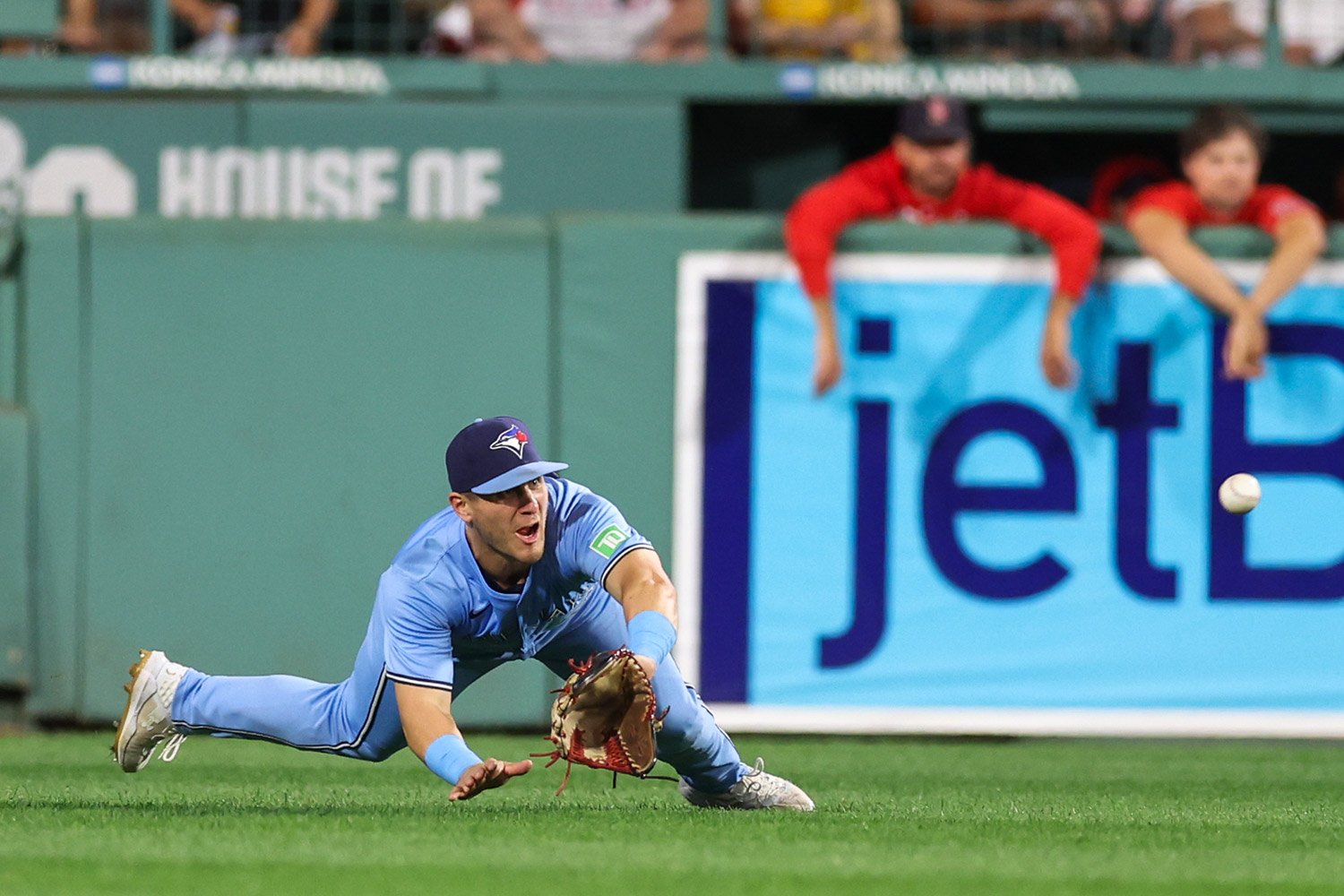
In recent seasons, the Toronto Blue Jays have been a top-tier defensive team. By the Def metric, Toronto was MLB’s best defensive team (19.1 Def) in 2024, and that ranking has remained unchanged thus far in 2025. An interesting question is whether some pitchers benefit more or less from Toronto’s defence.
Table 1 below displays the runs saved according to a selection of metrics, as described below: OAA, Catcher Blocking, Catcher Framing, and Catcher Throwing. Please note that any references to a metric refer to the number of runs saved or prevented equivalent to the metric. For example, Toronto’s 2024 OAA was 24, and the runs-prevented equivalent was 22.
Below are some observations:
1. Overall, Toronto’s runs saved by the defence are again MLB’s best this season.
2. Regarding OAA, Toronto’s ranking has slipped from fourth in 2024 to eighth in 2025. Notably, the OAA spread between Toronto’s plus-seven score and the fourth highest (10) is small. Given that approximately one-third of the season has elapsed, Toronto’s projected 2025 21 OAA (7 / 0.33) is similar to 2024’s OAA score. Overall, by the OAA measure, Toronto’s 2025 defence is nearly identical to the 2024 ballclub.
3. However, the OAA changes in the components from 2024 are interesting. Concerning the improved infield performance, both Vladimir Guerrero Jr. and Addison Barger are much better this season. Guerrero Jr.’s 2024 OAA runs prevented were minus seven, and Barger’s were minus four. In 2025, their comparable numbers are plus one and two, respectively.
4. Regarding the outfield’s underperformance vis-à-vis 2024, George Springer’s defence has deteriorated in 2025. Last season, Springer posted zero prevented runs. In this campaign, he has a -6 mark. Also, Daulton Varsho has missed considerable time this season, although Myles Straw’s performance (+4) has partially mitigated Varsho’s absence.
5. Toronto’s catchers are better this season than last. The primary reason is that Danny Jansen, other than Catcher Blocking, was below average in 2024. Tyler Heineman is above average in Catcher Throwing, and average at Catcher Blocking and Catcher Framing. Alejandro Kirk continues to be above average in these catcher metrics.

The Defence Beneficiaries
So, let’s examine how Blue Jay pitchers have benefited or not from Toronto’s defence. I limited the sample to the ten Blue Jay pitchers with the most innings as of June 3, 2025. Consider Table 2 and Table 3.
As I noted earlier, this article is focused on the quality of Toronto’s defence when specific pitchers are on the mound. For the sake of simplicity, I have ignored the defensive contributions of pitchers when they are pitching. Those contributions include how well they field their position and their consistency in hitting the targeted spot (missing the target by a wide margin can negatively affect a catcher’s ability to frame pitches).
Unsurprisingly, starters benefit more from Toronto’s elite defence because they log more innings and throw more pitches than relievers. This observation aligns with the total number of saved runs by the pitcher. For this reason, I split the pitchers into two groups, starters and relievers. The items of interest include the following:
1. In 2025, Toronto’s starters have benefited from improved infield defence. For the starters listed, the total OAA runs prevented number is plus nine, higher than 2024’s plus three.
2. Concerning outfield defence, the team’s OAA runs prevented score ranks #14. Last season, the total runs saved for the listed starters was +14; this season, it is plus three. The innings pitched by these starters to date are 45% of their 2024 innings. Accordingly, I projected the 2025 total to be 7 (3 divided by 0.45), which is half of 2024’s total. Overall, the outfielders better served Toronto’s 2024 pitchers than the 2025 group.
3. It is noteworthy that Chris Bassitt has not benefited from better infield play. Despite increasing his GB% from 2024’s 40.3 to 46.2 in 2025, the runs saved are zero.
4. Also, on balls in play hit towards the pitcher or other infielders, Bassitt’s 2025 xBA against is 0.190, and the BA is 0.067, a 0.123 differential (0.190 less 0.067).
5. For comparison, Kevin Gausman’s 2025 xBA and BA on similar batted balls are 0.252 and 0.064, respectively. The difference is 0.188. So, due to luck or other factors, Gausman and Bassitt have nearly identical batting average (BA) numbers, yet Bassitt has a much better xBA (0.190 versus 0.252).
6. Perhaps the explanation of Bassitt’s relative lack of quality infield defence is that opposition batters are following the advice of Willie Keeler.
7. Another anomaly is Gausman’s relatively lesser share of Catcher Framing benefits. More work is needed, but I will note that Gausman’s strike rate in 2025 and 2024 were 47.7% and 45.9%, respectively. The 2025 strike rate for Jose Berrios is 54.9%, and 52.5% in 2024.


The Running Game
For purposes of evaluating a catcher’s ability to defend against stolen bases, Baseball Savant’s Catcher Throwing metric is vastly superior to the Caught Stealing% (“CS%”) datapoint. CS% does not isolate baserunner speed, lead distance, pitch velocity and location, pitcher handedness, and other factors. For the record, Toronto’s CS% was 23.6 in 2024, MLB’s eighth best. In 2025, the CS% is 32.1, MLB’s fifth best. Unfortunately, Baseball Savant does not offer catcher throwing data by pitcher. However, we can examine a pitcher’s contribution to defending the opposition’s running game.
For this article, my focus is on the ability of Toronto’s pitchers to restrict the lead distance of opposition baserunners, be it as a base stealer or not. The importance of a reduced lead for a base stealer is obvious. However, the longer a baserunner’s lead in a non-steal situation, the higher the probability that, for example, the runner will be safe at the next base or disrupt a potential double play.
The lead distance data does not distinguish between baserunner characteristics, such as whether the runner is a base stealer or how aggressively the runner takes a lead from the base. Furthermore, for purposes of this analysis, I will assume that, if a pitcher’s average baserunner lead is less than the MLB average, the pitcher does a better-than-average job of holding runners. If the average lead is higher, the pitcher does a below-average job of holding runners.
Lo and behold, Table 4 and Table 5. Below are some observations:
1. The first thing to note is that when Bowden Francis is on the mound this season, there have been no stolen base attempts. Okay, as one wag noted, why try to steal a base when Francis is pitching when you can wait for the home run? Notably, Francis’s HR/PA% has jumped to 6.7 in 2025.
2. However, last season, when Francis had a 4.2 HR/PA%, slightly higher than MLB’s 3.0 HR/PA%, there was one stolen base attempt in 474 stolen base opportunities.
3. The MLB average stolen base attempt percentage was 1.4 (stolen base attempts divided by stolen base opportunities). Accordingly, based on the MLB average rate, there should have been seven attempts when Bowden was on the mound.
4. The average leads when Francis makes his first move, and when he releases the ball, are better than the MLB Average. Accordingly, it appears that runners do not get a good read when Francis is on the mound.
5. Yariel Rodriguez is terrible at holding runners. The average lead when the pitch is released, be it in stolen base opportunities or stolen base attempts, is much higher than the MLB Average.
6. Generally speaking, in stolen-base opportunities and stolen base attempts, Toronto pitchers are better this season than last at restricting baserunner leads. If you want proof, please compare Table 4 to Table 5; there is significantly more green in Table 4 than in Table 5.


The Last Word
The Toronto Blue Jays continue to excel at defence. An individual starter benefits more from the stellar defence than a reliever because a starter registers more innings and pitches. There are some anomalies, such as the lesser infield defence experienced by Bassitt compared to the other starters, and Gausman’s lesser share of the Catcher Framing spoils. Lastly, Toronto’s pitchers are generally better this season than last at limiting the leads that opposition baserunners take when on the basepaths.
Do you approve of Blue Jays ownership?

Follow Jays Centre For Toronto Blue Jays News & Analysis



- Spanky__99 and Mike LeSage
-
 1
1
-
 1
1


Recommended Comments
Create an account or sign in to comment
You need to be a member in order to leave a comment
Create an account
Sign up for a new account in our community. It's easy!
Register a new accountSign in
Already have an account? Sign in here.
Sign In Now