


Blue Jays Video
Welcome to Shape of the Blue Jays, my column where I dig into Statcast numbers to analyze recent pitch shape and swing shape trends for Toronto Blue Jays players and discuss how they have impacted their performance. Click here to read the last edition.
Quick Hits: Offense
- Despite a couple of isolated positive efforts recently, the Jays' offense has been an unfortunate combination of injured and bad this year. They're still the standard of the league when it comes to making contact, and they're still hitting a ton of line drives. They have a bottom-three chase rate in MLB, but their bottom-10 chase rate last year wasn't much better. The balls in play just haven't been as threatening: They have the fourth-worst barrel%, fifth-worst hard hit%, and third-worst average exit velocity. Last year got better as it progressed, but on the season, they were merely average to decent in these categories.
- There have been some clear team-wide mechanical differences at the plate. These don't lie so much with how fast they're swinging, but rather their inability to make their contact useful. They're bottom-three in both of Statcast's squared-up% and blast% (the latter being squared-up fast swings) after being top 10 in both last year.
- They pulverized fastballs in October, but in the regular season, their real calling card was spoiling secondaries. This year's Blue Jays haven't been half bad with heaters, but they led the league last year in wOBA, xwOBA, and contact% against breaking balls and off-speed pitches. In 2026, that has turned into a bottom-10 wOBA, although their xwOBA suggests it should be better, and they're still not missing them. In sum, I wouldn't say their underlying process has been terrible, but until the quality improves on their balls in play, they won't score many runs.
Louis Varland
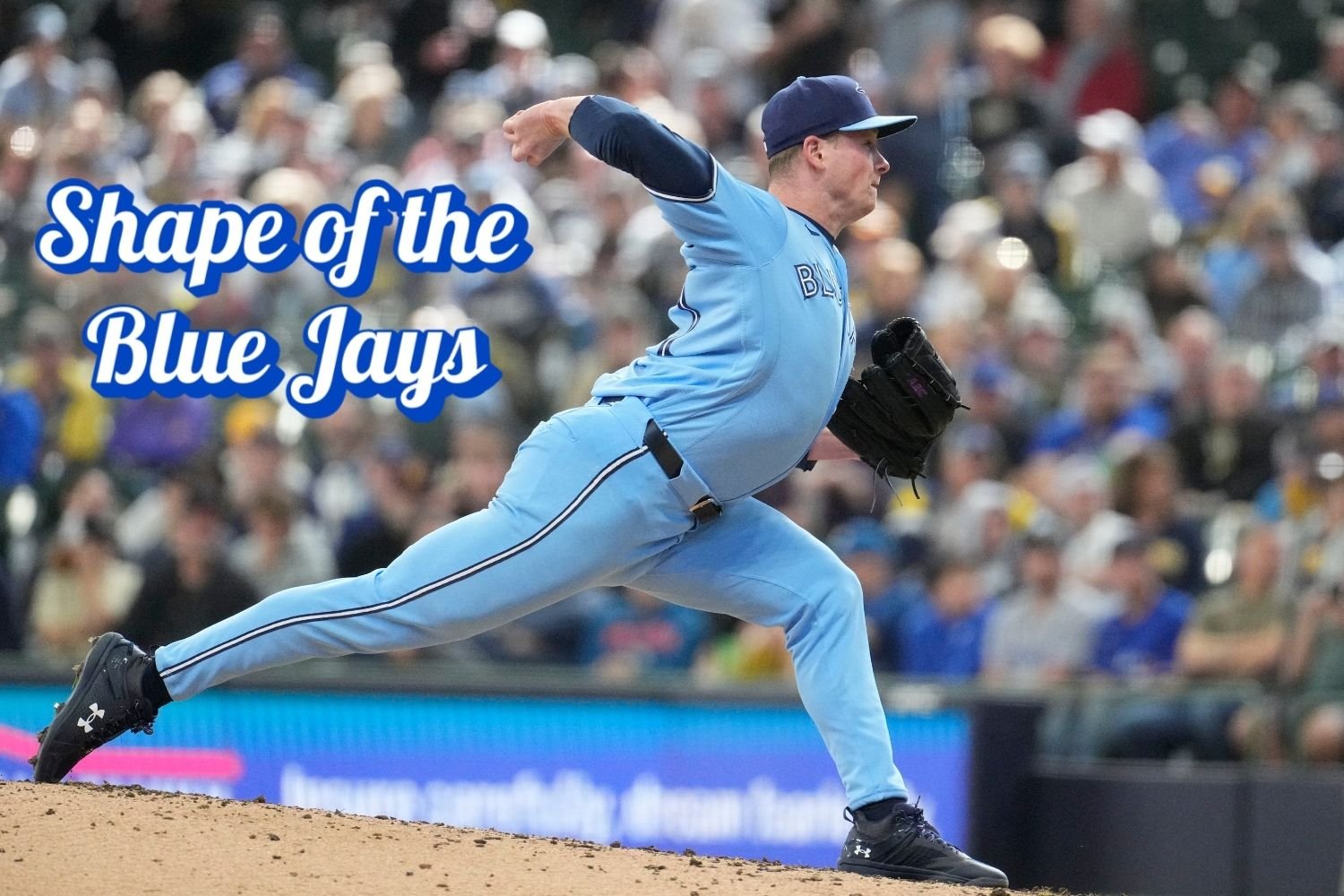
If you don't like where the Blue Jays are at now, it's hard to imagine where they'd be without Louis Varland, who has been lights-out (0 ER, 16 K, 11 IP). Discourse surrounding the closer position captivated the fanbase after he bailed them out in the 10th inning on Monday in Milwaukee, but they can't afford to confine Varland's role to just one inning with what he's doing.
Pitch usage-wise, he's in a very similar spot to when Toronto acquired him from the Twins last year, but he's showing some slightly better shapes across the board. He's added a tick of vertical break to his fastball, proceeded with the more downward changeup he flashed in spring training, and generated more lift and glove-side movement on his low-90s slider.
Varland MLB Ranks, 2026 (Among 215 Qualified Relievers)
| Stat | Rank |
| K% | 7 |
| K-BB% | 11 |
| GB% | 25 |
| xFIP | 6 |
| Pitching+ | 5 |
per FanGraphs
According to the Blue Jays broadcast on Thursday afternoon, Sportsnet's Hazel Mae asked Varland if he felt there was anything specific in his arsenal that made his fastball and curveball play up. I'm paraphrasing here, but he essentially said that regardless of the opponent's strengths and weaknesses, any well-executed pitch is a good one, regardless of the situation. That's a good summary of how things are going for him right now. The stuff is just so good throughout the arsenal, and he can throw strikes too.
Daulton Varsho
After a tough start, Daulton Varsho has become one of the few bright spots in the lineup, going 10-for-26 with three home runs since the start of the Twins series last weekend. His bat tracking specs are surprisingly way different from last year's excellent but injury-shortened performance: He has lost bat speed but also shortened his swing by a lot (the two are correlated), going from a pull-air approach to an all-fields, line-drive one.
Most intriguingly, his strikeout rate is down to 11.9%. His previous career-best is 21.3%. I'm sure that will go up, as he's currently making an unsustainable amount of contact outside the zone, but he's also making more contact in the zone too, which is a more repeatable skill.
Varsho Swing Mechanics, 2025 vs. 2026
| Year | Bat Speed | Swing Length | Swing Tilt | Contact Point (rel. to home plate) | Attack Angle | Attack Direction |
| 2025 | 75.6 mph | 7.9' | 30° | -0.8" | 13° | 4° pull |
| 2026 | 73.4 mph | 7.5' | 28° | -2.9" | 8° | 0° |
| MLB Avg. | 71.7 mph | 7.3' | 32° | 2.9" | 10° | 2° pull |
per Statcast
One thing I can't make sense of: Despite flattening out his swing and attack angle, centering his attack direction, and letting the ball travel further, he's... still pulling balls in the air at a remarkable pace. However it's happening, it's working. Varsho has also trimmed his chase rate and is walking at a 10.4% clip, which would tie a career high.
As for his throwing arm, which was dangerously weak after shoulder surgery, his maximum and average throw velocities from the outfield are still below-average, but each is up about 7.5 mph compared to last year, a good sign for his health. He's up to a .267 batting average and 132 wRC+ on the year, and is on a pace of about 4.9 fWAR per 650 plate appearances. If that holds, he's going to get paid at season's end.
Patrick Corbin
Patrick Corbin turned in a fine performance in his second start as a Blue Jay on Thursday at Milwaukee (5.2 IP, 1 ER, 4 H, 6 K, 1 BB) after a rough debut last Friday. In that first outing, his cutter got crushed by righties on the outer half of the plate. That remained the case, but this time, he started the game by relying much more on his four-seamer and managed to avoid giving up early home runs. No stuff model is ever going to write home about it (91 mph, 14" iVB, 9" arm-side HB), but it doesn't seem like the Brewers were expecting it, considering he barely threw it against Minnesota. During his second trip through the order, he quickly reintroduced the cutter as velocity on the fastball dipped into the high-80s. He also pushed his sinker more to righties (38%) than in his first start (22%).
It was his slider, though, that gave the Brewers fits all game long. It's nothing more than a slow gyro (79 mph, 0" iVB, 3" glove-side HB), but it was responsible for five of his six strikeouts on the day. It got a 50% chase rate, seven misses on 10 swings, and a 50% called strike plus whiff rate. Overall, I'd expect his usage patterns to change again in his next start. Staying unpredictable and changing things up the more hitters see him is how he'll be effective.

Patrick Corbin Slider Whiffs by Location, 2026/04/16 (Statcast)
All visuals and figures courtesy of Baseball Savant and FanGraphs. Up to date as of April 17, 2026.




Recommended Comments
There are no comments to display.
Create an account or sign in to comment
You need to be a member in order to leave a comment
Create an account
Sign up for a new account in our community. It's easy!
Register a new accountSign in
Already have an account? Sign in here.
Sign In Now