


Blue Jays Video
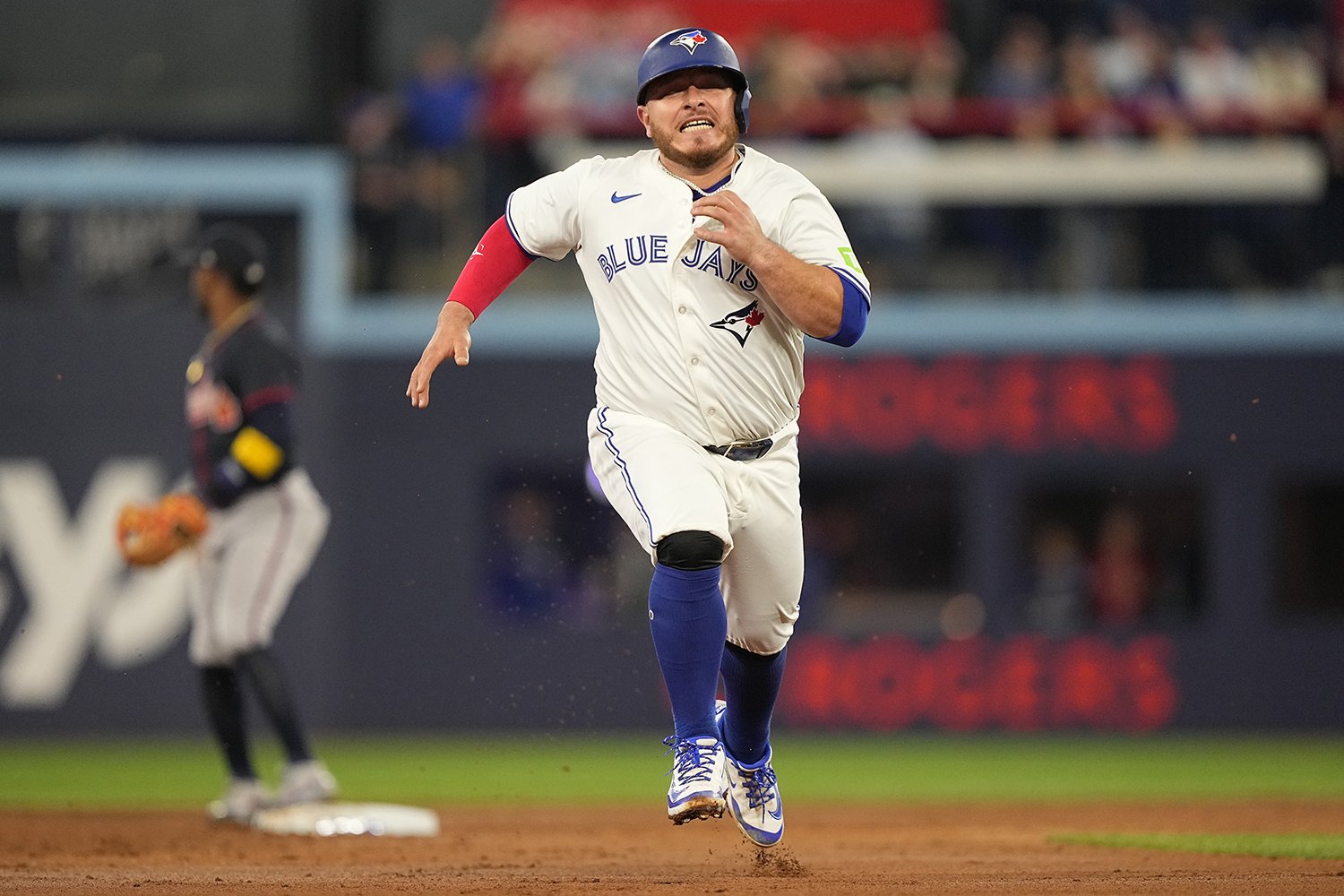
There was a moment in Wednesday’s game against the Braves that highlighted a small piece of baseball strategy. Leading off the bottom of the second, Alejandro Kirk singled, then moved up to second on an Alan Roden hit-by-pitch. After Ernie Clement popped out, Addison Barger hit a hard line drive out to center field. Kirk went halfway between second and third and then retreated when Michael Harris II pulled it in for the second out.
On the broadcast, Buck Martinez mentioned that if there had been no outs, Kirk should have been looking to tag up, but with one out, the conventional wisdom is to go halfway. It’s an idea that sort of holds up with a few caveats. Ignoring the other runner, and using a run expectancy matrix, we can see that there is a marginal difference of around a tenth of a run between runner on second and runner on third with two outs. It’s slight, especially compared to numerous other scenarios. If we are being diehard sabermetric managers, we might prefer that Kirk tag up. Of course, this conventional wisdom predates run expectancy matrixes, probably by decades, and we can look at the argument from that perspective.
It goes like this: Let’s start with the assumption that no matter what the runner does, they will likely score if the fly ball gets past the outfielder. Our scenario only applies to a ball that is caught, fumbled, or dropped. We also need to recognize that in most cases, the ball will be caught, and often in a location where tagging up wouldn’t be feasible (large portions of left and center field as well as shallow right).
Tagging Up
The benefit of tagging up, obviously, is that the runner can end up on third base if the ball is caught. Choosing to tag up comes with a slight risk of being thrown out. It also largely eliminates the chance to score if the fielder makes an error or doesn't get to the ball. With two outs, several opportunities to score a runner on third disappear. No more sacrifice fly or fielder’s choice, though they can still reach home on a passed ball, wild pitch, balk, or any kind of hit.
Going Halfway
If the runner goes halfway, they increase the chance of scoring if the outfielder makes a mistake fielding the ball, or if it lands without being caught. In most cases where the ball is caught and they retreat to second, they can then score on most hits, as they will be running on contact. This is why the run expectancy is so close: the inning ends on any out, so the number of possible outcomes is much smaller. They lose out on the opportunity to score on passed balls, wild pitches, and balks, but those instances are rare.
On balance, you can see why managers have historically taught this baserunning strategy. If you squint just right, it works out. With our more sophisticated statistical models, we can see that tagging up is a marginally better strategy at a macro level. It wouldn’t be surprising to learn that some enterprising analyst has run the numbers on this and knows the optimal approach. Like so many of these small details, this choice is going to be pointless almost all the time but will pay off once in a while.
One last wrinkle. During the next at-bat, Spencer Strider threw the ball away trying to pick Kirk off at second base. Roden and Kirk moved up and the inning ended with runners on second and third. There may be a universe where that error occurred at third because Kirk tagged up and the Jays added another run to a 3-1 victory. Maybe the matrix is right after all.








Recommended Comments
Create an account or sign in to comment
You need to be a member in order to leave a comment
Create an account
Sign up for a new account in our community. It's easy!
Register a new accountSign in
Already have an account? Sign in here.
Sign In Now