


Blue Jays Video
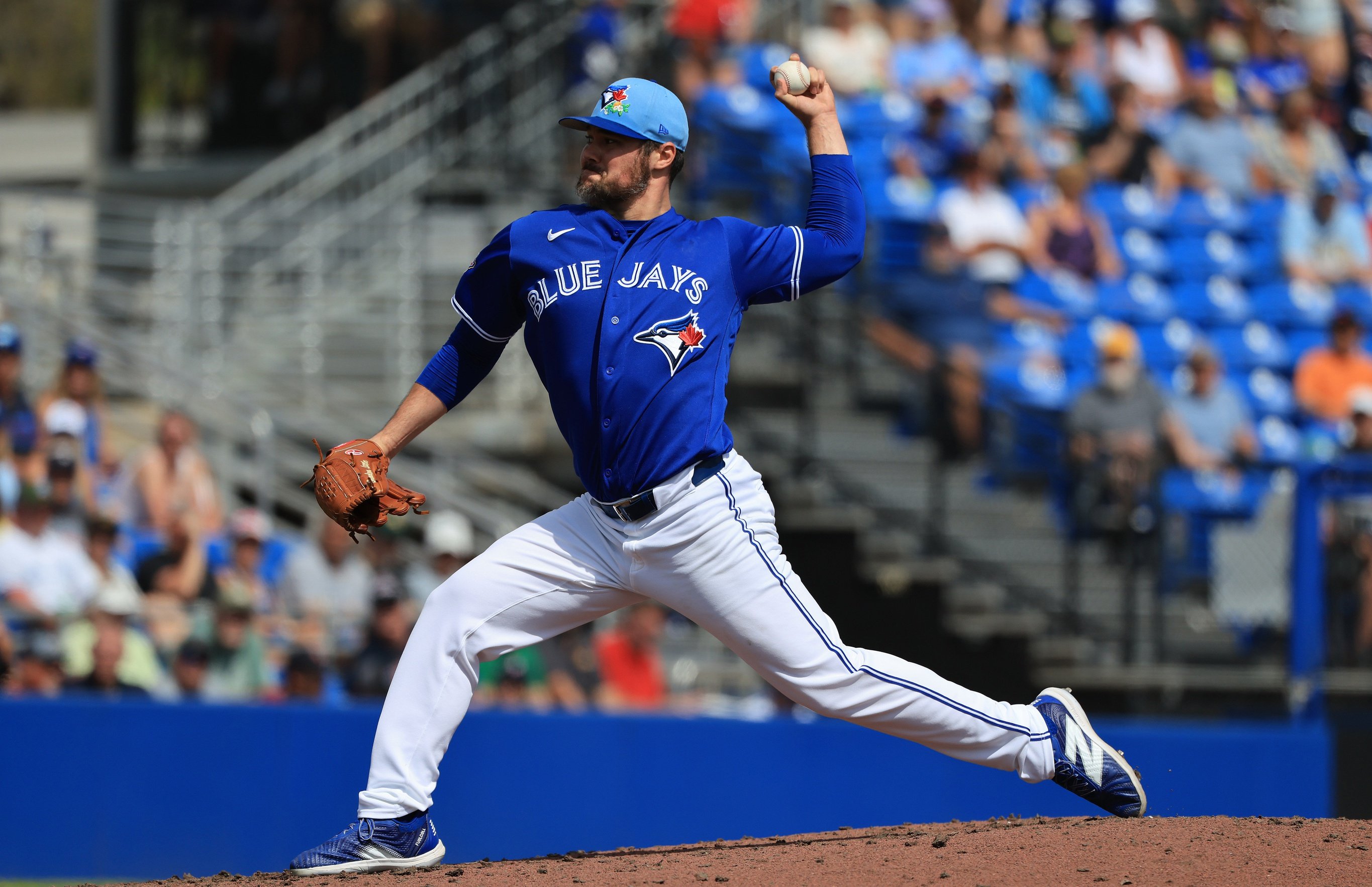
Brendon Little had an up-and-down 2025 season. Before August, among relievers with at least 20 innings, his xERA and K-BB% percentile rankings were 85th and 82nd, respectively. However, for the balance of the regular season, Little’s xERA and K-BB% percentile rankings slipped to 32nd and 7th, respectively. During Toronto’s postseason run, manager John Schneider used Little in only six of the Blue Jays’ 18 playoff games, including just once in the World Series. In those six outings, Little posted an 11.89 FIP, 3.00 WHIP and -0.84 WPA. Clearly, Little was much better before the calendar turned to August.
So, which Little should we expect to witness in 2026? To answer that question, let’s dig into what happened in 2025. The table below is a good starting point. For the 2025 regular season, Little’s 72nd percentile xERA ranking was good, and his FIP (86th) was even better. And there are a few other points of interest. First, throughout 2025, Little’s BB% was near the worst among MLB relievers. As a result, his WHIP percentile ranking was negatively affected by the high walk rate. Second, Little’s K% percentile ranking was elite before August, but slipped to 37th after July.
| Games | xERA | FIP | xFIP | K% | BB% | K-BB% | WHIP | |
|---|---|---|---|---|---|---|---|---|
| Before August 1 | 95th | 85th | 90th | 94th | 96th | 2nd | 82nd | 39th |
| After July 31 | 98th | 32nd | 57th | 35th | 37th | 3rd | 7th | 3rd |
| 2025 (1) | 99th | 72nd | 86th | 81st | 90th | 2nd | 59th | 29th |
| (1) Before August 1, relievers with at least 20 innings (249 relievers); after July 31, relievers with at least 10 innings (261); and, for the season, relievers with at least 30 innings (244). Regular season only. | ||||||||
| Source: FanGraphs | ||||||||
Let’s drill down to pitch type for a better understanding of Little’s performance. The table below has the details. His arsenal before August was a knuckle curve (48%), sinker (46%), cutter (5%), and a four-seam fastball (1%). After July, there was a noteworthy change: knuckle curve (39%), sinker (45%), cutter (15%), and four-seamer (1%). From a throwing-strikes perspective, it is understandable why Little reduced his use of the knuckle curve in favour of the cutter. After July, Little’s knuckle curve found the strike zone just 24% of the time, which was surpassed by the in-zone percentage of his cutter (60%). Furthermore, in the post-July period, Little’s cutter had the highest chase rate of his three main pitches, and the knuckle curve’s chase rate fell from 39% before August to 25% after July.
|
Pitch Mix% |
Whiff% | Zone% | Swing% | |||
|---|---|---|---|---|---|---|
| In-Zone | O-Zone | In-Zone | O-Zone | |||
|
Knuckle Curve
|
||||||
| Before August 1 | 48 | 56 | 25 | 75 | 69 | 39 |
| After July 31 | 39 | 55 | 24 | 76 | 76 | 25 |
|
Sinker
|
||||||
| Before August 1 | 46 | 36 | 48 | 52 | 49 | 23 |
| After July 31 | 45 | 21 | 45 | 55 | 63 | 18 |
|
Cutter
|
||||||
| Before August 1 | 5 | 32 | 24 | 76 | 64 | 35 |
| After July 31 | 15 | 28 | 60 | 40 | 61 | 29 |
|
2025 MLB
|
25 | 51 | 49 | 67 | 28 | |
| Source: Baseball Savant | ||||||
Concerning the metrics of his three most-used pitches, the next table shows, from a K% perspective, that only Little’s knuckle curve was elite throughout 2025. Regarding BB%, his knuckle curve’s walk rate spiked to 17.1% after July, and the sinker produced higher-than-average walk rates. An interesting stat is that Little’s post-July sinker K% was zero, despite his throwing it nine times (11% of pitches in two-strike counts). Overall, Little’s sinker was ineffective, mainly because that offering had a minus-9.5 K-BB%, compared to the average reliever's positive 13.5 K-BB%. On a positive note, all three pitches generated lower-than-average barrel/PA rates.
| K% | BB% | xwOBA |
Barrel /PA% |
K% | BB% | xwOBA |
Barrel /PA% |
|||
|---|---|---|---|---|---|---|---|---|---|---|
|
Knuckle Curve
|
Cutter
|
|||||||||
| Before August 1 | 55.7 | 6.6 | 0.181 | 3.8 | Before August 1 | 8.3 | 16.7 | 0.336 | 0.0 | |
| After July 31 | 45.7 | 17.1 | 0.288 | 2.9 | After July 31 | 27.3 | 9.1 | 0.292 | 0.0 | |
| 2025 | 53.2 | 9.2 | 0.207 | 3.5 | 2025 | 17.4 | 13.0 | 0.315 | 0.0 | |
|
Sinker
|
||||||||||
| Before August 1 | 14.3 | 20.2 | 0.373 | 4.8 | ||||||
| After July 31 | 0.0 | 16.7 | 0.354 | 2.4 | ||||||
| 2025 | 9.5 | 19.0 | 0.367 | 4.0 | ||||||
|
MLB Reliever
|
22.8 | 9.3 | 0.311 | 5.3 | ||||||
| Source: Baseball Savant | ||||||||||
One last table showing some of Little’s in-zone and out-of-zone metrics. The highlights from this table are as follows:
- Both in-zone and out-of-zone, batters did not hit for power against Little (better than average xISO numbers).
- Little’s in-zone K% was near the MLB average. However, while his pre-August 55.0% out-of-zone K% was elite, it was below average after July. Furthermore, Little’s post-July out-of-zone BB% soared to 50.0%. The change in out-of-zone K% and BB% numbers was consistent with the decline in batter chase rates from pre-August (33%) to post-July (22%).
- Despite Little’s better-than-average xISO, the elevated post-July .403 out-of-zone xwOBA is explained by the K% decline and BB% increase.
- An interesting factoid is that before August, Little had two walks called despite the pitch being located in the strike zone.
| xwOBA | xISO | K% | BB% | |||||
|---|---|---|---|---|---|---|---|---|
| In-Zone | O-Zone | In-Zone | O-Zone | In-Zone | O-Zone | In-Zone | O-Zone | |
| Before August 1 | 0.314 | 0.226 | 0.167 | 0.043 | 16.7 | 55.0 | 2.0 | 24.0 |
| After July 31 | 0.283 | 0.403 | 0.065 | 0.003 | 16.9 | 30.0 | 0.0 | 50.0 |
| 2025 | 0.304 | 0.280 | 0.137 | 0.031 | 16.8 | 47.5 | 1.4 | 31.9 |
| MLB | 0.325 | 0.297 | 0.208 | 0.051 | 16.6 | 34.2 | 0.8 | 23.6 |
| Source: Baseball Savant | ||||||||
So far, I have identified three factors that contributed to Little’s performance slip after July.
- The struggle to locate his pitches in the strike zone.
- Batters chased Little’s pitches at a lower rate than before August. These two factors contributed to Little’s K-BB% falling from its pre-August heights of 20.4% to a mere 4.5% after July.
- Continued heavy usage of his sinker, an ineffective pitch (.367 xwOBA).
The fourth and last factor that added to Little’s poor post-July performance woes appears to be fatigue. For the 2024 and 2025 regular seasons, including the 16 outings he had in Buffalo in 2024, Little had the fifth-most outings (144) and threw the sixth-most pitches (2,281) among relievers. Furthermore, John Schneider used Little a lot on short rest. For example, Houston’s Steven Okert posted a 2.63 xERA in 68 reliever outings in 2025. Of those outings, 72% (49) occurred on zero to two days' rest, and 49% (33) on less than two days' rest. On the other hand, of Little’s 79 outings, 90% happened on zero to two days' rest (71), and 59% on less than two days' rest (47). Little was a tired lad by the end of the 2025 regular season.
Given the four noted factors that contributed to Little’s post-July underperformance, why should one expect Little to return to his pre-August self? Clearly, Little needs to make some changes, which Mitch Bannon of The Athletic discussed with the lefty (and covered in his February 14, 2026, article, Blue Jays bullpen bites: Brendon Little’s lessons, Tyler Rogers to WBC and more). The highlights from the conversation are as follows:
- Because Little was primarily a two-pitch pitcher, his catchers and opposing hitters knew that he tended to throw the knuckle curve when he was ahead in the count and the sinker when behind. The data support Little’s contention. When he was ahead, Little threw the knuckle curve 81% of the time (he used the sinker and cutter at 13% and 6% rates, respectively). When he was behind in the count, Little used the sinker 66% of the time (he threw the knuckle curve and cutter at 24% and 10% rates, respectively).
- Accordingly, Little told Bannon that he was adding a four-seam fastball and slider to his arsenal. In two outings this spring training, Little’s pitch mix (52 pitches) has comprised the knuckle curve (28.8%), four-seamer (21.2%), sinker (30.8%), and cutter (19.2%). It is noteworthy that, according to Baseball Savant, Little has not thrown a slider thus far.
- Hence, if Little can offer more competitive pitches in all count situations, the likelihood of better performance should increase.
- Furthermore, Little opined that the four-seam fastball and slider are easier to command, which should lower last season’s 15.3% BB%.
- To address the fatigue issue, Little noted that last season he often threw too many pitches in his pre-game or warmed up too quickly in the bullpen. He plans to conserve energy this season.
Also, with Toronto’s addition of Tyler Rogers, and with a full season from Louis Varland, Schneider will have more reliever options, thereby reducing Little’s number of outings and giving him more rest between appearances.
The Last Word
Little has above-average stuff, which is what makes him so attractive as a pitcher. In 2025, the overall Stuff+ mark was 117, but his Location+ was only 81. If Pete Walker can work his magic, as he did with Robbie Ray, then through the addition of two easier-to-command pitches (four-seamer and slider), Little can hopefully improve his Location+. Nevertheless, one should expect Little to have a relatively high walk rate, but he can lower it to a more competitive level, which, combined with his high K%, should generate a well-above-average K-BB% score. Furthermore, Little has superior barrel/PA numbers, which will lead to a top-tier xERA (all things being equal). Lastly, a less fatigued Little in 2026 should perform better this season. Regarding the question of whether Little can replicate the best part of his 2025 season, the answer is yes. Will he? We will have to see!







Recommended Comments
There are no comments to display.
Create an account or sign in to comment
You need to be a member in order to leave a comment
Create an account
Sign up for a new account in our community. It's easy!
Register a new accountSign in
Already have an account? Sign in here.
Sign In Now