


Blue Jays Video
Jays Centre is counting down the top 50 Blue Jays in franchise history. Check out prior entries in the series here:
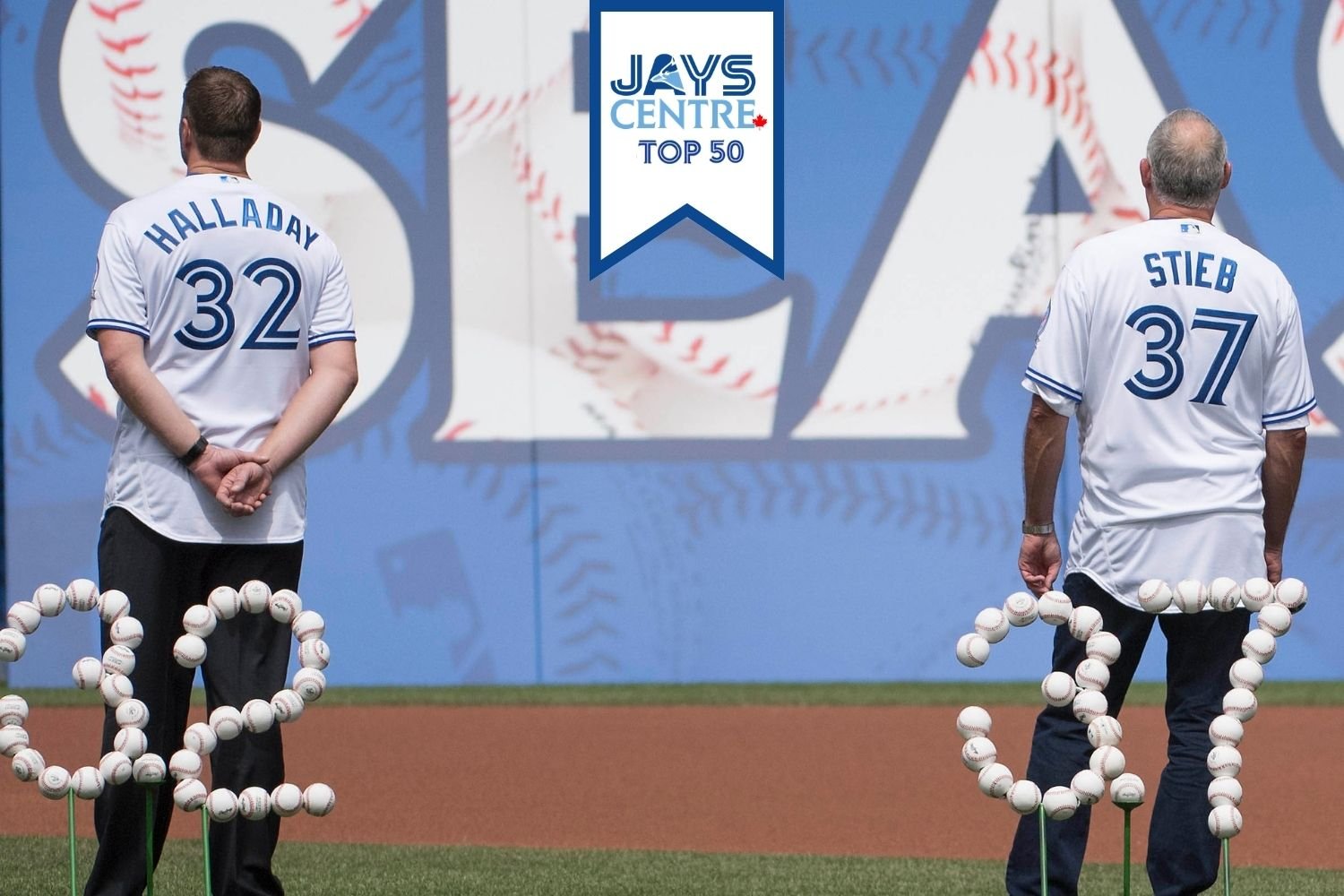
Every participating writer had these players as their top two. Not everyone had them in this order, but it was always this pair. There are arguments that can be made for flipping the order, and I made those same arguments myself, but I’m less interested in knocking one of these guys to build the other one up – I just want to celebrate them both. I even considered cheating the process and leaving the top two unranked, but that felt a little underhanded, and I wouldn’t want to deny those that have been following along of the payoff. For full transparency, I submitted my ballot with these two in the order they appear today. If we did it again a year from now, there is no guarantee I wouldn’t flip them; it’s that close.
These two pitched in different eras but had a beautifully poetic moment of overlap. It also feels very quintessentially Torontonian that both players were the absolute peak of performance for multiple seasons, but the teams they were surrounded by couldn’t elevate them to allow for some of the playoff heroics we’ve documented with other players on this list. Not to say that these pitchers don’t each have a signature game to point to – in fact, I think one of them is pretty obvious – but with these two, we can talk about a few special moments.
No. 2: Dave Stieb
- 1979-1992, 1998
- 7x All-Star
- Franchise All-Time #1: bWAR (56.9), wins (175), innings pitched (2873), strikeouts (1658), games started (408), complete games (103), shutouts (30), quality starts (244)
- Single Season #1: Innings pitched (288.1), complete games (19), shutouts (5)
The Legend of Stieb is almost more outsized than his accomplishments, and considering how many franchise #1 spots he occupies, that’s saying something. He played college ball as an outfielder and was pressed into service as a pitcher when his team was shorthanded. It turned out he was a pretty good pitcher. Drafted by the Jays in June of 1978, he would make his major league debut in June the following year. He would go on to be the best starting pitcher of the 80s and would lead the league in bWAR for three consecutive seasons from ‘82 to ’84. That stretch of dominance hadn’t happened since Lefty Grove in the 1930s. He was selected as an All-Star seven times (more than any other Jay), so within the context of the Toronto team, he was recognized for his performance. A look at the Cy Young voting in his peak years suggests that maybe he was underrated (or unfairly penalized for being on an up-and-coming team) on the larger scale. Similarly, the lack of Cy Youngs – there’s an easy argument for him deserving three (or more) – combined with his delayed eligibility for the Hall of Fame, may have conspired to knock him off of the ballot in his first year, receiving only 1.4% of the vote. Twelve players that shared space on the ballot with Stieb are now in the Hall – we’ll save the debate about how many of them Stieb was better than for another day – but none of them (including two former Jays) are on the Level of Excellence.
The Moment(s): If you were going to pick a single game or moment for Stieb, it would have to be the no-hitter. On September 2, 1990, Stieb achieved the feat that no other Blue Jay, before or since, has been able to do. He got his elusive no-hitter. Jon Bois and the good people at Secret Base did an incredible job with their four-part documentary chronicling Stieb’s chase for this accomplishment and the absurd number of times he was *that close* to it before finally getting his white whale. No one in the franchise’s history has as many complete games or as many shutouts as Stieb, and everyone else is tied for second when it comes to no-hitters.
The moment I’d like to shine a little light on comes after the no-hitter. That 1990 season marked the final time Stieb would throw 200+ innings in a year. He had averaged 222 innings per season for 12 straight years, so it’s hard to say that injuries cut his career short, but Stieb always felt like a guy who could pitch forever – until he couldn’t. In 1991, he had pitched just under 60 innings through April and May (adding another complete game along the way) until a collision while covering first base led to a back issue requiring surgery and ending his season. In 1992, he would make it almost to 100 innings (one more CG mixed in) before again ending his season prematurely in August. By this time, the chronic back and shoulder issues he was battling were too much to overcome, and after missing out on the ‘92 playoff and World Series run, he was released by Toronto in the offseason. The less said about his 22.1 innings in Chicago, the better.
He would return to the organization as a spring training coach in 1998. While throwing and coaching, Stieb noticed that his old injuries weren’t bothering him like they used to and that he was able to pitch again – at age 40. This wasn’t just a ‘franchise great re-signs with former team to announce retirement’ kind of move. Like he did throughout his career, Stieb put in the work. He threw 81 innings in the minors, working himself into a position where he fully deserved the call-up. He would pitch just over 50 innings in the majors, mainly in a relief role, but making three spot starts along the way. Most importantly, it allowed Stieb to retire on his own terms.
No. 1: Roy Halladay
- 1998-2009
- 6x All-Star, Cy Young, Hall of Famer
- Franchise All-Time #1: fWAR (48.6), WPA (29.8)
- Single Season #1: Wins (22), BB/9 (1.08)
Roy Halladay would make his debut with the Blue Jays on September 20, 1998. He would start the game and pitch five innings, giving up two earned runs and striking out five. The first line in the box score for the bottom of the sixth inning reads: “Dave Stieb replaces Roy Halladay pitching,” and while that was true for the game, the opposite was happening for the franchise. A week later, Halladay would make his next start and give the most Stieb-like performance possible. A complete game, one-hitter. That one hit came with two outs in the ninth inning and blew up Halladay’s no-hit bid and shutout with one swing. The most poetic part of the whole thing was that the ball landed in the Blue Jays' bullpen and was grabbed by Stieb. “How can you not be romantic about baseball?” doesn’t feel like it cuts it, but it does feel notable that we had both of these pitchers here together, if only for a brief time.
Halladay was once described as pitching with “grim determination,” and that was a phrase that always stuck with me. It often felt like he didn’t necessarily want to be pitching, but that he had to be pitching. Again, much like Stieb before him, Halladay hated to give the ball up. Where Stieb has the franchise lead for wins, strikeouts and shutouts, Halladay is the next up.
How close he came to never appearing on any of these lists is a hard thing to quantify, but in the 2000 season, he struggled. “Struggled” is really putting it mildly, and a bit of a disservice to every pitcher that has ever struggled to find ‘it’ on the mound. Halladay was bad. Where Stieb’s story is one of almost immediate and lasting greatness, Halladay’s is that of the phoenix rising from the ashes. Gord Ash(es), the Toronto GM at the time, made the call to demote Halladay. Rather than send him to Triple A as would be the usual move, Halladay was sent all the way down the ladder to Single A. By July of 2001, he would work his way back into the big league rotation, having changed his delivery and regained his confidence, ending the ‘01 season with a complete game shutout.
The next two seasons, Halladay would lead the league in bWAR, and in 2003, his greatness would be recognized with his first Cy Young Award.
From the time Halladay made his debut in 1998 until his departure after the 2009 season, the Blue Jays teams he was a part of only finished better than third in the division one time (a second-place, 10-games-back finish in ‘06). With the likelihood of playoffs on the horizon seemingly dim, Toronto made the difficult decision to trade Halladay, sending him to the Philadelphia Phillies for Travis d'Arnaud, Kyle Drabek and Michael Taylor. This trade felt different than any other I can recall. It was like setting the genie free at the end of Aladdin, or what I imagine parents feel like when their kids move out and start a life on their own. It was a trade made to help the Jays rebuild for the future, sure, but it also gave Halladay something he wasn’t going to get here: postseason baseball. When Halladay went out there and threw a no-hitter in the first postseason start of his career, Toronto fans watched with a mix of pride and sadness. It was a similar mix of pride and sadness when he was posthumously elected into the Hall of Fame in 2019. His addition to the Level of Excellence came the year before, along with the retirement of his No. 32. His legacy lives on throughout the city with Roy Halladay Field in Scarborough, the first fully accessible field in the city.
The Moment(s): That second start, the near no-hitter, is certainly one. His final two starts with Toronto were both complete game shutouts and a fitting way to end his tenure with the franchise. The game(s) I’d like to look at, though, came at the end of his Cy Young-winning season in 2003. That September, Halladay made six starts. Five of them were complete games. Two of them were shutouts. You can take your pick of which was most impressive, but for me, it's the 10-inning game against the Tigers. He threw 10 frames, faced 35 batters, gave up only three hits and did it all on 99 pitches to win 1-0 (shoutout to Bobby Kielty for the walkoff). If you want to take the game before, where Halladay struck out 10 Yankees in a complete game win, or the game after, where he only needed 93 pitches in a complete game against Tampa, I wouldn’t quibble with you. You could take the last game of the month too – another complete game win to give Halladay his franchise-record 22nd win. It was the most dominant month by the most dominant pitcher this franchise might ever see.






Recommended Comments
There are no comments to display.
Create an account or sign in to comment
You need to be a member in order to leave a comment
Create an account
Sign up for a new account in our community. It's easy!
Register a new accountSign in
Already have an account? Sign in here.
Sign In Now