


Blue Jays Video
Lost in this uneven season has been how deliberately the Blue Jays have constructed a roster that keeps replenishing with contributors. Through targeted transactions, pro scouting and a development pipeline, the quiet work behind the scenes has done a lot of lifting, not just this year but over the last few seasons, creating a team that might bend but doesn’t break.
Beneath the surface, this has been one of the organization’s most successful years in aligning player development and pro scouting, two areas that are effectively working in tandem rather than in parallel. As a result, the team is deeper, more adaptable, and far more resilient than its up-and-down record might suggest.
The Jays are identifying the right players, not just in their organization but across baseball, and then putting them in positions to succeed almost immediately. For years, this has been the difference between contenders who sustain success and those who fluctuate year to year.
When the Jays acquired Louis Varland, it wasn’t with a lot of fanfare. Initially a starter for the Twins, he had only transitioned into a more flexible role in recent seasons. Prior to being fully leaned on in this role, he showed swing-and-miss ability that the Blue Jays believed could play up in shorter outings.
The Jays managed to pick him up along with infielder Ty France in exchange for outfielder Alan Roden and pitching prospect Kendry Rojas.
Last season’s contributions with the Jays, especially in the postseason, showed his ability to handle leverage, and that has carried into this year. With the exception of Saturday afternoon’s blown save, Varland has been unstoppable. He is carrying an ERA and WHIP under 1.00 with double-digit saves. He has allowed just a handful of earned runs over more than 37 innings while striking out nearly 50 batters, placing him among the most effective relievers in the American League.
Roden has been injured for much of this season, while Rojas was recently called up to the Twins and is 1-0 in 5 games with an ERA of 1.26 in 14.1 innings. He has 14 strikeouts but has walked 10.
Alongside Varland in the bullpen is Braydon Fisher. Another leverage arm that manager John Schneider doesn’t hesitate to call upon.
Acquired in a relatively low-cost move, Fisher has turned into a legitimate force in the bullpen. His 3.38 ERA across 36 appearances, paired with 40 strikeouts in 37.1 innings, reflects not just effectiveness but trust from the coaching staff in meaningful situations.
In exchange for utility player Cavan Biggio and cash considerations, Fisher arrived from the Dodgers in June 2024. He signed a one-year, pre-arbitration contract with the Jays prior to this season for just under $800,000.
After one appearance with the Jays so far, it looks like Simeon Woods Richardson might be another example of the front office taking a low-risk look at a familiar arm. With the Twins, he struggled to a seven-plus ERA this season. It is his second time with the organization, as originally, he was acquired in the Marcus Stroman trade with the Mets before being moved in the José Berríos deal. Even in a limited sample, the appeal remains innings stability rather than upside alone.
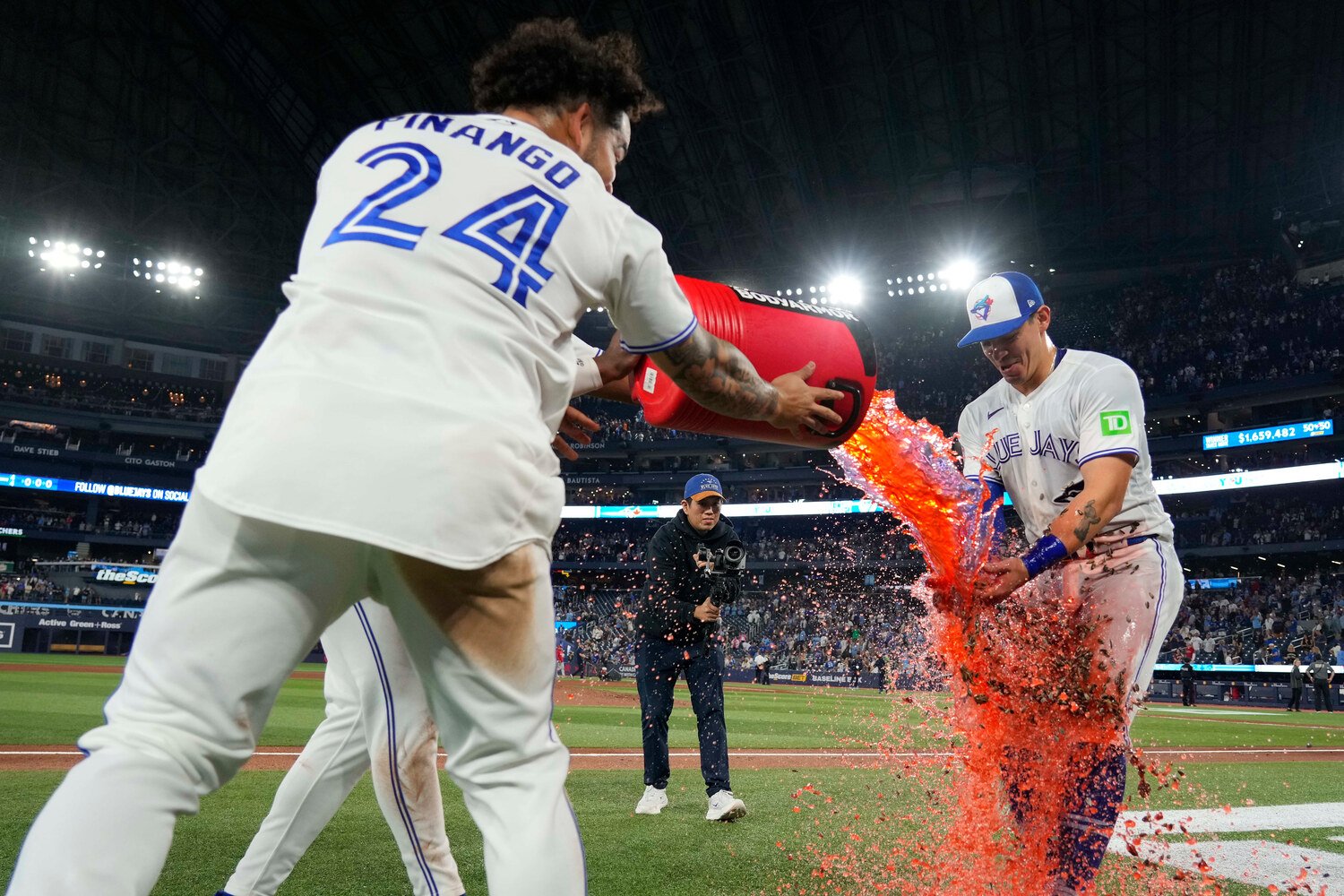
It isn’t just pitching. On the position player side, the Nate Pearson trade in July 2024 has become a defining example of organizational clarity. Rather than continuing to wait on unrealized upside, the Blue Jays redistributed that risk into multiple pieces, most notably Yohendrick Piñango.
The early returns in 2026 have been impressive for Piñango. He is hitting around .290 with an OPS near .800, adding four home runs and 18 RBIs in a relatively small sample.
That level of immediate contribution from a development acquisition is exactly what modern roster building is supposed to produce. It is not just about future value, it is about accelerating that value into major league impact.
What about the Jays’ most All-Star-worthy contributor, Ernie Clement? He was acquired on a minor league contract in 2023 after being released by the Athletics. So far this season, he is hitting just over .300 with an OPS close to .800, alongside seven home runs and 28 RBIs. His 83 hits place him among the most consistent contact hitters in the league this season.
That type of production, especially from a player once viewed as a utility option, underscores how well the Blue Jays are maximizing player profiles.
Catcher Brandon Valenzuela forced the Jays to DFA Tyler Heineman, as he has excelled since being called up. Valenzuela seemed like a secondary acquisition when the team acquired him from the Padres in exchange for Will Wagner.
When you trace it back, it becomes part of a much larger chain of decisions, a domino effect that illustrates exactly how this front office is creating value.
The path to Valenzuela begins with the Yusei Kikuchi trade. In that deal, the Blue Jays acquired Wagner, a bat-first infielder who represented a controllable and flexible asset. Wagner was acquired both for his offensive profile and his potential as a movable piece.
The trade that flipped Wagner for Valenzuela was done to address an area of need: catching depth. Valenzuela was deemed not quite ready in the offseason, so the Jays tendered Heineman a contract.
An extended look in spring training identified some development that needed to be done before he’d be ready. Those adjustments in the minors paid off once he was called up after Alejandro Kirk got injured.
Valenzuela was a long-term plan that has worked out ahead of schedule, while Jesús Sánchez represents the front office’s willingness to make a direct, calculated bet on upside and trust its development infrastructure to extract more from a player than his most recent results might suggest.
The Jays acquired Sánchez in February 2026, sending Joey Loperfido back to Houston in a one-for-one swap that carried both financial and roster implications. Loperfido was also part of the Kikuchi deal.
Toronto took on Sanchez’s $6.8 million salary and gave up a more flexible, optionable player in Loperfido, who could move between Triple A and the majors. The team was looking for an impact bat and, for the most part, that’s what they have gotten.
Through 66 games, Sánchez is hitting .287 with seven home runs, 29 RBIs, and an OPS of .787. Those numbers represent a clear jump from his 2025 production and align directly with what the Blue Jays believed they could unlock. His production has provided balance to a lineup that has needed consistent left-handed offense.
None of these players were big acquisitions, but each has been part of keeping the team competitive during a rough start to the season.
The costs, in almost every case, reflect a front office not fixated solely on the here and now but instead looking to the future. Take one or several of those players out of the mix, and this season could be even more frustrating.
Instead, the Jays remain competitive in a season that has not been smooth. They are only two games out of the Wild Card.
In a season when their top players have not played to expectations, the team’s middle layer has kept them competitive.
The front office deserves as much credit for that as the players executing it on the field.
Statistics updated prior to games on June 16.





Recommended Comments
There are no comments to display.
Create an account or sign in to comment
You need to be a member in order to leave a comment
Create an account
Sign up for a new account in our community. It's easy!
Register a new accountSign in
Already have an account? Sign in here.
Sign In Now