

.jpg.69ea18e742c990cb446f4598fa7c8025.jpg)
Blue Jays Video
Through no fault of his own, David Cone’s return to Toronto had not gone to plan.
Cone first arrived in Toronto late in the 1992 season and, after helping the Blue Jays win their first World Series, the Kansas City native signed a three-year deal to pitch for his hometown Royals. He was his usual terrific self and won the Cy Young Award in 1994’s strike-abbreviated season. As a union representative, Cone sat in as little progress towards a deal was made through the winter, and when the strike came to an end in April, the Royals were looking to downsize their payroll.
It was at this time that Gord Ash was able to get to his long-awaited work. After spending years serving under Pat Gillick, Ash finally ascended to Toronto’s big chair when Gillick stepped aside as general manager in the early days of the strike. Ash had made a few minor deals during the winter, but days after baseball resumed business, Ash struck his first big trade. “A Pat Gillick special,” Ash declared, “I just did it five months early, that’s all.”
“It says we’re not going to be retooling this year...we’re going to try and win.”
If Ash knew what would happen in less than five months, he might have toned down the bravado.

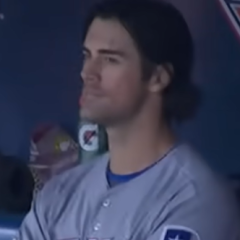
Ash held the press conference and started by announcing he had signed six minor league players, including Chris Stynes. Then, he said the Mets were coming to play an exhibition game at SkyDome before the season started. And oh, by the way, we also traded Stynes for David Cone. The man was feeling himself. (photo credit: Carlo Allegri/AFP via Getty Images)
Cone pitched like an ace for Toronto, a team that struggled once the season began. Cone had a no-hit bid broken up in the ninth inning of a start in June, his finest of the year, but the Blue Jays responded by winning just five of their next 18, dropping to 24-39 and a dozen games out of the division. Cone was one of the few players keeping the Blue Jays from truly bottoming out. He threw eight innings of one-run ball in Seattle on July 14; the win marked his sixth victorious start following a Toronto loss on the season.
By then, trade rumours had picked up around the Blue Jays and, specifically, Cone. The Blue Jays had interest in working out a contract extension with the pitcher, something that Cone’s worth and baseball’s cloudy economic picture were making difficult. If Ash did decide to trade the right-hander, he would be asking for a premium, and with good reason. At least nine teams expressed interest in Cone, and when Texas made a final offer, Ash told them they had the fourth-best proposal.
Ash was also fielding calls on other veterans, including Joe Carter. The hero of the 1993 World Series was hitting .330 entering June but had since fallen off a cliff. A 4-for-51 stretch in July plummeted his average to .249 and, likewise, any interest from San Diego in a reunion. Not exclusive to Cone, Ash was thought to be asking for a heavy return on Carter, as well as Paul Molitor or John Olerud. “We’re not seeking anything that we haven’t given up in the past,” said Ash. “Nobody knows better than us what you have to give up to become a contender.”

Baltimore was realistically the only spot for Carter leading up to the deadline, but the O’s ended up acquiring Bobby Bonilla from the Mets. Carter was owed $5.5 million in 1996, and the market for non-rentals in the immediate aftermath of the strike was murky. Fine by Carter, who was all smiles in saying, “I’m still here” after the deadline passed.
On July 28, manager Cito Gaston walked up behind Cone and tapped the pitcher on the shoulder. Summoned to Gaston’s office, Cone was told he had been traded to the Yankees, who sat 4.5 games behind Boston in the division. In return, Toronto received three right-handed pitching prospects: Jason Jarvis, Mike Gordon, and Marty Janzen. For his part, Ash said he never retreated from his high return demands and that the Yankees including Janzen was the “key” to the deal. Thinking otherwise, Richard Griffin penned in the Toronto Star:
QuoteWhat matters is that Ash was unable to make the deal he had sought for the last month. His desire was to manipulate a deal for one of his highly paid veterans in exchange for a couple of players – one to help immediately and one for the future. He did not succeed. What he received in return was what the Yankees were willing to offer. In his first stare-down as a general manager, Ash blinked.

If Ash blinked, Roberto Alomar fumed. The impending free agent was already dealing with a lot. During a day game earlier that month, Alomar was pulled off the field and met by Toronto police officers in the Blue Jays' clubhouse. He lived in the SkyDome’s hotel, and that weekend, a 31-year-old woman checked in and brought a gun. She intended to kill Alomar. “It could be the end of me in Toronto,” an emotional Alomar said afterwards, “I have to think if I want to stay here.”
Now this. ‘92 and ‘93 felt like a lifetime ago for Alomar. No more Toronto and no more Ash, who refused to negotiate a new deal during the season, adding to the second baseman’s frustration. “I’ve already made a decision about whether to come back here or go for free agency,” Alomar declared after the trade. “It makes me think the Blue Jays are trying to rebuild. If you’re a free agent, you have to go to a winning team.”
The next stage of David Cone trade grief took the form of pouting. A day after the trade, Alomar asked out of the lineup, in what would turn out to be an 18-11 win over Oakland. He was in uniform but didn’t even head out to the dugout, departing quickly after the final out amid trade speculation. He wished. Buck Martinez, then of TSN, said while Alomar was disappointed in the Cone trade, his real disappointment lay in not being traded himself. “I want the fans to know that if I’m not here, it’s not because I didn’t want to be,” he expressed, but added that Ash’s refusal to discuss a contract made it "tough for me to come back here.”
For his part, Ash called his second baseman an integral part of the team’s future but was holding off on any contract extensions until baseball’s new revenue sharing and free agency plans were finalized. If Alomar was trying to force his way out of Toronto at the deadline, it was not going to work. “I don't anticipate any more trades,” Ash correctly predicted 24 hours before the deadline. “If we can get what we consider fair value, we'll make a deal, but right now it doesn't look like that's going to happen.”

Value so fair even Wikipedia is bringing its citation game.
Janzen had dominated the Florida State League prior to the trade and would hop into the Blue Jays’ organization in Double A, where he won five of seven starts with a 2.63 ERA to close out 1995. He failed to make the team out of spring training in 1996 before eventually having a disastrous run in Toronto’s rotation, being battered for 95 hits and 60 earned runs across 73 innings. He returned for one more season, pitching 12 games out of the bullpen, before the upstart Arizona selected him in the expansion draft. By that time, Jarvis had already departed the organization, and Gordon would leave the following year; neither would progress past Double A.
At the time of the trade, Ash had asked fans for patience, comparing the deal to Gillick’s trade with San Diego that brought Alomar and Carter to Toronto. It aged worse than his “Pat Gillick special” boast. If the 1995 trade deadline was Ash’s first chance to steer the ship, he veered off onto a course that never improved much over his tenure. The Blue Jays should have traded Alomar after they dealt Cone, but, considering the return on the latter, Toronto was just as well to play out the final few months of Alomar’s contract.





Recommended Comments
There are no comments to display.
Create an account or sign in to comment
You need to be a member in order to leave a comment
Create an account
Sign up for a new account in our community. It's easy!
Register a new accountSign in
Already have an account? Sign in here.
Sign In Now