


.jpg.f3f5fd12756fe44017d9b4593684f277.jpg)
Blue Jays Video
Dylan Cease isn’t pitching like Dylan Cease.
Cease is arguably having the best season of his career. A 2.28 ERA, an absurd 36.4% strikeout rate, and an elite 4.7 fWAR all rank him at the top of the American League. But as the season has gone on, he’s been doing things slightly differently than what the Blue Jays saw from him earlier in the year.
Historically, Cease has overwhelmed hitters with a high-90s fastball and one of the game's nastiest sliders, using the combination to generate elite swing-and-miss numbers. While that's still a crucial part of his game plan, the Blue Jays have seen a very different pitcher over the last few starts.
First, let's revisit his recent start at the end of July in Boston. Cease was incredible on this day. He threw a complete game shutout, allowing just one hit and three walks, throwing a season-high 120 pitches and dominating Red Sox hitters all afternoon. By Baseball Reference Game Score, it was the sixth-best start in Blue Jays franchise history.
Early on in that start, Cease was raising eyebrows, but for a different reason. His velocity had dropped suddenly. His four-seam fastball, which usually sits at 97 mph in the first inning, was down to just 93.7 mph, which was by far the lowest he’s averaged in the first inning this season. In fact, that's the lowest his first-inning four-seam velocity has been in any start of his career.
A sudden drop in velocity can be a warning sign of injury or fatigue, so seeing Cease sit that low raised alarm bells, but those concerns were quickly dispelled. Cease’s fastball velocity returned, and he hit as high as 98.5 in the ninth inning. Post-game, Cease himself said, “People usually start to panic because that is definitely abnormal. But nothing really hurt. It’s just my body was really not wanting to cooperate, and that’s baseball.”
The important takeaway is that Cease did not think the velocity drop was injury-related. Crisis averted, at least for the time being. But it has become a trend. In the two starts following his outing in Boston, his first-inning velocity remained below his season norm:
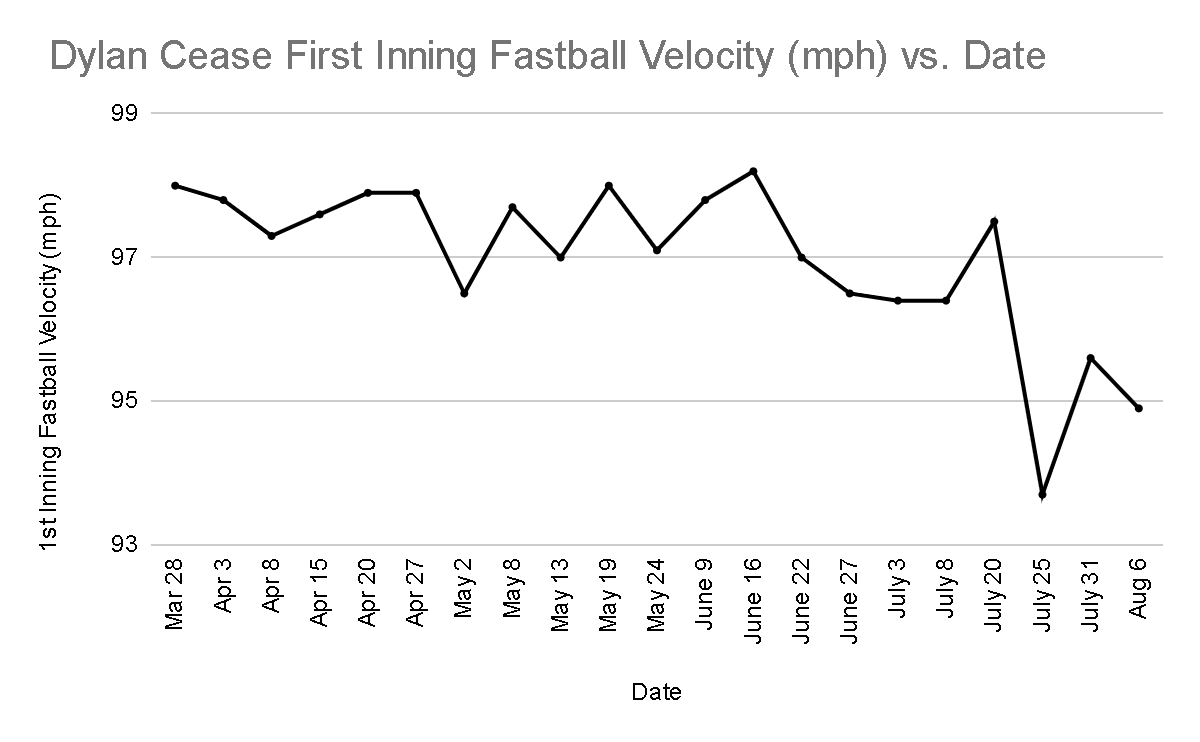
The velocity drop isn’t the only way Cease has looked different recently. He also hasn't been able to generate as many swings and misses as the year has gone on. His whiff rate has been below his 2026 average (34.9%) in five of his last six starts, reaching a season-low 22.7% in his latest outing:

Decreased velocity and diminished swing-and-miss rates are likely related. However, none of this necessarily means Cease is becoming a worse pitcher. Pitching is much more complicated than just throwing the ball hard and inducing swings and misses. Since the All-Star break, he’s posted a 1.29 ERA in four starts despite his average four-seam velocity dropping 1.2 mph and his swinging strike rate falling 1.2 percentage points. If anything, you could argue he’s looked like an even better pitcher.
So what exactly is going on here?
If injuries are not a concern, there are a few possible explanations; workload management could be one of them. Kevin Gausman had stretches of play where his fastball velocity dropped early in starts, and Justin Verlander famously had similar stretches where he’d have diminished velocity early before ramping back up later in starts. So, the idea of a veteran starter sacrificing early velocity to preserve stuff later in games isn’t unprecedented.
Cease is one of only five pitchers since the start of 2021 to throw more than 1,000 innings. John Schneider recently mentioned the Jays would be moving to a six-man rotation, with the intention of getting Cease more rest. Now, with injuries to Trey Yesavage, Jameson Taillon, and Spencer Arrighetti, moving to a six-man rotation seems unlikely.
There is also the consideration that the Blue Jays are trying to get Cease to pitch deeper into games. Earlier in the season, Cease was effective, but he was battling high pitch counts, which forced him out of games early. He only made it through six innings once in his first six starts. The problem was never that Cease couldn’t get outs; it was that it was taking him too many pitches to get them:
| Stat | First Six Starts | May 1-July 24 | July 25- Present |
| ERA | 2.87 | 2.59 | 0.41 |
| IP/Start | 5.2 IP | 6.1 IP | 7.1 IP |
| Pitches/IP | 19.21 | 16.64 | 14.55 |
| Avg Four-Seam Velo | 97.8 mph | 97.5 mph | 96.0 mph |
| K-BB% | 23.2% | 27.0% | 28.2% |
| SwStr% | 16.1% | 14.1% | 14.1% |
Lately, that hasn’t been an issue. He’s shown a willingness to trade some velocity and swing-and-miss for efficiency. His average four-seam velocity has fallen 1.8 mph from his first six starts, while his innings per start have increased from 5.2 to 7.1. The results have been longer outings, fewer innings for his bullpen to cover, and no meaningful decline in his run prevention. The Blue Jays are 8-3 in the 11 starts in which he's thrown six or more innings, compared to 5-5 when he hasn't reached that mark, and he hasn’t thrown fewer than six innings in a start since June.
That's where Cease’s evolution becomes particularly interesting. It's not just helping the Blue Jays win games; it's strengthening his case in the AL Cy Young race.
As of now, Cease is in a neck-and-neck race with Cam Schlittler of the Yankees. Schlittler has had an incredible season in his own right, but if you look at the two side by side, it becomes clear just how close the race is:
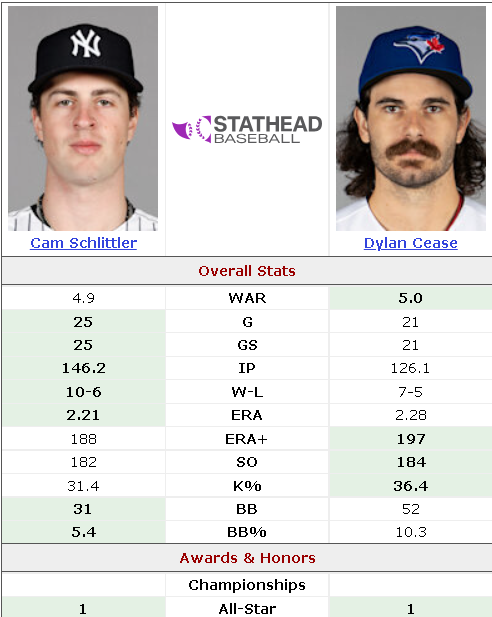
Looking at the stats, the two pitchers compare closely across several categories. Cease has an advantage in strikeouts, bWAR, and FIP, suggesting that on a rate and performance basis, he has been the more dominant pitcher when they’ve both been on the mound. Schlittler has the advantage in starts and innings pitched (Cease spent time on the 15-day IL earlier in the year), and the fact that the Yankees are likely headed to the playoffs while the Jays are on the outside looking in may matter to voters.
Going forward, if Cease can continue to pitch at this level and continue to be durable and go deep into his starts, then he has a legitimate chance to pull away from Schlittler in the final weeks of the season.
This is what makes Cease so dangerous. He hasn’t lost the ability to overpower hitters; he’s simply proving that he doesn’t need to do it on every pitch. If opposing hitters begin sitting on his softer fastballs early in games, then Cease can still reach back for 99 mph or throw the wipeout slider. If he can continue to do that while pitching deeper into games, the Blue Jays will be getting something even more valuable than the ace they signed. They have a pitcher who has found another way to dominate.
And the American League should take notice.






Recommended Comments
There are no comments to display.
Create an account or sign in to comment
You need to be a member in order to leave a comment
Create an account
Sign up for a new account in our community. It's easy!
Register a new accountSign in
Already have an account? Sign in here.
Sign In Now